
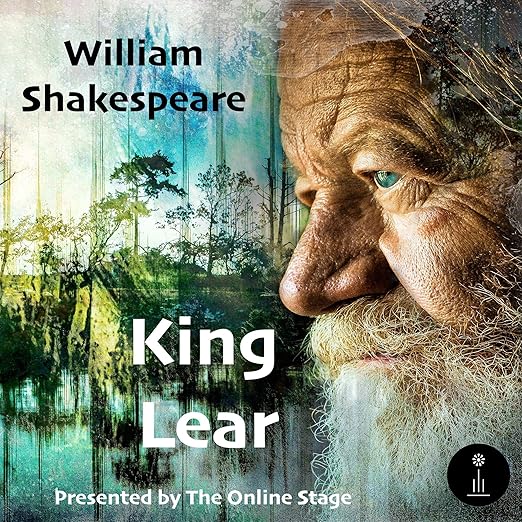
Lear divides his kingdom in the very first scene, demanding public declarations of love from three daughters before he'll hand over a single acre, and everything that destroys him afterward traces back to that one act of vanity dressed up as retirement planning. This audiobook is a solo performance: one actor, Ron Altman, moving between Lear's unraveling mind, Cordelia's stubborn honesty, and Edmund's gleeful scheming without a full supporting cast to lean on, which forces a kind of concentrated attention that a starrier multi-voice production can sometimes let a listener drift away from.
The Verdict, Briefly
The synopsis itself offers the right comparison: Lear ranks alongside Sophocles' Oedipus as a tragic protagonist destroyed less by outside villainy than by his own initially reasonable choices curdling into catastrophe. Once Lear unfolds what the text calls his darker purpose in that opening scene, every subsequent betrayal, family rupture, and act of cruelty follows from a chain he set in motion himself.
Samuel Johnson, the eighteenth-century critic and lexicographer, reportedly found Cordelia's death too heartbreaking to reread for years, and that detail is worth sitting with rather than treating as trivia. It's a genuine data point about how this specific ending has unsettled serious readers across nearly three centuries, not just contemporary audiences primed for tragedy.
That phrase, Lear's darker purpose, is worth close reading on its own. It's the hinge where a father's vanity stops being merely foolish and starts actively generating the tragedy that follows, and the play never lets Lear, or the listener, look away from the fact that he built his own downfall with his own hands before anyone else's betrayal compounded it.
Shakespeare likely wrote King Lear around 1605, adapting an older, gentler legend about a king named Leir that originally ended happily, with Cordelia restoring her father to the throne. Shakespeare's decision to darken that ending, letting Cordelia die anyway even after reconciliation, was a genuinely radical departure from his source material, and it's part of why the ending has landed as such a betrayal of expectation for centuries of audiences, since anyone familiar with the older legend would have expected mercy at the last moment.
The Gloucester subplot runs directly parallel to Lear's own story: another father, another set of children split between loyalty and betrayal, another catastrophic misjudgment of which child actually loves him. Shakespeare braids the two plots together so tightly that Gloucester's literal blinding midway through the play works as both a horrifying event on its own terms and a grim metaphor for the failure of judgment driving both storylines at once.
Why King Lear Works as an Audiobook
I could not find a prior track record for Ron Altman, so this is a fresh assessment based purely on what the role demands: solo narration of a full tragedy requires voicing an enormous named cast, Lear, Cordelia, Goneril, Regan, Gloucester, Edmund, Edgar, Kent, and the Fool among them, through voice alone, a distinct technical challenge from narrating prose fiction with a narrator's voice doing most of the work between dialogue tags.
One reviewer's reaction is genuinely useful here: they called this their favorite Shakespeare play, citing 'some of the finest poetry Shakespeare ever wrote' and 'his most memorable characters,' and specifically noted they'd read it repeatedly without yet seeing a staged or filmed version, which speaks to how well the text itself carries the experience even before performance is added.
At three hours and twenty-nine minutes, this is an accurate, unabridged reading of the play text rather than a truncated version; full Shakespeare plays run considerably shorter than novels because dialogue-driven verse simply contains less prose per hour than narrative fiction does.
The Fool is one of the hardest roles to get right in any format, a character whose entire function is speaking uncomfortable truths to Lear disguised as nonsense and riddles, and a solo audio performance depends almost entirely on vocal contrast to keep the Fool legible as a distinct presence rather than just another voice blending into the mix.
The storm scene, Lear raging against the elements on the heath, 'blow, winds, and crack your cheeks,' is one of the most demanding passages in the entire Shakespeare canon to perform, requiring a narrator to convey a king's mind fully breaking apart in real time using voice alone, with no staging or lighting to support the moment.
The play's language rewards close listening in ways a silent read can undersell, particularly Lear's fractured syntax as his mind unravels across the middle acts; hearing those broken sentences performed aloud, rather than parsed silently on a page, makes the specific mechanics of his mental collapse far more viscerally clear.
Points to Consider
Two of the three attached reviews on this listing don't actually evaluate this audio performance at all. One, titled around a 'production in panels,' describes what reads as an illustrated study edition aimed at students who once, in the reviewer's words, cheated with comic books, not this audio recording. Another reviewer explicitly discusses 'quality as a Kindle book' and downloaded ebook text formatting, which is a different product entirely. Only one review genuinely engages with the play itself, so the aggregate star rating shouldn't be read as reliable evidence about this specific narration.
Because no reviewer directly confirms how well Altman differentiates the large cast vocally, listeners who have struggled with single-narrator Shakespeare before should sample a few minutes before committing, especially if you're used to full-cast dramatized productions of the tragedies.
This edition's runtime lines up closely with other unabridged single-narrator recordings of Shakespeare's tragedies, which typically run three to four hours depending on how much an actor lets the verse breathe versus moving briskly through it; Altman's reading sits toward the brisker end of that range.
Should You Listen to King Lear?
This suits listeners who want the unfiltered text without adaptation, students who want a straightforward unabridged reading to study alongside the printed play, and anyone who prefers a single sustained voice over a full-cast radio-drama approach to Shakespeare.
Listeners who enjoy tracing a single archetype across literary history will find useful material here too: Lear's particular blend of vanity and eventual clarity-through-suffering echoes forward into countless later tragic figures, making this a useful anchor text for anyone reading Shakespeare's tragedies as a connected body of work rather than four isolated plays.
Skip this if you specifically want a full-cast dramatized production with distinct actors per role, or if you're hoping this listing's attached reviews will tell you much about the actual audio performance, since most of them turn out to be about entirely different editions of the text.
In Brief
- Narrator: Ron Altman narrates solo with no prior track record I could confirm, taking on Shakespeare's largest tragic ensemble through voice alone.
- Subjects: familial betrayal, the cost of vanity, tragic self-destruction
- Tone: Bleak, formal, unrelentingly heavy by design
- Bottom line: A solid unabridged entry point for Lear newcomers, though the attached reviews mostly describe other editions, not this performance.
Is this audiobook a full-cast dramatized production, or a single narrator reading the entire play?
It's a solo performance. Ron Altman voices the entire cast, Lear, Cordelia, Gloucester, Edmund, and the rest, alone, rather than a full-cast dramatized adaptation with separate actors per role.
Do the listed reviews for this audiobook actually describe Ron Altman's performance?
Mostly not. Two of the three attached reviews describe a print study edition and a Kindle ebook respectively, neither of which addresses this audio narration directly, so the star rating shouldn't be read as reliable performance evidence.
Is this audiobook the complete, unabridged text of King Lear?
Yes. The three-hour, twenty-nine-minute runtime reflects a full, unabridged reading of the play; Shakespeare's dialogue-driven verse simply runs shorter than prose fiction of comparable literary weight.
How does a solo narrator handle King Lear's large cast of characters in this audiobook?
Through voice alone, without a supporting cast, which is a genuine technical challenge; no reviewer directly confirms how well the differentiation lands, so sampling a few minutes first is a reasonable approach for cautious listeners.







