At a Glance
- Narrator: Edward Herrmann's authoritative, measured delivery suits the gravity of the subject, giving young listeners a voice that feels trustworthy rather than condescending.
- Subjects: Presidential legacy and political violence, the cost of public life, American historical trauma
- Tone: Suspenseful and solemn, with the propulsive pacing of historical thriller writing
- Bottom line: A tightly adapted audiobook for young readers that treats the Kennedy assassination with historical seriousness and narrative energy in equal measure.
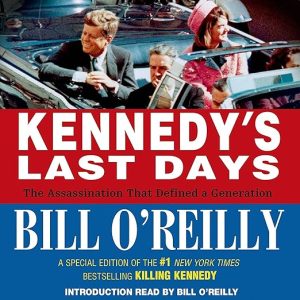
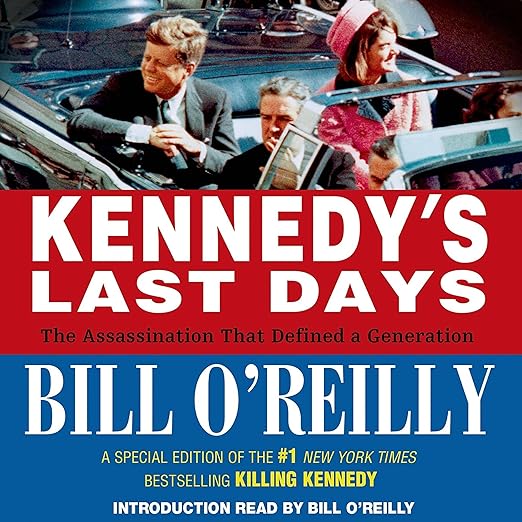
Dallas, November 22, 1963: among the most documented hours in American history, yet somehow still capable of generating fresh tension when handled by a skilled writer. Bill O'Reilly's adaptation for younger readers of his bestselling historical thriller Killing Kennedy sets out to make one of the twentieth century's defining tragedies accessible to readers from age ten and up. The audiobook Kennedy's Last Days, read by Edward Herrmann, runs three hours and fifteen minutes and is an efficient, serious piece of historical storytelling calibrated for a younger audience without talking down to them.
How Kennedy's Last Days Holds Up
O'Reilly adapted this from his adult bestseller rather than writing down to a younger audience, and that distinction matters. The adapted text does not condescend; it condenses and clarifies, but it preserves the essential architecture of the original: the dual narrative following Kennedy's presidency and Lee Harvey Oswald's radicalization, running in parallel toward the inevitable convergence in Dealey Plaza. One reviewer who gave this to both an eight-year-old and a thirteen-year-old found both fully engaged, and that range makes sense. O'Reilly's thriller pacing translates well to younger audiences precisely because he does not sentimentalize. Kennedy's political failures, including the Bay of Pigs and the PT-109 incident, are treated with the same directness as his achievements.
Edward Herrmann's narration is a significant asset. His voice carries the gravitas of a historian without the formality that shuts young listeners out, and he manages the split-focus narrative, following both Kennedy and Oswald in alternating sequences, with clarity. The book is described as history that reads like a thriller, and in audio that quality is amplified. Herrmann reads the build toward Dallas with measured urgency, never overstating, trusting the material to generate its own pressure. His handling of the assassination sequence itself is exact and restrained, which is the correct choice for a young audience.
Why Kennedy's Last Days Works as an Audiobook
The format serves the subject. Young readers who might struggle to sustain attention across a longer text, or who encounter JFK in a classroom context that drains the event of its dramatic energy, will find the audiobook format reactivates the story's human scale. Herrmann's voice becomes a guide through the sequence of events in a way that helps listeners track the narrative without getting lost in historical detail. At just over three hours, it is compact enough to be completed across a couple of sessions, which is a practical consideration for middle-grade listeners who are not yet accustomed to longer audio formats.
The adaptation also functions well as a companion to classroom study. Teachers or parents who want to build historical context around the Kennedy era will find that this audiobook provides a clear, narrative account of the events and the political climate leading up to November 1963 without requiring prior knowledge. One reviewer described it as informative, comprehensive, and educational, which is accurate, though O'Reilly is careful to keep the thriller energy alive throughout. The book does not read as a lesson; it reads as a story about real people facing real consequences. The Kennedy family's life under public scrutiny, the crises that defined the presidency including the Cuban Missile Crisis and the civil rights confrontations, and the nation's complicated relationship with its youngest elected president are all woven into the account with the efficiency of a writer who knows how to serve both history and narrative at once.
Weak Spots in Kennedy's Last Days
Listen for how O'Reilly handles Lee Harvey Oswald. The decision to follow Oswald as a character running parallel to Kennedy, rather than keeping him as a peripheral threat until the final act, is what gives the adaptation its narrative tension. O'Reilly presents Oswald as an angry, isolated man whose trajectory is intelligible even when it is not sympathetic. That framing, presenting a clear account of how an ordinary person becomes capable of an extraordinary act of violence, is both historically useful and genuinely unsettling for young readers in the best way.
Also pay attention to the treatment of the immediate aftermath. The book does not end with the shots in Dealey Plaza; it follows through to Oswald's own murder in police custody, which is both historically accurate and structurally important. The fact that Oswald never stood trial means the story has no conventional resolution, and O'Reilly does not manufacture one. Young listeners will likely have questions about Jack Ruby and the conspiracy theories that emerged afterward, and the book handles these carefully without turning the narrative into a speculation exercise. Herrmann's narration of the final sequences carries a quiet gravity that signals to younger listeners that this is history worth taking seriously.
The Right Listener for Kennedy's Last Days
This audiobook is designed for readers aged ten and up, and that guidance is accurate. Younger children would need adult support to process the political and historical context. Middle-school students who have encountered JFK in school but want a fuller narrative account will find this genuinely useful. Adults who read the original Killing Kennedy may find the adaptation too compressed, but as a gift or a shared listening experience with younger family members it works extremely well.
Listeners who are skeptical of Bill O'Reilly's journalism background or who want a more scholarly account of the assassination should look elsewhere; this is narrative nonfiction with a thriller sensibility, not historiography. But for young people encountering the Kennedy assassination for the first time, or adults looking for a concise audio treatment of the events for a family listen, this is a serious, well-executed audiobook. Herrmann's recording was made before his death in 2014 and captures a voice that defined a certain quality of American public authority; his presence alone makes this a worthwhile historical document alongside a good listen.