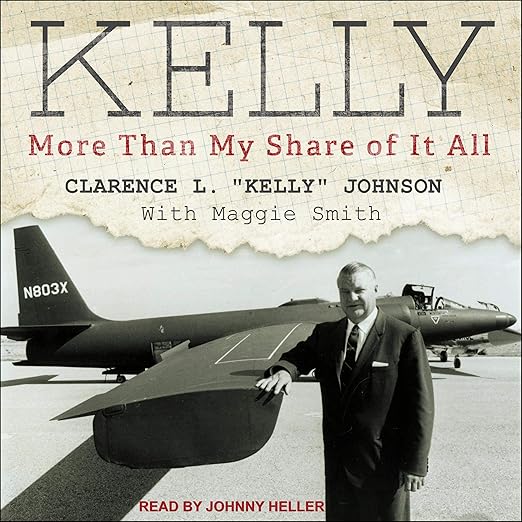
I came to Kelly with a specific question in mind: what does the person who designed the SR-71 Blackbird, the U-2, the P-38 Lightning, and the Lockheed Constellation, among many others, actually think about the work? Not the mythology that has built up around Skunk Works and the Cold War reconnaissance programs, not the retrospective hagiography, but the direct account of how a kid who was told by a teacher that he would never amount to anything became the most consequential aircraft designer in American history. Six hours in, I had a partial answer and a strong sense of what Johnson considered worth recording and what he considered private, which turns out to be a meaningful part of the book's character.
Clarence Kelly Johnson led the Lockheed Skunk Works division for decades, operating with a degree of autonomy from corporate oversight that would be essentially unimaginable in modern aerospace development. The Skunk Works rules, fourteen principles for getting difficult things done quickly with small teams and minimal bureaucracy, are still discussed in engineering and product management circles as a model of high-performance organizational design. Johnson did not develop these rules theoretically. He developed them by building aircraft faster and cheaper than anyone thought possible and then continuing to do so across a career that spanned the piston engine era and the Space Age.
How Kelly Holds Up
The autobiography has a quality that several reviewers note both as praise and mild complaint: it is lean almost to a fault. The early sections, covering Johnson's childhood and his pre-war years at Lockheed, are detailed in ways that give you a real sense of how he developed as an engineer and as a manager of technical problems. The pace accelerates significantly by World War II, and from that point forward the book covers an extraordinary sequence of projects with a brevity that reflects Johnson's personality and values rather than any inadequacy of memory.
One reviewer who loved the book wanted more, specifically more about how the Constellation acquired its distinctive shape, what it actually felt like to ride in an SR-71, and the texture of relationships with the pilots, engineers, and government officials who populated Johnson's career. The want-more response to Kelly is, in a sense, the highest compliment available. Johnson earned so many interesting stories across his career that six hours barely scratches the surface, and the restraint with which he tells them makes you lean forward rather than back. For readers who finish this book wanting the longer version, Ben Rich's Skunk Works fills considerable of that gap from the perspective of Johnson's handpicked successor.
Why Kelly Works as an Audiobook
The management principles section of the book is, for readers approaching it from an interest in organizational design, the most durably interesting material. Johnson operated on the conviction that the simplest solution to a problem is almost always the right solution, that large teams produce bureaucratic inertia rather than better results, and that the relationship between a program manager and the customer must be direct enough that decisions can be made without layers of intermediary approval. The U-2 was designed by roughly fifty engineers. The SR-71, arguably the most complex aircraft of its era, was developed in a timeframe that modern aerospace programs would consider impossibly optimistic.
The contrast with how major aerospace programs now operate is implicit throughout the book and becomes explicit in Johnson's later chapters where he reflects on what he sees as the deterioration of the conditions that made Skunk Works possible. These sections carry an elegiac quality, the record of someone who built something exceptional and can see that the institutional conditions for building it again have been systematically dismantled. It is worth noting that the U-2 was designed over what one reviewer describes as a long weekend during a business trip to the UK. That detail alone captures something about what organizational simplicity, combined with extraordinary talent, can achieve under the right conditions.
Weak Spots in Kelly
Johnny Heller is among the most reliable narrators in nonfiction audio, and he brings to Kelly a quality that the material requires: technical precision combined with genuine warmth for the subject. Johnson was famously unsentimental about his own achievements, preferring to discuss what worked and why rather than to celebrate himself, and Heller captures that register without making the narration feel cold. The voice suits a man who was most eloquent when discussing aerodynamics and least comfortable discussing his own extraordinary contributions to American history.
At six hours and six minutes, the audiobook is shorter than most biographies of figures with Johnson's scope of achievement, which reflects the autobiography's own compression. Listeners who want a fuller treatment of the SR-71 program, the Skunk Works culture, or the Cold War context in which Johnson's most celebrated aircraft operated will find Ben Rich's Skunk Works an essential companion volume. The two books together give you something close to a complete picture of what the Skunk Works actually was and how it produced what it produced.
The Right Listener for Kelly
Aviation enthusiasts already know Kelly Johnson's name and will find the autobiography essential, despite its occasional compression. Readers interested in the history of American Cold War technology and the institutional conditions that made programs like the U-2 and SR-71 possible will find it illuminating beyond the technical content. Readers interested in management philosophy and organizational design will find the Skunk Works principles section among the more grounded and practically useful treatments available, rooted as they are in decades of demonstrated results rather than theoretical framework. The book is dated in some of its future-facing sections, written as they were in the 1980s, but the core material on how Johnson thought about aircraft and about the work of engineering is as fresh as the aircraft themselves still appear when they sit on museum floors.
Before You Press Play
- Voice: Johnny Heller brings Kelly Johnson's autobiography to life with the kind of technical assurance and quiet authority that suits a man who preferred elegant engineering solutions to self-promotion.
- Big ideas: Aerospace engineering genius, American innovation under pressure, the Skunk Works philosophy
- Atmosphere: Understated and precise, the autobiography of a man who let his aircraft speak for themselves and wrote the same way
- Worth it?: Kelly is an essential document for anyone interested in American aerospace history and the management philosophy that built some of the most remarkable aircraft ever designed.
How much of the book covers the Skunk Works management philosophy versus the aircraft themselves?
The management principles emerge throughout but are most explicitly addressed in Johnson's reflection sections and in his later chapters. The aircraft design and development stories are the bulk of the content, with the organizational philosophy woven through rather than isolated in a single section.
Is the book appropriate for readers without technical aerospace knowledge, or is it written for engineers?
Johnson writes for an intelligent general audience rather than for specialists. The technical content is present but not impenetrable, and the management and personal narrative dimensions are fully accessible without aerospace engineering background. Reviewers with no technical background describe finding it entirely readable.