The Short Version
- Voice: Barbara Villa narrates this Italian-language edition, the recording is for Italian-speaking audiences only; the original English text was published under a different title.
- Big ideas: Academic ambition and its psychological costs, descent mythology from Orpheus to Dante, rivalry and its transformation into something else
- Atmosphere: Dense and literary, with a darkly satirical edge toward elite academic culture
- Worth it?: R.F. Kuang at her most allusive and structurally ambitious, rewarding for readers who enjoy literary horror with intellectual scaffolding, though the Italian-only audio limits this edition's audience significantly.
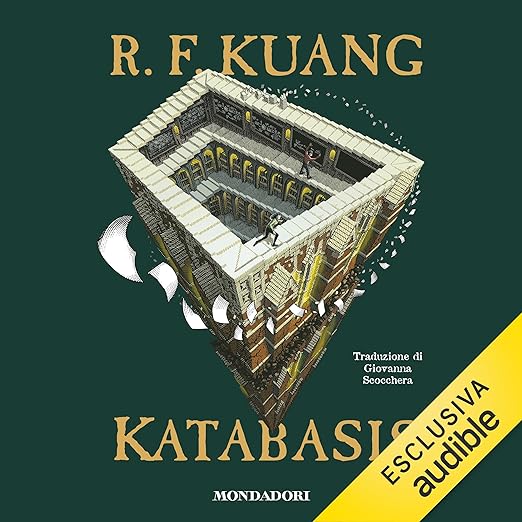
R.F. Kuang has become one of the most formally ambitious novelists working in genre-adjacent literary fiction, and Katabasis, available in this Audible edition in Italian, narrated by Barbara Villa, represents her at her most explicitly mythological. I want to be upfront with you about something before going further: this particular audiobook edition is the Italian translation published by Mondadori, not an English-language recording. If you are looking for an English audio version of Kuang's work, this is not it. If you read Italian, what follows will be relevant to you.
The novel follows Alice Law, a magic researcher at Cambridge who has sacrificed her pride, her health, and her mental stability in pursuit of recognition from Professor Jacob Grimes, described in the synopsis as the greatest magician in the world. When Grimes dies in a magical accident for which Alice may be responsible, she faces an impossible problem: the letter of recommendation she needs for her academic future is now in the possession of a dead man. Her solution is to descend into Hell and retrieve it. Her rival, Peter Murdoch, has the same idea. They go together, armed with chalk for drawing pentacles and the collected literature of descent narratives from Orpheus to Dante.
First, the Big Picture
Kuang's previous novels, Babel, Yellowface, The Poppy War trilogy, established her as a writer who uses genre conventions to interrogate power structures, particularly within institutions: the publishing industry, colonial academia, imperial military hierarchy. Katabasis extends that project into magical academia proper, with the katabasis myth (the heroic descent into the underworld) serving as her formal organizing structure. The choice of Orpheus and Dante as explicit guides, the characters literally carry the texts with them, is characteristically Kuang: she makes her intertextual scaffolding visible rather than hiding it, which is either a mark of intellectual confidence or a willingness to be accused of pretension, depending on your disposition.
One Italian reviewer described the novel as pretentious, noting its parade of literary citations and extended introspective monologues, and observed that reducing the novel by two-thirds would improve it. This is a real tension in Kuang's work, she is a writer who commits fully to her structural ambitions and occasionally pays the price in pacing. Readers who responded to Babel's density will recognize the register; those who found Babel overlong may have the same experience here.
Why Katabasis Works as an Audiobook
The specific critique Kuang appears to be making in Katabasis concerns what elite academic culture does to people who are already operating at psychological extremes, the way institutions extract from their most committed participants and call it excellence. Alice's willingness to descend into literal Hell for a letter of recommendation is played both for dark comedy and for genuine horror, and when the satire is working it lands with considerable force. The Cambridge setting, noted by the Italian reviewer as part of a trend of Anglophone authors fictionalizing Oxbridge and Ivy League environments, is deployed with awareness: this is not accidental. These are the specific institutions whose prestige structures Kuang is examining.
The relationship between Alice and Peter is the book's emotional center, and Kuang is careful to keep its trajectory uncertain, they may become the perfect allies the synopsis suggests or something that destroys them both. Villa's narration reportedly handles that uncertainty with sufficient control, though without hearing the original English text's audio version for comparison, any assessment of this Italian recording's specific interpretive choices is limited.
A Few Reservations
Listeners familiar with the descent narrative tradition will get more from Katabasis than those encountering it cold. The Orpheus myth structures the novel's central danger, what you risk by looking back, what the underworld costs those who enter it with insufficient humility. The Dante parallel gives the descent itself a moral geography: Hell in Kuang's version has its own logic, and it is not the logic described in the texts Alice and Peter carry as guidebooks. That gap between the literary accounts of Hell and the actual experience of it is where the novel's most interesting thinking happens.
The novel was released in November 2025 in this Italian edition. English-language readers will want to seek the original publisher's edition; this Mondadori recording is specifically for Italian-speaking audiences and represents a translation rather than the original text.
Who Should Listen to Katabasis
Italian-speaking listeners who enjoy literary dark fantasy with strong intertextual ambition and an interest in Kuang's ongoing critique of institutional power will find this a rewarding listen, with the caveat that patience with extended introspection is required. Readers who know Babel will recognize the mode and can calibrate their expectations accordingly. English-speaking listeners looking for Kuang in audio should seek her other available English recordings; this particular edition serves a different audience entirely.
Common Questions
Is this Katabasis audiobook available in English?
This specific edition is the Italian translation published by Arnoldo Mondadori Editore and narrated by Barbara Villa. It is produced for Italian-speaking audiences. English-language listeners should check for separate English-language audio editions of Kuang's novel from her original publisher.
Is the novel suitable for readers who found Babel too dense or long?
Reviewers suggest Katabasis has similar tendencies, extended introspective passages, literary citation, and a commitment to its formal structure that occasionally slows the pacing. One Italian reviewer specifically described it as benefiting from significant reduction. Readers who struggled with Babel's density should approach this with similar expectations.
What mythological sources does Katabasis draw on most directly?
The novel uses the Orpheus myth and Dante's Inferno as explicit structural guides, the characters literally carry these texts into the underworld. Kuang makes the intertextual scaffolding visible rather than implicit, and the tension between what the literary accounts of Hell promise and what the actual descent delivers is central to the novel's thematic project.