Quick Take
- Narration: Julie Brierley brings the same focused intelligence she applies to other Manning titles, clear, appropriately paced, and well-suited to a cookbook-style technical resource.
- Themes: PostgreSQL extensibility, polyglot persistence replacement, developer pragmatism
- Mood: Opinionated and energizing, the kind of technical book that makes you want to open a terminal
- Verdict: An unusually persuasive argument that your specialty database stack is more complicated than it needs to be, backed by actual implementation guidance.
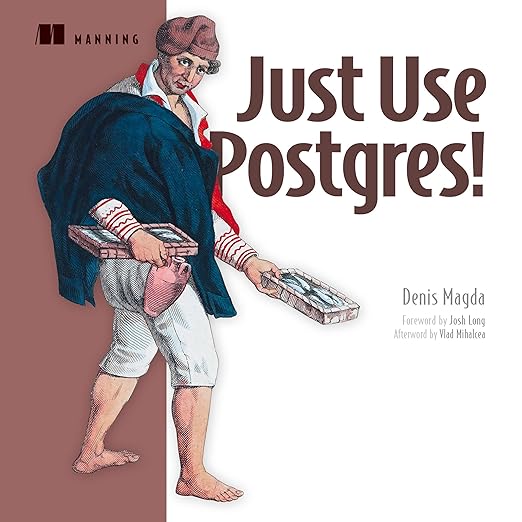
The premise of this book landed on me at exactly the right moment. I’d spent a week prior listening to a different database book that made a compelling case for a time-series database for a particular use case, and I found myself wondering whether the overhead of maintaining another system was really justified. Denis Magda answers that question directly and with more technical depth than the title’s deliberately provocative phrasing suggests. This is not a polemic against specialty databases, it is a systematic demonstration that Postgres has grown sophisticated enough to handle many of the workloads that historically required them.
Magda brings serious credentials to this argument. His background spans Java work at Sun Microsystems and Oracle before focusing on distributed systems and, more recently, Postgres. The book’s organization reflects a practitioner’s knowledge of where developers actually reach for specialty tools: there are chapters covering the vector store use case (usually Redis or a dedicated vector database), geospatial queries (usually PostGIS, but Magda shows this is available as a Postgres extension), full-text search (usually Elasticsearch or Solr), JSON document storage (usually MongoDB), message queuing (usually Kafka or RabbitMQ for simpler use cases), and time-series data (usually InfluxDB or TimescaleDB). Each chapter is organized as a recipe: here is the use case, here is how Postgres handles it, here are the limitations you should know about.
The pgvector Chapter and Why It’s the Most Timely
The section on using Postgres for generative AI applications via the pgvector extension is the chapter most likely to be genuinely new information even for experienced Postgres users. As organizations build RAG systems and embedding-based search, the reflex has been to reach for dedicated vector databases. Magda walks through how HNSW indexes (Hierarchical Navigable Small World, the index type that makes approximate nearest-neighbor search fast at scale) work in pgvector, and he is honest about the scale at which a dedicated vector database starts making more sense than a Postgres-based approach. That kind of honest scoping makes the chapter more valuable, not less, it tells you when to use the tool and when to look elsewhere.
The reviewer who called out his own experience in trading systems and low-latency infrastructure captures something real about the book’s appeal. Magda is not writing for newcomers deciding which database to learn first, he’s writing for experienced engineers who have accumulated a stack and are now paying the operational tax of maintaining it. The combination of covering pgvector, TimescaleDB, PostGIS, pgmq (a message queue extension), and full-text search capabilities in a single coherent volume makes the consolidation argument concrete rather than theoretical.
The PDF Companion and a Note on Format
Like other Manning audiobooks, this one ships with a companion PDF, which is important for the code-heavy recipe chapters. Magda’s examples include actual SQL, window functions, CTEs, HNSW index creation syntax, and the geospatial query patterns using PostGIS. Julie Brierley handles the spoken SQL competently, but the PDF is where you want to be when following a recipe. The listening experience works best when you use the audio for the explanatory context around each recipe and the PDF for the actual implementation reference.
The extension ecosystem Magda introduces, pgvector, PostGIS, pgmq, TimescaleDB, and others, is one of Postgres’s genuine differentiators that many developers underutilize. Each extension is presented with enough context to understand when it applies and enough code to understand how to use it, which is exactly the right balance for a cookbook format.
What the Reviews Confirm and What They Don’t
The 5.0 rating across 17 listeners is encouragingly consistent, with reviews spanning developers coming from SQL Server, developers learning Postgres for the first time, and experienced Postgres users looking to understand its more advanced capabilities. The consensus is that Magda writes clearly and that the book’s examples are practical and well-sequenced. What the reviews don’t address is the book’s coverage of the specific contexts where Postgres is not the right answer, Magda includes this material, but it tends to be briefer than the enthusiastic sections, which is probably unavoidable given the book’s argument.
If you are running a data infrastructure that includes multiple specialty databases and have been wondering whether some of that complexity is justified, this book will give you a structured framework for evaluating it. Even if you conclude that your Elasticsearch cluster or your dedicated vector database is earning its keep, you’ll come away with a significantly better understanding of what your Postgres installation is capable of doing that you haven’t asked it to do yet.
Frequently Asked Questions
Does this book cover pgvector and vector similarity search in enough depth to evaluate whether to use it instead of a dedicated vector database?
Yes, the pgvector coverage includes HNSW index creation and performance considerations, and Magda is honest about the scale thresholds where a dedicated vector database becomes more appropriate. It is one of the more practically useful treatments of the topic in current audiobook form.
Is the companion PDF essential for following the code examples, or can you get the value from audio alone?
The PDF companion is strongly recommended for the recipe chapters, which include actual SQL for each use case. The audio explains the conceptual context well, but the implementation syntax really needs to be read visually. Treat it as a hybrid resource.
Does Just Use Postgres address the operational overhead of running multiple Postgres extensions, or does it focus only on the feature demonstrations?
Magda touches on operational considerations, particularly around extension installation and version compatibility, but the primary focus is on capability demonstration rather than production operations management. Teams evaluating this for production use should supplement with extension-specific operational documentation.
How does this compare to the official PostgreSQL documentation for learning Postgres’s more advanced features?
The official documentation is authoritative and comprehensive but organized as a reference rather than a learning resource. Magda’s book is organized around use cases rather than features, which makes it substantially easier to follow if your starting point is a specific problem to solve rather than a feature to understand.