Key Details
- Performance: Bryan Stevenson reads the adaptation of his own book, which puts the lawyer who argued the cases in the booth rather than a hired performer.
- What it covers: wrongful conviction, the American justice system, mercy as daily legal practice, a hard subject rewritten for teenagers
- Feel: Sober and plainspoken, heavier in the opening chapters than the school-assignment framing suggests
- Our call: The right length and the right voice for an assigned read, as long as you sample the first hour for a sensitive listener.
Two votes hold up the 4.7 rating badge on this audiobook listing, and five written responses sit underneath it. That arithmetic does not work. No pair of whole-star votes averages 4.7, and a counter reading 2 cannot account for five people who sat down and wrote paragraphs. So read the column instead. What you find is not a verdict on a recording. It is five accounts of a book moving through American schools, from an 11th grader's summer reading list to an 8th grade classroom where a teacher set it beside To Kill a Mockingbird. That is useful. It is simply not what the number appears to be measuring.
What Bryan Stevenson Delivers
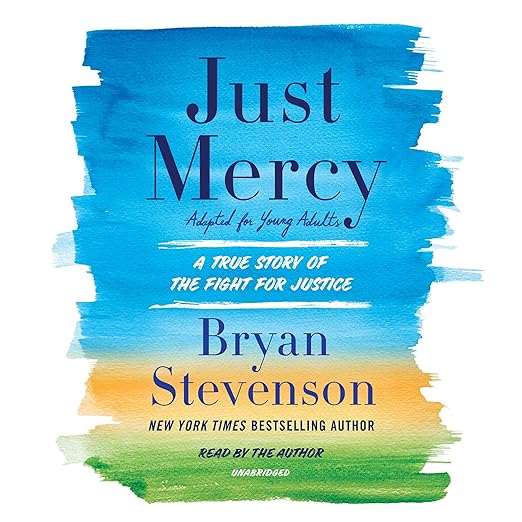
Start with the credit line. Bryan Stevenson wrote the original, and Bryan Stevenson reads this adaptation, six hours and thirty-five minutes of it, for Listening Library. That matters here, because the stories belong to people Stevenson represented as a lawyer, and the description states that a portion of the proceeds goes back into that work. What the record does not tell you is who performed the adaptation. The byline credits Stevenson alone, while the description says only that the book was adapted from the original bestseller, passive voice, no name attached. Somebody reshaped this text for younger readers, and that person is nowhere on the page.
School is the only subject the response column has. A parent bought it as a summer reading book for an 11th grader and reports the movie came next. Another calls it the middle school all-school summer read. A third has put two children through it with a fourth lined up. A teacher describes assigning excerpts from the adult edition alongside To Kill a Mockingbird with 8th graders and says the conversation that followed was lively and informed. The briefest entry runs to a single line: ordered for school, exactly what was needed.
Only one response hesitates, and it happens to be the most useful one on the page. Writing at four stars, LM Marsh warns that the first couple of chapters are graphic about the accusations and the arrests, then asks how a sensitive 12-year-old is meant to get through material that had an adult in tears every few pages. That is the only age calibration anywhere in this record, and it comes from a parent rather than from the publisher. The entry then breaks off in the middle of a word, mid-sentence, on the subject of the film.
What Bryan Stevenson Gets Right
Hearing this rather than reading it comes down to whose voice does the telling. Stevenson is not performing a novel. He is describing legal work done on behalf of people the description calls the poor, the wrongly convicted, and those whose lives have been marked by discrimination and marginalization. When the person who stood in those courtrooms is also the person in the booth, the reading carries an authority a hired voice cannot manufacture. At six hours and thirty-five minutes it is also a short listen for a subject this heavy, which is a deliberate property of an adaptation built for teenagers rather than a shortcoming.
Adaptation is the second argument. The description sets out the intent plainly: young people of today will find themselves called to action and compassion in the pursuit of justice. Salon, quoted in that same copy, calls it exciting that young readers are getting a version tailored for them. Kirkus Reviews, in a starred notice the description also reproduces, calls the result a deeply moving collage of true stories and required reading. Those are publisher-selected quotes, but at least they were written about this edition, which is more than the rest of the praise on this page can claim.
For a parent or a teacher, the most concrete evidence sits in the response from Syd Mae. Having read the adult edition a year earlier while teaching To Kill a Mockingbird to 8th graders, this teacher brought excerpts of Stevenson's stories into the same unit and found students responding well enough that parents noticed. That is a specific classroom use, reported by somebody who tried it. Nothing in the column speaks to whether a class can follow six and a half hours of audio together, but the material has clearly survived contact with real thirteen-year-olds.
Where Bryan Stevenson Loses Some Ground
Read the description closely and something odd surfaces. Four endorsements appear under headings in capital letters, and two of them are explicitly filed as praise for Just Mercy: A Story of Justice and Redemption, which is the adult book, not this one. Desmond Tutu, Tracy Kidder and John Grisham are quoted about a title that is not the one on this listing. Only the Salon and Kirkus lines sit under praise for the young adult version. A shopper skimming the page sees a Nobel laureate endorsing the book in hand. A careful reader sees an endorsement borrowed from a different edition and reprinted here.
The film material deserves the same caution. The opening line of the description advertises a major motion picture starring Michael B. Jordan, Jaime Foxx and Brie Larson, plus an HBO documentary feature. None of that is inside this recording, and the only response that mentions the movie mentions it as the thing an 11th grader wanted to watch once the text was finished.
Then the score. The badge reads 4.7, the counter reads two ratings, and five people have written paragraphs beneath it. A 4.7 average cannot be assembled out of two whole-star votes under any rounding convention, so the badge and the counter are plainly describing different pools. Treat the figure as decoration and the paragraphs as the evidence, remembering that all five grade a printed book bought for a class. On what the recording sounds like, this page is blank.
Who Should Pick Up Just Mercy (Adapted for Young Adults)
Students who have been assigned the book, and the parents and teachers doing the assigning, are precisely who wrote in, which makes the audience easy to name. Add adults who want Stevenson's account at six hours rather than at full length, and anyone who would rather take this material in the author's own voice than in a performer's. Households with a younger or more sensitive reader should take the four-star warning at face value and sample the first hour before handing over the headphones.
Look at the adult edition instead if you want the case histories at full length, or if you want to know exactly what was trimmed, because this record never says and never names the person who did the trimming. Listeners who buy audio for performance should know what they are getting: one unhurried voice, no cast, no production to speak of. Anyone who needs the courtroom detail in full will have to go back to the original, and nothing on this listing will tell them how much of it is missing.
Before You Listen
How does this audiobook differ from the adult edition of Just Mercy?
The description says only that it was adapted from the original bestseller, without naming who adapted it or specifying what changed. One four-star response assumes the content has been toned down, and flags that as an assumption rather than a fact. The record offers nothing more precise, so the difference remains undocumented on this page.
Who narrates the Just Mercy young adult audiobook and how long does it run?
Bryan Stevenson reads it himself, in a Listening Library production running six hours and thirty-five minutes and dated September 18, 2018. The author byline and the voice credit are the same name, so the account of the cases comes from the lawyer who worked them rather than from a performer engaged for the job.
Is it appropriate for a middle schooler?
The column includes both an all-school middle grade read and an 11th grade summer assignment, so schools clearly use it at both levels. One parent cautions that the early chapters describe accusations and arrests graphically enough to unsettle an adult. Preview the opening hour before deciding for a younger or anxious listener.