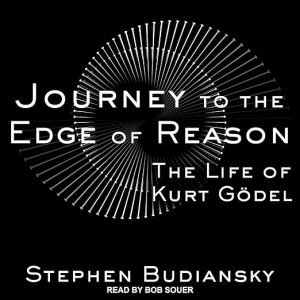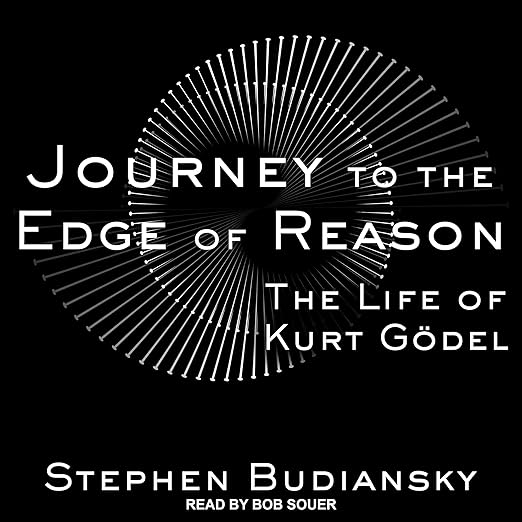
I have a long-standing interest in the history of mathematics and logic, and Kurt Godel has always occupied a particular place in that interest, simultaneously central to the foundations of modern thought and strangely peripheral in the biographical literature. Nearly a hundred years after the incompleteness theorems changed what mathematicians believed was possible, the man himself remained largely unexamined at book length. Stephen Budiansky's Journey to the Edge of Reason fixes that gap.
I listened to this on a long train journey, which felt appropriate. The book follows Godel from his childhood in Brno through the intellectual ferment of interwar Vienna, his survival of the collapse of European intellectual culture, his friendship with Einstein at Princeton's Institute for Advanced Study, and ultimately his death by self-starvation, the result of paranoia so total that he would not eat food he could not verify was safe. It is not a comfortable story, and Budiansky does not soften it.
How Journey to the Edge of Reason Holds Up
What distinguishes this biography from earlier accounts of Godel is its use of primary sources: Budiansky draws on voluminous letters and writings, and critically on a shorthand diary that had never before been transcribed. That diary gives the book access to Godel's interior life in a way that his public intellectual persona, carefully controlled and famously elliptical, never allowed. The portrait that emerges is of a person of extraordinary perceptual precision who applied that same precision to the interpretation of social signals around him, with increasingly catastrophic results as his paranoia developed.
The intellectual content is handled with genuine care. Budiansky explains the incompleteness theorems at sufficient depth to make clear why they mattered, why the claim that any sufficiently rich mathematical system must contain true statements that cannot be proved within that system was and remains philosophically explosive, without turning the biography into a mathematics textbook. Reviewers with and without mathematical backgrounds describe finding the explanation illuminating rather than alienating.
Why Journey to the Edge of Reason Works as an Audiobook
Bob Souer narrates for Tantor Audio, and his performance matches the book's register: measured, intelligent, respectful of the material without being reverential toward it. The biographical narrative and the mathematical excursions require different pacing, and Souer adjusts appropriately. At 8 hours and 52 minutes, the audiobook is long enough to do justice to the scope of Godel's life and short enough that it does not lose momentum in the later sections dealing with his mental deterioration.
The Vienna sections are among the best in the book. Budiansky evokes the intellectual world of the Vienna Circle and the cafe culture of interwar Europe with real vividness, and Souer's delivery in those passages captures the sense of a world at its most brilliantly alive just before its destruction. A reviewer who had actually lived in Prague and traveled between Prague and Vienna noted the historical accuracy and emotional resonance of those sections.
Weak Spots in Journey to the Edge of Reason
One scholarly reviewer notes that Budiansky understandably avoids deep engagement with Godel's early life due to source limitations, and that for readers who want a philosophical deep-dive into the incompleteness theorems specifically, Nagel and Newman's Godel's Proof remains the dedicated resource. This is a biography first, and its treatment of the mathematics is contextual rather than comprehensive. That choice is defensible; readers who want the technical depth alongside the biographical narrative will want to read Godel's Proof as a companion.
The book's account of Godel's friendship with Einstein is one of its genuine pleasures. Two men who had both survived the collapse of their native European cultures walking together at Princeton, debating physics and philosophy while Godel worked on a cosmological model in general relativity that would prove time travel theoretically possible, is the kind of historical detail that sounds invented but is documented.
Who Should Listen to Journey to the Edge of Reason
Readers with an interest in the history of mathematics, logic, or philosophy of science will find this essential. The book also functions as intellectual history and as biography for readers with no mathematical background who are drawn to stories of extreme minds and the communities that shape them. Listeners who want to understand why Godel's incompleteness theorems matter beyond the academic mathematical context, for artificial intelligence, philosophy of mind, and the limits of formal reasoning, will find the book an ideal orientation. Those seeking a deep technical account of the mathematics should pair it with dedicated mathematical texts.