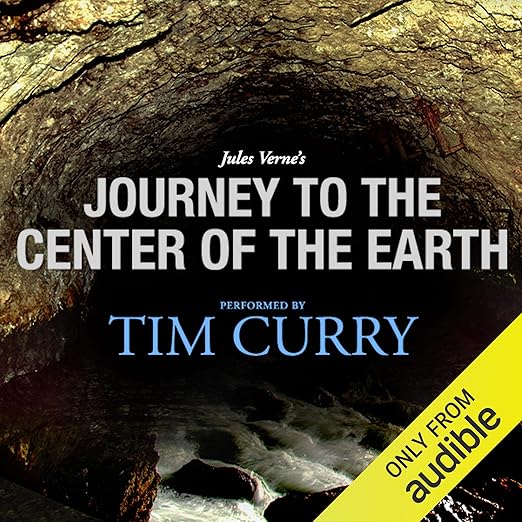
Otto Lidenbrock's expedition through the earth's crust gets a genuinely theatrical reading here, and Tim Curry's name in the title is not just billing, it is the entire pitch. I revisited this audiobook specifically to hear how Curry handles Jules Verne's eccentric professor and his crew as they descend through giant mushroom forests, past a herd of mastodons, and toward a pit of magma, and the performance treats all of it with the same relish Curry brings to any role built on barely contained enthusiasm.
Verne's novel is one of the earliest true works of science fiction, predating most of what the genre would later become, and this production frames Curry's involvement explicitly as an encore: he previously narrated a customer-favorite edition of A Christmas Carol for the same producer, and returns here for a second collaboration.
Verne's Blueprint for Scientific Adventure Fiction
What holds up remarkably well nearly two centuries later is how much Verne treats scientific exploration itself as the genuine adventure, not just the backdrop for one. Lidenbrock is driven by pure intellectual hunger rather than treasure or glory, and the expedition's escalating bizarre discoveries, prehistoric humans, impossible insects, an underground sea, read less like fantasy set dressing and more like a period-accurate vision of what nineteenth-century readers imagined real scientific discovery might still uncover.
One listener specifically situated the book within the broader debate over who really invented science fiction, weighing Verne and H.G. Wells against Mary Shelley and Edgar Allan Poe, a debate this book itself makes a strong case for taking seriously. Whatever your verdict on that question, Verne's structural template here, a small expedition, a hostile unknown environment, escalating discoveries, clearly seeded a great deal of the adventure and speculative fiction that followed it.
Verne wrote this as part of his sprawling Voyages Extraordinaires series, the same project that later produced Twenty Thousand Leagues Under the Sea and Around the World in Eighty Days, and the throughline across all of them is the same one on display here: ordinary scientific curiosity pushed to genuinely extraordinary extremes. Readers who know Verne mainly through Captain Nemo's submarine will find a smaller-scale but similarly audacious sense of exploration driving this earlier, foundational entry in that same body of work.
The novel's premise has proven durable well beyond the page, inspiring multiple film adaptations across different decades, each reinterpreting the underground expedition for its own era's special effects and sensibilities. That steady cultural afterlife is a reasonable indicator of how well Verne's core premise, ordinary scientific curiosity colliding with an impossible discovery, continues to hook new audiences generation after generation, audio listeners included.
The three-person expedition dynamic, Lidenbrock's manic obsession, Axel's far more reasonable fear, and their guide Hans's near-total silence and competence, gives Verne a built-in comic and dramatic engine: two very different reactions to mounting danger playing off each other constantly, with Hans functioning almost as a stoic anchor between them.
Tim Curry Voices Three Very Different Men
Curry's specific strength across this reading is range: the synopsis promises a variety of distinct character voices, and he delivers exactly that, giving Lidenbrock's manic scientific enthusiasm, his nephew Axel's more grounded anxiety, and their guide Hans's steady calm three genuinely different registers rather than one performer's voice with minor inflection changes between them.
This a Signature Performance edition specifically built around Curry's involvement, distinct from a standard unnamed-narrator reading of the same public-domain text, and that distinction matters for anyone comparing multiple available audio editions of this classic. If Curry's prior, well-received turn on A Christmas Carol won you over, this expedition-adventure register gives him a very different kind of material to work with, manic scientific wonder rather than gothic melancholy, and the range on display supports both.
Curry's career runs from theatrical rock musical icon to a famously unsettling children's-horror villain, and that same range, equally comfortable with camp and genuine menace, is exactly what a text this tonally varied benefits from: Lidenbrock's manic enthusiasm needs a performer unafraid of going big, while the expedition's genuinely dangerous stretches need real weight behind them too. Few narrators bring both halves of that range as naturally as Curry does.
Old Pacing, Older Science, Uneven Translations
At eight hours and twenty minutes, this is a full, unabridged classic rather than a condensed adaptation, and Verne's nineteenth-century prose style, long descriptive passages, period scientific digressions, will read as slower-paced than contemporary genre fiction to listeners used to modern pacing. That deliberate, exploratory pace is period-authentic rather than a flaw, but it is worth knowing going in.
This is very much a product of its era's assumptions about geology and prehistoric life, some of which read as charmingly, even amusingly, outdated by modern scientific standards. Listeners expecting scientific accuracy by today's understanding should treat the underground world Verne imagines as an artifact of period imagination rather than anything resembling a serious geological argument.
Verne's work has a famously uneven translation history in English; many nineteenth and early twentieth-century editions were heavily cut, altered, or clumsily rendered from the original French, which shaped English-language readers' impressions of his prose for generations. It is worth knowing which translation underlies any given audio edition, since a rough older translation can flatten exactly the enthusiasm and specificity that make Verne worth reading in the first place.
A Diary-Like Solo Read for Genre Fans
This suits classic science fiction readers curious about the genre's roots, fans of Tim Curry's theatrical range looking for a second performance beyond his Christmas Carol work, and anyone who enjoys expedition-adventure stories with a genuine sense of wonder driving them. Curry's specific gift for barely restrained enthusiasm is an ideal match for Lidenbrock's single-minded scientific obsession.
Listeners who want fast-paced modern adventure prose, or who find nineteenth-century descriptive digressions tedious, may find the pacing a real adjustment. For anyone approaching this as a genuine genre landmark rather than a quick thrill ride, Curry's performance is a strong, energetic way into a foundational text.
This is a solo narration rather than a full-cast dramatization, which suits Verne's structure well, since the novel reads largely as Axel's first-person account of the expedition, closer to a diary than an ensemble drama, and a single strong narrator carrying that account intact keeps the intimacy of that framing device intact.