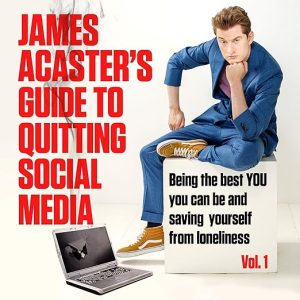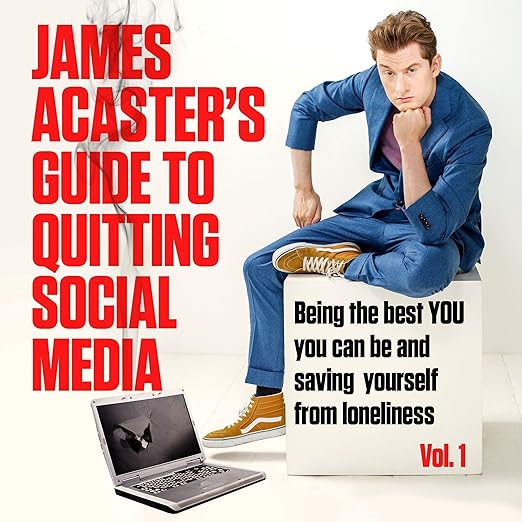
James Acaster painted over the screen of his old phone so he couldn't look at Instagram, a small, slightly unhinged detail that tells you everything about the comic register of this audiobook. What do you actually replace social media with once you quit, and can real life ever compete with a feed engineered to keep you scrolling? James Acaster's Guide to Quitting Social Media answers, sort of, with a string of increasingly absurd real-world substitutes: anonymously bullying strangers in person, seeing everyone's dogs the old-fashioned way, and getting invited to as many parties as physically possible.
Escalating Satire That Thins Out by the End
The joke embedded in the premise is that this is, by its own framing, a self-help book like no other, because the reader isn't helping themselves, James Acaster is helping them. That inversion runs through the entire runtime: every piece of advice is a mock-earnest satire of self-improvement content, delivered with the specific, escalating logic of a comedian building an elaborate bit rather than an author making sincere claims. Acaster quit social media for real in 2019, and the genuine relief he describes feeling gets filtered through increasingly ridiculous replacement activities for the rest of the book.
Reviewer joe offers the most useful calibration available: this is 'good, but not great,' not quite matching Acaster's earlier books, with the bit that 'runs too far and a bit thin' by the end. That's a fair read of the format's real limitation, a single extended satirical premise sustained across nearly seven hours asks a lot of one joke, however well-constructed, and the back half inevitably has less surprise left in it than the opening stretch.
Substitutes as Precise as the Bloated Title
The synopsis reveals the book's full, deliberately absurd official title, naming James Acaster's Guide to Quitting Social Media, Being the Best You You Can Be and Saving Yourself from Loneliness Vol. 1, a title so bloated with self-help cliches stacked on top of each other that it functions as a joke before the first chapter even starts. The shortened version used on most listings loses some of that immediate comic signal, so listeners judging the book by its more restrained cover title alone should know the interior tone leans even more maximalist and absurd than that title suggests.
The specific substitutes Acaster names, anonymously bullying strangers, getting public figures fired, immediately learning about celebrity deaths, are each engineered as a direct, one-to-one satirical mirror of a real, specific social media behavior, pile-ons, cancel culture, breaking-news notifications, rather than generic complaints about phones. That precision is what keeps the joke feeling sharp rather than like a general old-man-yells-at-technology routine, since Acaster is clearly diagnosing his own actual habits rather than technology broadly.
Built to Be Heard in His Own Voice
Self-narration is essentially mandatory for material built this specifically around a stand-up comedian's timing. Acaster's delivery carries the deadpan escalation that makes lines like getting invited to as many parties as possible land as satire rather than sincere advice, a comic rhythm that would be nearly impossible for another narrator to reconstruct from the page alone without direct access to how Acaster himself hears the joke landing.
Reviewer Kindle Customer's blunt recommendation, to 'do yourself a favor and binge all of his work,' points to something real about Acaster's audiobook catalog specifically: his written comedy is built to be heard in his own voice, and listeners who've enjoyed his stand-up will recognize the same rhythms and comic instincts translated directly into long-form audio here.
Acaster built a significant part of his stand-up reputation on tightly constructed, escalating premises taken to absurd logical extremes, the same basic comic engine driving his acclaimed stand-up work translated here into book form. Listeners already familiar with that style from his stand-up specials will recognize the technique immediately; those meeting Acaster for the first time through this book get a reasonably representative introduction to how his comic mind actually works, premise, escalation, increasing commitment to the bit long after a lesser comedian would have moved on.
That same commitment to underplaying the joke is what makes self-narration essential rather than simply preferable here. Deadpan depends on a very specific, hard-to-fake flatness of delivery, and a narrator without Acaster's own instinct for exactly how long to hold a straight face before the absurdity lands risks either winking at the audience too early or draining the humor out of the material entirely.
Its Own Ending Instructs You to Tweet
Reviewer Chris, who has read both Classic Scrapes and Perfect Sound Whatever, flags a real shift in approach: this book is 'missing the personal connection that Acaster typically makes between his life and the reader,' trading the more grounded, autobiographical comedy of his earlier work for a fully committed satirical bit instead. Listeners who came to Acaster through his more personal material should know this leans further into pure absurdist premise than character-driven storytelling.
The book also closes on a genuinely funny, self-aware joke worth flagging: it instructs listeners to help promote the audiobook by tweeting about it, a direct contradiction of its own quitting-social-media premise that Acaster clearly intends as the final punchline rather than an oversight. Missing that layer of self-awareness would mean missing part of the point entirely.
A 4.0 rating from 483 ratings is on the lower end for a comedy title with this much name recognition, and reading across the attached reviews, that softer reception tracks closely with reviewer joe's specific complaint about the central bit running thin rather than any broader dissatisfaction with Acaster's writing or narration. Listeners should calibrate expectations around a good, funny book rather than a career-best one.
For listeners who finish this one wanting more of the specific personal texture Chris found missing here, both Classic Scrapes and Perfect Sound Whatever are the better next stop, closer in spirit to memoir than to the sustained hypothetical bit this book commits to instead.
Real Advice Seekers Become the Joke's Target
Existing James Acaster fans, especially listeners who've already enjoyed his stand-up specials or his other audiobooks, are the clear best audience, since familiarity with his specific comic voice makes the sustained absurdist premise land more reliably across nearly seven hours than it would for a listener meeting him for the first time here.
The book's 2022 publication date, three years after Acaster's actual 2019 social media departure, means the material benefits from real distance and reflection rather than reading as a rushed, of-the-moment reaction. That gap gives the satire more shape and structure than a hastier take on quitting social media might have managed.
Skip this one if you're looking for either a genuine, practical guide to digital wellness or Acaster's more personal, autobiographical comedy style; this is neither, and listeners expecting real advice about their own phone habits, rather than an escalating satirical bit about replacing an app with chaos, are likely to find themselves the target of the joke rather than its intended audience.
Is this audiobook a genuine self-help guide to quitting social media?
No, and it says so itself. The premise inverts self-help entirely, with Acaster narrating an escalating satirical bit rather than offering real digital-wellness advice.
Do I need to have read James Acaster's other books before this audiobook?
No, but familiarity helps. Reviewer Chris, who's read Classic Scrapes and Perfect Sound Whatever, notes this leans further into pure satire and further from Acaster's usual personal storytelling.
How does this audiobook compare to James Acaster's earlier comedy work?
Reviewer joe calls it good but not great, saying the central bit runs a bit thin by the end compared to his first two books.