Key Details
- Read by: Cindy Kay steps outside her usual fiction lane into nonfiction game history and handles the dense chronology of names and dates with clear, unhurried professionalism.
- At its heart: Video game industry history, Capcom's corporate turnaround, franchise creative reinvention
- Vibe: Research-dense but affectionate, built for fans already invested in the series
- Short version: Essential for Resident Evil devotees who want the real development history, less useful as a general gaming-history primer.
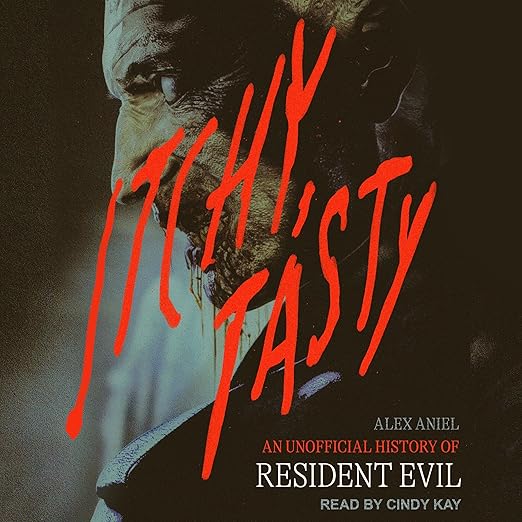
Resident Evil's original 1996 release didn't just launch a franchise, according to Alex Aniel's account it saved Capcom from real financial trouble at a moment the company badly needed a hit. Itchy, Tasty, a title borrowed from the original game's own infamous, clunky English dialogue, spent two years in development as Aniel tracked down former Capcom staff and pieced together the internal story behind every mainline entry released between 1996 and 2006. This audiobook, narrated by Cindy Kay, turns that research into a chronological account of how a horror franchise conceived in the late 1980s grew, nearly stalled at the turn of the century, and then reinvented itself with Resident Evil 4.
Kay Narrates Game History After Romance Fiction
Cindy Kay is a narrator I've mostly heard on romance and middle-grade fiction, so nonfiction game history is new territory for her here, and it shows in a good way: she treats the material with the same clarity she brings to emotionally complex younger protagonists, letting Aniel's research speak plainly rather than performing enthusiasm the text doesn't ask for. That matters because this genre lives or dies on whether a narrator can keep a parade of Japanese developer names, internal Capcom division titles, and release-date chronology straight without losing listeners who are not already fluent in game-industry structure, and she manages it capably without the pace ever slowing to a crawl.
The genre tag attached to this listing, Programming & Software Development, is a clear mismatch worth flagging; nothing here is a coding tutorial or software history in the technical sense. Itchy, Tasty is oral-history journalism about a specific creative and business story, closer in spirit to a well-researched music biography than to any programming reference. Listeners browsing by that category tag should not expect technical software content, and readers of Jason Schreier's studio-history journalism are a much closer comparison point for what this book actually delivers.
Chillingly Mundane Final Words From a Research Diary
The book's title is itself a piece of series lore worth knowing: 'Itchy. Tasty.' are the chillingly mundane final words of a research diary found within the original 1996 game, written by a scientist realizing too late that the virus is transforming his own body. Aniel borrowing that line for his own title signals exactly the kind of insider fluency this book assumes throughout, a wink aimed squarely at listeners who already know where that phrase comes from rather than an accessible title built for newcomers.
One franchise-specific wrinkle worth knowing: Resident Evil was released in Japan under an entirely different title, Biohazard, a naming split that still affects the series today and that any thorough development history has to address directly. Listeners should expect Kay's narration to move between both names as the book covers Capcom's own internal terminology, and that dual-title fluency is a small but real test of a narrator's comfort with franchise-specific detail that a less specialized reader might stumble over.
Paying Respect and Homage to the Creators
The two years of original interviews are the entire case for this audiobook over a surface-level retrospective. Reviewer belkitoFUERTE notes that the book 'pays respect and homage to the creators of the games' rather than just cataloguing release dates, and Craig Sears, reviewing as a 'longtime fan of the series,' specifically credits the 'illuminating look into the development of the franchise's classic era.' First-person testimony from the people who actually built Resident Evil's jump scares and fixed-camera-angle tension is not something a listener can get from a general gaming-history podcast, and it is the specific value only original reporting like Aniel's can supply.
The narrower ten-year window also works in the book's favor rather than against it. Rather than racing through decades of sequels, spin-offs, and reboots at a superficial pace, Aniel gets real depth on the era most fans consider the series' creative peak, the transition from fixed-camera survival horror to Resident Evil 4's over-the-shoulder action reinvention. That focus lets the audiobook spend real time on why RE4 succeeded rather than just noting that it did.
The financial-rescue angle also deserves more attention than a passing mention. Capcom's own struggles heading into the mid-1990s, following costly bets outside its core arcade and console business, are part of why Resident Evil's breakout success mattered so much internally, and Aniel's interview access lets him trace that internal pressure directly rather than inferring it from sales figures alone. That corporate-survival context gives the book stakes beyond franchise trivia, turning a video game history into something closer to a startup turnaround story.
Stops Prematurely at the Ten-Year Mark
The most consistent complaint, and it comes through in the reviews attached to this title, is scope. Howard Blatz enjoyed the book but was disappointed to find it 'stops prematurely,' covering only the first ten years rather than the full franchise history through Resident Evil 6 and 7. Anyone expecting a complete survey through the series' recent output should know upfront that this audiobook ends around Resident Evil 4; whether Aniel is saving the rest for a sequel volume is not something this particular listing confirms either way.
This is also a book written for an audience that already cares about Resident Evil specifically. Aniel assumes real familiarity with character names, game mechanics, and franchise lore rather than building that context from scratch, which is the right call for the target reader but means casual listeners with only passing knowledge of the series may find themselves occasionally lost in developer-team specifics that a documentary aimed at a general audience would have explained more patiently.
The audiobook format itself suits this kind of chronological, chapter-by-chapter structure well; Aniel organizes the book roughly game by game, which translates naturally into listenable chunks that work for a commute or a workout without requiring a listener to track a single continuous narrative thread. That structural clarity partly offsets the genre's density, even for listeners who occasionally lose track of a specific producer or designer's name.
How Fixed Cameras and Tank Controls Got Made
This one is close to essential listening for anyone who grew up on the original PlayStation-era Resident Evil games and has ever wondered how those fixed camera angles, tank controls, and famously awkward dialogue actually got made. It also holds real appeal for listeners interested in Japanese game-industry history more broadly, since Capcom's internal struggles and eventual turnaround double as a case study in how a single franchise can rescue an entire company's finances.
Skip it if you are looking for coverage of recent Resident Evil entries or a broader history of survival horror as a genre; this audiobook's ten-year window stops well short of both. Listeners without existing affection for the series may also find the developer-by-developer detail more granular than they need, since Itchy, Tasty rewards depth of fandom more than it accommodates newcomers.
A Few Questions About Itchy, Tasty
Does this audiobook cover the newer Resident Evil games or the remakes?
No. Itchy, Tasty focuses specifically on the games released between 1996 and 2006, ending around Resident Evil 4, so listeners wanting coverage of the series' more recent entries will need a different source.
Is Itchy, Tasty the right audiobook if I only know Resident Evil from the movies?
Probably not as a starting point. The narration and source material assume real familiarity with the games' characters, mechanics, and internal lore, so listeners without that background may find some sections harder to follow.
Why is this audiobook filed under Programming & Software Development?
That genre tag appears to be a mismatch. Itchy, Tasty is narrative game-industry journalism built on two years of interviews with former Capcom staff, not a technical or coding-focused title.