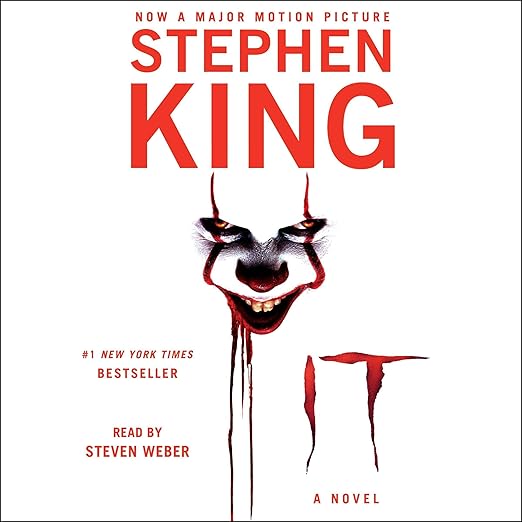
Derry sits at the center of Stephen King's map, a small Maine city where the haunting is not a metaphor, and this is the book where all of it begins. Seven people who fought something in the sewers as teenagers come back twenty-eight years later because children are dying again and a promise is a promise. The audiobook is forty-four hours and fifty-five minutes long in Steven Weber's reading for Simon and Schuster Audio, which makes it the longest commitment on most shelves and the better part of six working days of attention.
Derry Tackles Back Everyone Who Reads It
The Losers is what the most recent response calls the group, and it describes meeting them for the first time better than any blurb: a reader who knew King only through the films, was unimpressed by The Shining, decided to tackle this one and reports being tackled back. What makes the entry useful is what came afterwards, which was going back to look up details, re-reading individual scenes and sitting inside the atmosphere rather than moving on to the next book. Novels this size either evaporate or take up residence.
Sewers are where the thing lives, and the architecture is the reason the novel works. Two timelines run in parallel, one set of people, twenty-eight years apart, with each adult carrying a hole where the memory of that summer used to be until it comes back. The copy calls it an evil without a name, which is accurate and also the trick, because what the book is really about is what a town agrees not to notice. The crimes in Derry are municipal before they are supernatural.
Weber Must Voice Seven Kids and Adults
Weber has to be seven children, the same seven as adults, and the town surrounding them, across nearly forty-five hours, and nobody among the five written responses says a word about how that goes. The column is unanimous about the novel and silent about the recording, which is the most consequential gap on this listing, since the difference between a good reader and a poor one is measured in days at this length. Audition one chapter from the childhood timeline and one from the adult timeline before committing.
Forty-Four Hours Earn the Jedi Master Label
Forty-four hours intimidates more buyers than the plot ever does, and the India entry, from September 2019, speaks straight to that reader. It reports never having attempted a book of this size before, being genuinely frustrated through the early stretch, and then going deep enough to be unable to climb back out. That is the standard shape of the experience and the reason the runtime is a smaller obstacle than it appears. The first few hours are the entry fee, and the book collects it without apology.
Horror is the tag, and the oldest response explains why that label undersells the thing. Written by somebody fifteen years into reading King, it credits an extraordinary eye for detail, a strong sense of place and the patience to pay out a plot line slowly, then calls King the Jedi Master of creepiness. That entry also mentions having watched the 1990 television version long before opening the novel, which is how a large part of this audience arrives: knowing the shape of the story and none of its substance.
French Import Warns Buyers About English Text
France produced the strangest entry in this column, and it concerns something other than this recording. That five-star, filed in July 2020, praises the product as good quality at a more than affordable price, notes that the two volumes have been bound together into a single book, and warns other buyers, in French, that this edition is in English, which several people had apparently missed. A review of a physical import, written in another language, is sitting underneath an English-language audio listing.
Pages rather than hours are the unit everybody here counts. The Egypt entry, filed in June 2024, calls the book absolutely massive at twelve hundred pages and argues the bulk gets used rather than wasted, which is a print measurement applied to an audio product; the same entry describes growth in both main characters, where the copy counts seven. None of that makes these responses worthless. It does mean one page collects verdicts on paperbacks, imports and a recording under a single average, and only one of the three is on sale.
Simon and Schuster's description was written for readers as well. It addresses readers of Stephen King directly, points out that Derry recurs in Bag of Bones, Hearts in Atlantis and 11/22/63, and closes with a newspaper line advising that the book be read in a well-lit room only. All charming, and entirely untouched by the existence of a recording. Anyone trying to work out what the audio edition adds over a paperback gets no help: the description mentions no bonus material, no chapter apparatus and nothing about the reader.
Marathon Listeners Should Never Double the Speed
Marathon listeners are the obvious audience and they tend to know it: people who want a book to live inside for a month, who enjoy a story running two clocks at once, and who can hold seven names steady across forty-four hours without a cast list. Anyone who listens at double speed will finish sooner and lose the property that makes this work, which is accumulation. Derry gets under your skin through repetition, and repetition is the one thing enormous novels can afford.
Completists arriving from the films will find a book considerably larger than either of them, and the copy advertises Chapter One, Chapter Two and the HBO Max series set in Derry in its opening sentence, which tells you how much of this audience comes by screen. What nobody should do is treat forty-four hours as an evening horror listen, because the register sits closer to a town biography with a monster inside it than to scares delivered on a schedule. Buy it as a long novel, and the horror arrives on its own terms.
- Narration: Steven Weber is credited alone for seven children, the same seven as adults, and the town around all of them, across nearly forty-five hours.
- Themes: A town that agrees not to see, memory returning on schedule, childhood friendship as a weapon, an evil without a name.
- Mood: Immense, patient, genuinely frightening.
- Verdict: The runtime is the actual decision here; commit to it as a month-long novel rather than an evening horror listen and it repays the hours.
How long is the It audiobook, and how should I plan the listen?
Forty-four hours and fifty-five minutes, read by Steven Weber for Simon and Schuster Audio and released in January 2016. At an hour a day it is roughly a six-week project, and the two-timeline structure rewards steady listening rather than long gaps, because names and childhood details recur constantly.
How does It connect to other Stephen King books?
Through Derry itself. The copy notes that the town reappears across several of his novels, naming Bag of Bones, Hearts in Atlantis and 11/22/63, and states that all of it starts here. You can listen without having read any of them; the connection is a setting rather than a continuing plot.
Which screen versions does the listing reference?
The description names the films It: Chapter One and It: Chapter Two, and cites the HBO Max series It: Welcome to Derry as drawing inspiration from the novel. Those are marketing connections rather than contents, so nothing from the adaptations appears in this recording.
Is this audiobook abridged?
The record carries no abridgement label, and a runtime approaching forty-five hours is consistent with the complete novel rather than a shortened edition. Nothing in the description mentions cuts or condensation. If that matters to you, the runtime is the most reliable evidence the listing provides.