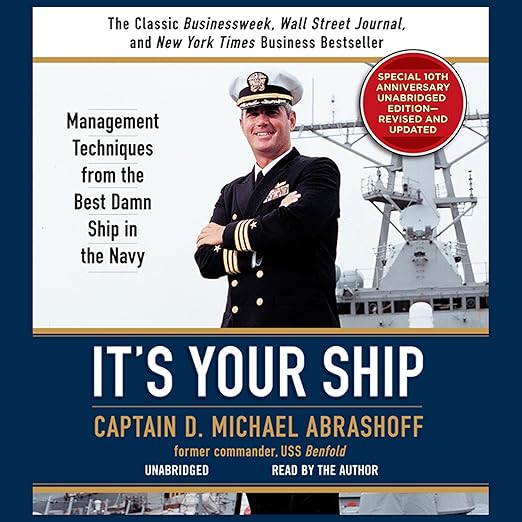
I had a colleague who kept a copy of It's Your Ship on her desk for years and cited it in almost every conversation about organizational change. I finally listened to it during a long stretch of travel, and I understood immediately why it had staying power. Captain Abrashoff tells his story with the unhurried confidence of someone who is not trying to sell you on a methodology. He is simply telling you what happened on USS Benfold and letting the outcomes speak for themselves.
The setup: Abrashoff takes command of a guided missile destroyer that is, by most metrics, underperforming. High reenlistment attrition, low crew morale, a culture shaped by top-down directives that leave sailors feeling like cogs rather than contributors. What Abrashoff does over the next two years becomes the basis for a book that has been required reading in MBA programs, military leadership courses, and corporate management training for more than two decades.
What D. Michael Abrashoff Delivers
The book's core insight is simple and consistently demonstrated: the people closest to a problem usually understand it better than leadership does, and most organizational waste comes from failing to ask them. Abrashoff describes soliciting one-on-one input from every sailor aboard, a process that felt almost heretical within a chain-of-command culture but produced immediate, measurable improvements. He reduced tedious, low-value maintenance tasks. He sent sailors to take college entrance exams forty miles off the Iraqi coast because they wanted to use the GI Bill and no one had ever thought to help them do it while deployed.
The chapter on communication, which describes how Abrashoff became known as Megaphone Mike for overcommunicating the ship's mission and rationale, is directly applicable outside the Navy. The argument that people execute better when they understand why, not just what, is not new, but Abrashoff supports it with specific results from a controlled environment that most management writers cannot claim.
What D. Michael Abrashoff Gets Right
The self-narration is the right choice for this material. Abrashoff's voice carries the dry humor and grounded confidence of someone who did the thing he is describing rather than observed it from a consulting distance. A German reviewer noted the book's authentic, personal style, and that quality is amplified in audio. When he describes the moment he realized he needed to change his own leadership before he could change his ship, it lands with a weight that the page version cannot fully carry.
At six and a half hours, the book is appropriately sized for its content. It does not pad. Every chapter closes a loop that earlier chapters opened, and the cumulative effect is a portrait of organizational transformation that feels earned rather than curated.
Where D. Michael Abrashoff Loses Some Ground
The military context is the book's greatest strength and its main limitation. The Navy is a hierarchical institution with clear metrics for success, fixed personnel, and a defined mission. That clarity makes the leadership principles easy to demonstrate but also makes them harder to translate directly into, say, a creative agency or a nonprofit with ambiguous success measures. One reviewer noted that readers without military background may need to work harder at the translation, and that is a fair assessment.
The book also reflects a particular era. Abrashoff commanded Benfold in the late 1990s, and some of the cultural references and communication technologies he describes feel dated. The principles are not, but occasional context requires updating.
Who Should Pick Up It's Your Ship
Leaders who are skeptical of management theory and respond better to documented case studies than to abstraction. Veterans entering civilian management roles, who will recognize the naval context immediately and may find the translation more natural than civilian readers do. Anyone who manages a team that is underperforming and suspects the problem is structural rather than individual. This is not a book for early-career professionals still learning the basics; it is a book for people who already lead and want to lead better.
A Few Questions About It's Your Ship
How does Abrashoff's self-narration affect the listening experience?
Significantly and positively. His voice carries the relaxed authority of the stories he is telling, and his delivery includes the kind of dry, self-aware humor that suggests he knows exactly how some of his early management mistakes sound in retrospect. A professional narrator reading the same text would produce a more polished audio product but a less authentic one.
Is It's Your Ship a good audiobook for a management team to listen to together?
Yes, particularly if the team is working through a culture change or trying to increase employee ownership. The specific examples provide useful reference points for shared discussion, and the six-hour runtime is manageable as a group listen spread over a few weeks.