Quick Take
- Narration: Bill Heavey reads his own material with the wry self-awareness of a man who has made peace with his own incompetence – the delivery is warm, unpolished in the best way, and entirely believable.
- Themes: foraging and self-sufficiency, suburban absurdity vs. wild instinct, the comedy of aspiration
- Mood: Laugh-out-loud and oddly moving, like a campfire story told by someone who almost burned the camp down
- Verdict: If you want a foraging memoir that is actually funny – not ‘charming’ funny but laugh-til-you-choke funny – Heavey delivers the real thing.
I found this one at the tail end of a summer when I had been half-heartedly tending a container garden on my apartment balcony. Two tomato plants, one persistent aphid colony, zero actual tomatoes. I hit play on Heavey’s audiobook somewhere around the time I threw out the second dead basil plant, and I did not stop until he was baking a pie from foraged wild cherries in a backyard he had systematically terrorized all season.
Bill Heavey is a longtime contributor to Field and Stream and knows his way around a hunting blind. What he does not know, at the start of this project, is how to grow a single vegetable without inviting squirrel-related catastrophe, how to forage mushrooms without first confirming they are not poisonous, or how to make cattail pancakes that anyone would voluntarily eat a second time. The gap between his competence in the field and his absolute bewilderment in the garden is the engine that drives this book, and it is a very good engine.
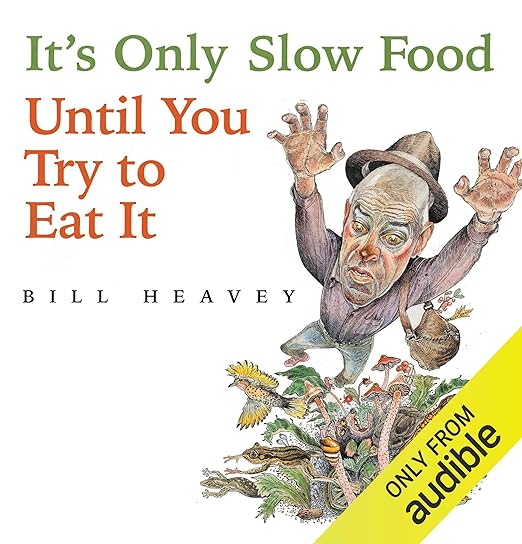
Our Take on It’s Only Slow Food Until You Try to Eat It
What makes this audiobook succeed where similar projects fail is Heavey’s refusal to arrive at easy conclusions. He does not end the book having conquered nature or discovered his inner pioneer. He ends it having caught some perch on the Potomac during what he calls abundance mania, having dug up his backyard and driven himself to squirrel murder in the process, and having eaten enough technically edible meals to understand why supermarkets exist. The self-deprecation is real rather than performed, and that makes the difference between a book you believe and a book you endure.
The cast of teachers he encounters is genuinely remarkable. Paula, the DC fisherwoman apparently known as the Pablo Escobar of herring, is a character who deserves her own memoir. Hue, a Bronze Star military survival instructor turned foraging expert, brings a quiet seriousness to the project that Heavey can never quite match. Michelle, a single mother who eats local with total unselfconsciousness, and Jody, a weathered Cajun fisherman, round out a group of people who are the opposite of what you would expect from a Washington-area foraging book. Heavey listens to all of them with genuine curiosity, and it shows.
Why Listen to It’s Only Slow Food Until You Try to Eat It
The author-narrator combination here is rarer than it sounds. Heavey reading his own material brings a kind of authenticity that a professional narrator, however skilled, could not manufacture. You can hear him remembering the misadventures as he recounts them, finding them still funny years later. One reviewer wrote that the Kindle fell onto their face more than once as they fought sleep to keep reading, and in audio that impulse translates into genuinely reluctant pauses at stopping points.
The recipes embedded at the end of each chapter are a nice structural touch. They range from practical to barely instructive to philosophically hilarious, and Heavey reads them with the same dry delivery he brings to the rest of the book. The recipe for cattail pancakes is perhaps the best argument for eating something else that I have ever encountered in audio form.
What to Watch For in It’s Only Slow Food Until You Try to Eat It
A few listeners expecting a tighter, more instructional foraging guide have noted that the chapters run long and that the book wanders. This is accurate and should be considered a feature rather than a bug if you value the company of a digressive, self-aware narrator. If you need systematic foraging guidance, there are better books for that. If you want the experience of following a curious, fallible person through northern Virginia, Louisiana, and Alaska as he tries to figure out what wild food actually tastes like before he gets back to the grocery store, Heavey is your guide.
The book covers an impressively wide geographic and ecological range for something rooted in suburban northern Virginia. The Potomac perch run, crayfish hunting in Louisiana, and caribou on the Alaskan tundra all appear without feeling forced or travelogue-ish. Heavey earns each location because each one is tied to something he genuinely needed to learn.
Who Should Listen to It’s Only Slow Food Until You Try to Eat It
This is the right book if you are a Field and Stream reader who wants to hear Heavey in longer form; if you enjoyed books like Michael Pollan’s The Omnivore’s Dilemma but wanted more squirrel-related slapstick; or if you are a failed container gardener with feelings about it. Readers who prefer a purer foraging how-to or who find self-deprecating humor wearing over nine hours may want to read reviews before committing. But anyone who has ever eaten something technically edible and deeply disappointing will recognize Heavey immediately.
Frequently Asked Questions
Does Bill Heavey narrating his own book work, or does it feel amateurish compared to professional audiobook narrators?
It works very well here. Heavey has a conversational, self-aware delivery that suits the material – this is a book about a man making a fool of himself, and hearing him recount it himself adds a layer of authenticity that a produced professional performance might smooth away. It is not a technically polished narration, but the rougher edges are part of what makes it believable.
Do I need to be interested in hunting and fishing to enjoy this book?
Not really. Multiple reviewers note that they came to the book without a hunting or fishing background and found it entirely accessible. The comedy of incompetence and the cast of eccentric teachers carry the book independently of any outdoor sports knowledge.
How practical is this as a foraging or gardening guide alongside the humor?
There are recipes at the end of each chapter, and Heavey does convey genuine information about wild watercress, pawpaws, mushrooms, and other forageable items within the beltway and beyond. But this is primarily a narrative memoir, not an instructional guide. Readers expecting systematic identification tips or growing advice should look elsewhere.
Is this a standalone audiobook or do I need to have listened to Heavey’s first book first?
It is entirely standalone. One reviewer notes it took some adjustment coming from Heavey’s shorter Field and Stream pieces, but the book introduces its own context fully and does not require knowledge of his previous work to follow or enjoy.