In Brief
- Performance: Megan Devine reads her own audiobook with calm authority and audible personal knowledge , her self-narration transforms the work in ways a hired narrator could not replicate.
- What it covers: Grief without a roadmap, the failure of cultural grief scripts, building a life alongside loss
- Feel: Honest, gentle, and quietly radical in its refusal to promise resolution
- Our call: A grief audiobook that prioritizes accuracy over comfort , essential for grieving people and those who love them.
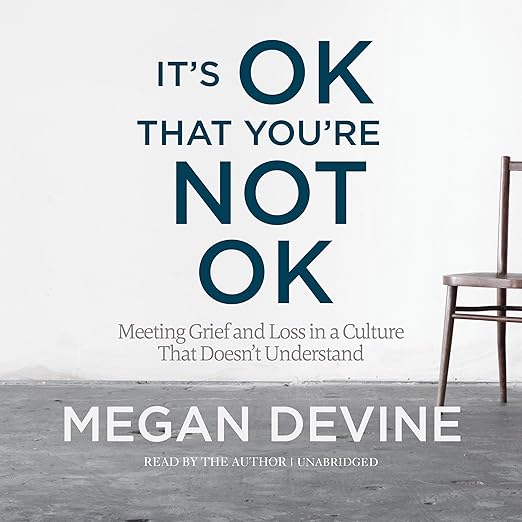
Megan Devine reads her own audiobook, and the choice reshapes It's OK That You're Not OK in ways that matter from the first chapter. Devine is a therapist who lost her partner to accidental drowning, which means she writes about grief from both sides of the clinical relationship , as someone trained to help others navigate loss and as someone who has been flattened by it. That dual positioning gives her authority that most grief books do not have, and hearing her narrate her own words adds a layer the text alone cannot fully convey. When she describes the moment she realized that all the well-meaning advice she had given clients over the years was wrong , or at least insufficient , the recognition in her voice is not performed. It is real.
The audiobook's central argument is one of the more useful things I have encountered in the grief genre: that the goal of 'getting back to normal' is not just unrealistic but actually harmful, and that the healthier path involves building a life alongside grief rather than treating it as a problem to be solved. Devine distinguishes between grief and the story we tell ourselves grief should look like, and that distinction , quiet but radical , runs through every section of the audiobook. She writes, 'Grief no more needs a solution than love needs a solution.' Hearing her say that rather than reading it gives it a different weight.
The Review
The audiobook works on multiple levels simultaneously, which is harder to achieve than it sounds. It speaks to people in acute grief , those who have recently lost someone and are being told they will feel better soon, they should eat something, they should try to sleep. It also speaks to the people surrounding the grieving: the friends and family who love someone in pain and keep saying the wrong things because the right things are so rarely modeled. And it speaks to anyone who wants to understand grief before they need that understanding, which Devine argues is a worthwhile form of preparation.
Devine debunks the stage model of grief not as a dismissal of Kübler-Ross but as a correction of how the stages are commonly applied. The stages were developed to describe how terminally ill people relate to their own deaths, not how the bereaved process the deaths of others. That distinction has been widely collapsed in popular understanding, and the result is a cultural script that leaves grieving people feeling defective for not moving through the stages in order. Devine dismantles this clearly and with clinical precision, and the relief that many listeners describe is the relief of being given accurate information about their own experience.
The mindfulness and creative practices included in the audiobook are practical rather than aspirational. She does not promise transformation. She offers specific tools , ways of managing sleep disruption, anxiety, and the physical toll of grief , that are grounded in what actually helps rather than what sounds helpful in theory. One reviewer described these sections as genuinely useful in getting through each day, and that modest but real claim is exactly what the audiobook aims for.
Why Listen to It's OK That You're Not OK
The self-narration is the primary reason to choose the audio format over the print edition. Devine's voice has a quality that is difficult to describe , calm without being distant, authoritative without being clinical. When she reads passages about the inadequacy of platitudes, you can hear the weariness behind the words, the years of watching those platitudes fail the people she cared for. That weariness is part of what makes her case so compelling. She is not a theorist arguing for a different approach to grief. She is someone who lived the difference between what grief looks like in the literature and what it looks like in a kitchen at 3am.
Several reviewers describe listening to this audiobook during their own grief, and the recurring description is one of being recognized. Not comforted in the conventional sense, but seen , told that what they were experiencing was not a failure of coping but an appropriate response to real loss. One reviewer, who had lost her son, wrote that no other grief book had resonated as accurately with her actual experience. That degree of recognition is not something a book achieves through polish. It requires the kind of honesty that Devine brings throughout.
The Caveats
The audiobook's approach may frustrate listeners looking for a clear recovery roadmap. Devine is explicitly skeptical of recovery narratives, and she does not provide a timeline or a set of sequential steps that lead from grief back to happiness. Her framework is more permissive than prescriptive, which is its strength but also a source of discomfort for listeners accustomed to self-help that organizes pain into manageable phases. If you are seeking reassurance that you will feel better by a specific date, this audiobook will not offer it.
At seven hours and nineteen minutes, the audiobook covers a substantial amount of ground, and some sections on the social dimensions of grief , why people say unhelpful things, how to communicate what you need , may feel less urgent if you are listening in deep personal loss rather than in anticipation of supporting someone else. The audiobook speaks to multiple audiences simultaneously and does not always prioritize them equally.
Should You Listen to It's OK That You're Not OK?
This audiobook belongs in the library of anyone who has experienced significant loss, anyone who loves someone currently grieving, and anyone who works in caregiving, counseling, or any field where they regularly sit with people in pain. Devine's self-narration makes it particularly powerful as an audio experience , this is one of those books where the format change from print to audio genuinely transforms the work. Listeners seeking a conventional comfort narrative, or a prescriptive step-by-step grief program, will find this audiobook more challenging and more honest than they might prefer. Those willing to sit with the complexity will find it one of the more accurate and useful things written on the subject.
Common Questions
Does Megan Devine narrating her own audiobook change the listening experience significantly?
Considerably. She speaks with the authority of both a clinician and someone who has experienced profound loss, and those two dimensions are audible simultaneously. Reviewers consistently describe a sense of recognition when listening , of being seen , that likely depends partly on hearing her voice rather than reading her words.
Is this audiobook appropriate to listen to during acute grief, or is it more useful as preparation?
Both. Reviewers describe finding it in the midst of loss and experiencing relief at having their experience accurately described. It also works as preparation , Devine argues that understanding grief before you need to is a form of care for yourself and others. The audiobook does not require you to be at a particular stage to be useful.
Does the It's OK That You're Not OK audiobook include the mindfulness exercises from the print edition?
Yes. The guided practices and mindfulness-based tools described in the text are included. Some exercises benefit from the audio format since they are designed to be listened to rather than read, though complex written reference material may be easier to engage with in the print or ebook version.
How does this audiobook differ from other grief books like The Year of Magical Thinking?
Devine's audiobook is more prescriptive and clinical than Didion's memoir , it draws on therapy practice and psychological research rather than personal narrative. Where Didion describes grief from the inside of the experience, Devine works to reframe how listeners understand and talk about grief, with practical tools alongside the theoretical reorientation.