
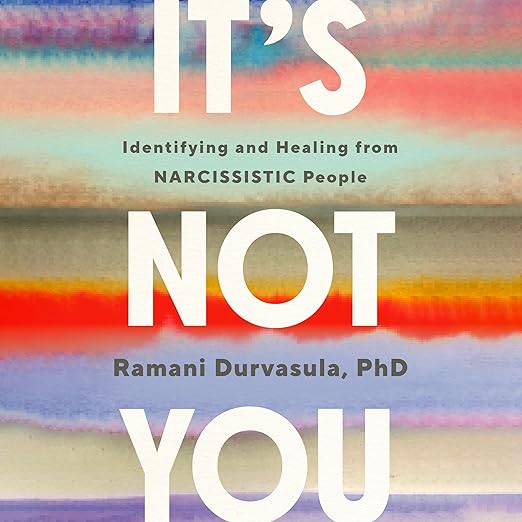
Skepticism about the word narcissist is now nearly as widespread as the word itself, and this audiobook has to get past that before it can do anything else. Ramani Durvasula spent more than two decades studying the territory and working with people who came out of it damaged, and the title is her whole argument compressed: whatever you did differently would not have mattered. Eleven and a half hours, read by the clinician who wrote them, published through Penguin Audio under Maria Shriver's Open Field imprint. The book reached the New York Times list on release, which for a work this technical is unusual.
Best endorsement here comes from someone who arrived hostile. That reader describes being 'very hesitant to jump on the trend of calling anyone who has mistreated me a narcissist,' rolling their eyes inwardly whenever the label got applied casually to an ex or a family member, and concluding that the word 'has been overly used and abused.' Then the review turns on itself. Being that dismissive, it says, led them to dismiss something real, and the sentence breaks off mid-word before naming what. That arc is the book's ideal reader in miniature, and it carries more weight than a dozen enthusiastic responses from people who arrived already convinced.
Durvasula earns that turn by being precise where popular writing on the subject is usually loose. She separates a personality style from a clinical diagnosis, insists the distinction matters, and declines to hand readers a checklist for labeling other people. The practical content sits in the second half: becoming resistant to gaslighting, chipping away at trauma bonds, grieving relationships that were painful rather than pretending they were not, and rebuilding a sense of self after long invalidation. She is candid that thriving during one of these relationships, not only after, is sometimes the only available option.
Eleven Hours of Taxonomy, Then Real Counsel
A Japanese-language entry accidentally supplies the sharpest possible description of what this book is. Rather than assessing it, that reader reproduces its architecture as a nested outline: the traits that define narcissism, a severity spectrum running from mild through moderate to severe, the several types the book distinguishes, the relationship between narcissism and a formal personality disorder, the neighboring conditions it sits alongside, and finally the mechanisms of harm. Part two, that outline notes, is recovery, and it occupies the whole back half.
Somebody had to sit down and rebuild that structure by hand in order to use it. Which is the honest case for and against this format at once. Heard straight through, the taxonomy passes by as a steady procession of categories, and eleven hours is long enough that the mild-moderate-severe distinctions blur unless you are taking notes. Heard as intended, with the recovery half doing the work, it functions beautifully, because Durvasula's tone in the second part is closer to counsel than to lecture, and counsel is exactly the thing that benefits from a voice.
Credibility matters more than usual in this corner of the market, which is worth saying plainly. Narcissism has become one of the most heavily monetized subjects in popular psychology, and a great deal of what gets published on it is written by people with no clinical training and no accountability for the harm a bad framework can do to someone already destabilized. Durvasula is a practicing psychologist who has spent decades on precisely this population, and the book was acquired by a major trade house rather than self-issued. Neither fact guarantees the argument is right. Both mean the argument was checked by somebody before it reached you, which in this genre is not a given.
This Listing's Title Is Missing Its Subtitle
Note first that the title on this listing is incomplete. One response quotes the full version, It's Not You: Identifying and Healing from Narcissistic People, and that subtitle carries real information about scope, which the bare three words do not. The same reader calls the book 'a comprehensive and compassionate guide' whose expertise 'shines through every page,' praise aimed squarely at a printed object, and the pattern holds across most of the column: this is a text whose reputation was built by readers rather than listeners.
Scope creep is the second hazard, and it belongs to the genre rather than to this book. Material about recognizing narcissistic patterns can slide easily into diagnosing everyone who has ever been unkind, and a listener without a printed page to slow them down is more exposed to that drift than a reader is. Durvasula guards against it repeatedly in the text. Whether the guard survives a distracted listen depends entirely on how you use it, and the book cannot control that.
Those Currently Inside a Relationship They Can't Name
Those currently inside a relationship they cannot name properly are the core audience, and the book is unusually good at reaching them without demanding they leave first. The reach shows in where the responses come from. One arrives in Italian, from a reader who wants the book translated so it can be recommended beyond psychology professionals and survivors to the general population, calling it a rigorous instrument against the damage caused by people with narcissistic and dark-triad traits. Another, filed from South Africa, recommends it for anyone on a healing journey after or during such a relationship. Neither audience needed a clinical background to get something out of it.
Approach with caution if you want a book about how to change the other person, since Durvasula states plainly that this is not available and builds her whole framework on accepting it. Listeners wanting a quick reference will also be frustrated, because the categories that make the first half valuable are the hardest part to retrieve later without a text to open. Came for neutral academic distance? It takes the side of the harmed party throughout and never pretends to do otherwise, which is a legitimate editorial choice and a real limitation at the same time.
Good to Know
Why is the title on this audiobook shorter than the printed edition?
The listing shows only the main title. The complete version adds a subtitle about identifying and healing from narcissistic people, which tells a buyer considerably more about what the book actually does. The recording itself is the full work, so the truncation is a catalog problem rather than an abridged edition.
Does this audiobook assume the narcissist in your life has been diagnosed?
No, and Durvasula is deliberate about it. She treats narcissism as a personality style that exists on a spectrum rather than as a diagnosis you need a clinician to confirm, which lets the book stay useful for people describing a parent, partner, or manager who will never sit in a psychologist's office.







