Before You Press Play
- Performance: Julie Taylor reads her own memoir with genuine warmth and occasional self-deprecating humor, the intimacy of a personal narrator works well for a story this candid about faith and doubt.
- What it covers: faith transitions and re-entry, grief as a spiritual catalyst, the neuroscience of belief
- Feel: Vulnerable and conversational, with flashes of humor
- Our call: A compact, honest account of one woman's back-and-forth with belief that will resonate most strongly with listeners navigating their own messy middle.
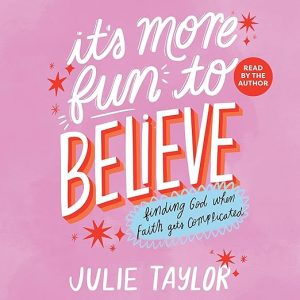
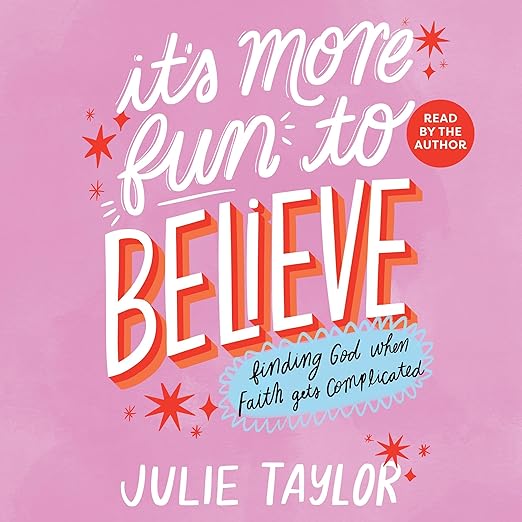
There are a lot of books about leaving faith. There are also a lot of books about finding it. Books about the repeated, uncertain journey between the two, leaving, returning on different terms, leaving again, and eventually arriving somewhere you hadn't planned, are considerably rarer. Julie Taylor's memoir sits in that narrower and more honest category, and at four hours it delivers its perspective without the inflation that sinks many spiritual memoirs.
I listened on an afternoon when I had been thinking about a friend going through her own faith transition, the specific ache of feeling that you no longer fit a belief system that once structured your entire life. Taylor's book doesn't resolve that ache, but it describes it with enough specificity that I felt less alone listening to it, and I imagine listeners who are in the middle of that process will feel the same.
Belief as a Chosen Engagement with Doubt
Taylor frames her journey not as a conversion narrative but as a long negotiation with uncertainty. The title itself carries the book's central argument: she comes to understand belief not as certainty or self-deception, but as a chosen engagement with questions that have no clean answer. That framing is more philosophically interesting than the usual faith-memoir binary, and Taylor earns it through her willingness to document the failure modes of both her skepticism and her belief, the cynicism that calcified into a closed system, and the religious community that demanded conformity she couldn't give.
The science element is real rather than decorative. Taylor draws on neuroscience to explain how belief acts as a gatekeeper for how we process experience, and she does this accessibly, she's not a scientist and doesn't pretend to be, but she uses the framework honestly to make sense of why her doubts felt so destabilizing at the cellular level, not just the theological one. Listeners who find the science of religious experience interesting, the work of Andrew Newberg or William James in a more personal register, will recognize the genre she's working in.
Returning to Belief While Keeping Every Doubt
The memoir's greatest strength is Taylor's refusal to resolve the tension cleanly. She returns to belief, but she returns having kept her doubts. The book's subtitle frames this as learning to "sit in uncertainty," and the text earns that language rather than using it as a platitude. She documents specific moments of doubt, the questions she describes: "I don't fit in this faith box anymore," "Can I believe without dismissing all my doubts?", not as rhetorical gestures but as the actual texture of her experience.
The grief dimension adds unexpected depth. Taylor is navigating not just intellectual doubt but losses that make the traditional consolations of faith feel both necessary and insufficient. The book is as much about grief as it is about religion, and that dual subject matter gives it more emotional range than a purely theological memoir would have.
Four Hours That Rush the Skeptic Years
The four-hour runtime is both the book's accessibility and its limitation. Taylor covers significant ground quickly, the childhood faith, the departure, the grief, the science, the return, and some listeners will wish for more development in the middle section where she describes the actual texture of her "cynical skeptic" phase. What led her to that position, and what exactly made it insufficient, is described rather than dramatized. The book tells more than it shows in places, which is a memoir-craft limitation rather than an emotional one.
The audience for this book is also fairly specific. It was published by Shadow Mountain Publishing, which has strong roots in Latter-day Saint literary culture, and while the book is not exclusively addressed to that tradition, listeners coming from very different faith backgrounds or no faith background at all may find some of the return-to-belief framing less resonant. Taylor is writing from inside a specific religious culture even when she is questioning it, and that context shapes the questions she asks.
For Anyone Mid-Transition in Their Faith
This one is for listeners who are actively navigating their own relationship with religious belief, those who have left, are leaving, or have returned with qualifications. It's also genuinely useful for people who love someone going through a faith transition and want to understand the experience from the inside. The humor Taylor brings to her own spiritual "ping-pong match" makes the book more accessible than its subject matter might suggest. Those looking for rigorous theological argument or scientific analysis will want to calibrate their expectations, this is personal memoir that uses science and faith as reference points, not a study of either.
Before You Listen
How does Julie Taylor incorporate neuroscience into a personal memoir?
Taylor uses findings from neuroscience, particularly around how belief shapes cognitive processing, as a framework for understanding her own emotional and spiritual experience. It's applied and accessible rather than technical. The science serves the personal narrative rather than competing with it.
Is this book appropriate for someone who has left faith entirely and has no intention of returning?
Taylor's journey includes a return to belief, and her ultimate framing is that choosing to believe (on one's own terms and with one's doubts intact) is meaningful. Listeners who are firmly settled in nonbelief may find the book's resolution less personally resonant, though the grief and doubt sections are broadly applicable.
Does the author-narrator format work well for this kind of intimate memoir?
Yes, Taylor's self-narration carries the vulnerability the book requires. A professional narrator reading this material would create more distance from the subject than the memoir's conversational register calls for. The four-hour format also means the intimacy doesn't overstay its welcome.