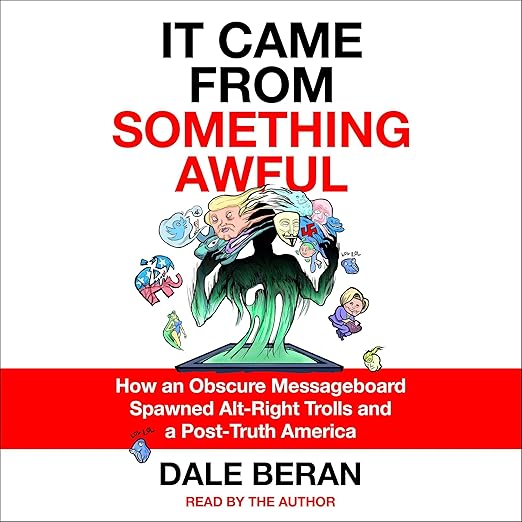
Quick Take
- Narration: Dale Beran reading his own work brings an insider’s controlled unease to the material, a voice that knows what it is describing from the inside without aestheticizing it.
- Themes: Internet subculture radicalization, disenfranchised male identity politics, the meme as political weapon
- Mood: Unsettling and intellectually absorbing, like reading a field notes journal from a strange country you half-recognize
- Verdict: The most thorough audio account of how 4chan became a political force, told by someone who was there and has the analytical distance to explain what he witnessed.
I listened to most of It Came from Something Awful during a week when the news cycle was generating exactly the kind of content the book describes: outrage loops, meme-accelerated political positions, and language migrating from fringe forums into mainstream political speech without most of the people using it knowing where it came from. The timing was clarifying. Beran’s account felt less like history and more like diagnosis.
Dale Beran has observed 4chan since its early years, and this is not a book written from the outside looking in with anthropological detachment. His relationship to the material is more complicated and more honest than that. He describes the site as a microcosm of the internet itself, simultaneously at the vanguard of contemporary culture, politics, comedy, and language, and a new low for all of the above. That dual register captures something essential: you cannot understand what 4chan became by treating it only as pathology. It had to mean something to a lot of people first.
From Rage Comics to Occupy to the Alt-Right
The arc Beran traces is genuinely surprising if you only know the endpoint. In the late 2000s, as the recession hollowed out economic prospects for a generation of young men, the same imageboard that became associated with the alt-right was also the online hub of the leftist hacker collective Anonymous and a prominent supporter of Occupy Wall Street. Understanding this pivot matters for understanding both the movement and the failure of progressive politics to hold that energy. Beran’s insider knowledge allows him to trace not just what happened but why the transition felt coherent to people living through it: the nihilism was constant, what changed was which target it found most satisfying.
The semi-legendary figures Beran profiles, including Topiary, tflow, Anachaos, and Sabu, emerge as something more dimensional than either hero or villain. One reviewer described this as the first book to make them feel genuinely old, which is an interesting response to a book that is fundamentally about youth culture and the way institutions fail to notice it until it has already shaped something consequential. That recognition, that this was not noise but signal, arrives too late for most adults, and Beran’s achievement is making the signal legible in retrospect.
The Meme as Political Infrastructure
The book’s most enduring contribution may be its account of how memes function as political communication. Beran traces the process through which 4chan’s culture transformed emotionally resonant images into a distributed propaganda system, one that operated outside the norms of journalistic fact-checking or political discourse precisely because it was never making explicit truth claims. Pepe the Frog, Wojak, and the various ironic deployment strategies that surrounded them were not incidental to the political outcomes Beran describes; they were load-bearing infrastructure.
This section of the book is where Beran’s background as both participant and analyst pays off most clearly. He can explain the internal joke logic well enough that readers who were never on 4chan can understand why the content landed the way it did for people who were. That explanatory bridge is not condescension; it is the work of a writer who understands his audience.
Self-Narration as the Right Call
Beran reading his own book matters here. The material has a quality of personal reckoning that a professional narrator could technically reproduce but would almost certainly flatten. When he describes what it was like to watch a community he knew transform from outsider irony into something with genuine political consequences, the specificity of that experience is audible in his delivery. He does not perform regret or alarm; he reads with the equanimity of someone who has thought through what he witnessed carefully enough to explain it, and that restraint is more effective than either outrage or nostalgia would be.
Who Should Listen and Who Might Struggle
Ideal for: anyone trying to understand the cultural origins of contemporary online political culture, media scholars and journalists covering internet radicalization, and readers who found themselves unexpectedly influenced by meme-native politics without quite understanding how. The writing is analytical without being academic, and the 10-hour runtime develops the argument at a pace that rewards full engagement rather than background listening. Those who want a strictly chronological news summary of specific political events may find Beran’s more interpretive approach less satisfying, but the interpretive work is exactly what makes this book valuable.
Frequently Asked Questions
Do you need to have used 4chan or know its culture to follow this book?
No. Beran builds the necessary context as the narrative develops, explaining terminology, format conventions, and cultural reference points without assuming prior familiarity. He bridges the insider and outsider perspectives explicitly, which is one of the book’s structural strengths.
Does the book cover Anonymous and Occupy Wall Street in depth, or does it skip quickly to the alt-right material?
Both are covered substantively. The Anonymous hacker collective period and the Occupy support are actually central to Beran’s argument about how the site’s ideology shifted, and he spends significant time on these before tracing the pivot to the alt-right. Understanding the leftist phase is essential to understanding why the transition felt coherent internally.
Is Dale Beran a participant in 4chan culture, a journalist covering it, or something between?
Something between. Beran has observed the site since its early years with genuine insider familiarity, but the book is analytical rather than confessional. He uses his insider knowledge to explain cultural logic that outsiders would miss, while maintaining the critical perspective of someone who has thought carefully about what he witnessed.
How does It Came from Something Awful compare to other books on internet radicalization and the alt-right?
Beran’s book is distinguished by its cultural depth and its refusal to treat the alt-right as having appeared from nowhere. By tracing 4chan back to its origins and through the Anonymous and Occupy period, he provides historical context that most alt-right analyses skip. Reviewers have described it as the most thorough account of 4chan’s cultural and political trajectory available in any format.