Trust-Driven Performance Needs Deliberate Architecture
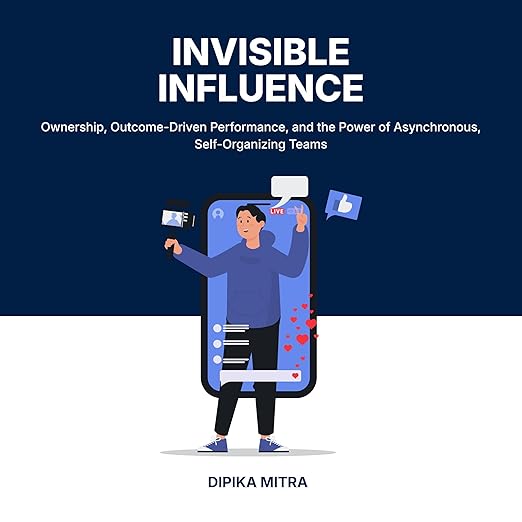
Dipika Mitra's Invisible Influence opens from a specific cultural diagnosis: in an era of digital dashboards, activity trackers, and relentless visibility, leadership has been mistaken for supervision. This is not a novel observation in management literature, but Mitra pursues it with more structural rigor than most books under two hours can sustain. Narrated by Gordon Webster across seventy-three minutes, this audiobook makes a case not just against micromanagement as a bad habit but against surveillance as an organizational design principle, and it proposes a coherent alternative framework built around systems, culture, and intentional design rather than oversight and presence.
The central argument Mitra is making will be familiar in outline to readers of Daniel Pink on intrinsic motivation or Cal Newport on deep work: excessive monitoring destroys the conditions required for meaningful contribution, replacing actual engagement with performative busyness. What distinguishes Invisible Influence from comparable titles is the specificity of the alternative it proposes. Mitra is not simply arguing that leaders should trust their teams and step back into a vague stance of confidence. She is arguing that trust-driven performance requires deliberate architecture: shared metrics, aligned objectives, feedback loops designed for self-correction, and a communication culture that protects rather than interrupts focused work. The framework has practical teeth that many philosophical treatments of this territory lack.
Webster's Calm Tone Matches a Book About Noise
Webster's narration is a genuine asset for this material. Mitra writes in a register that is analytical and precise, and Webster delivers the content with the calm, considered tone of someone who has thought carefully about what he is saying rather than performing enthusiasm for it. This matters for a book whose central argument is about reducing noise and increasing clarity in professional environments. A narrator who brought performative energy to this text would be tonally incoherent with its message. Webster does not make that mistake, and the result is a listening experience that feels genuinely aligned with the book's philosophy rather than at odds with it.
The asynchronous communication chapter is the section most likely to generate immediate practical application for listeners in knowledge-work environments. Mitra's argument here is that most organizational communication defaults are interruption-based not because they are more effective but because they are more visible, and that visibility is what managers in surveillance cultures have learned to reward. Shifting to documentation-first workflows, protecting focused time blocks, and treating meetings as purposeful rather than habitual requires changing what leaders notice and reward, and Mitra gives a practical account of how that shift begins to happen at the individual and team level. This is not a remote work guide, though the content is obviously relevant to distributed teams, but a deeper examination of why synchronous and interruptive communication became default practice and what it costs in attention, quality, and motivation.
Feedback Loops Are a Sharper Kind of Accountability
The outcome-driven performance framework at the heart of the book carries a specific practical implication that Mitra makes explicit: defining success by value delivered rather than hours logged requires that leaders get significantly clearer about what value means in their specific context. This is harder than it sounds and Mitra acknowledges this difficulty rather than papering over it. In many organizational contexts, hours and activity are visible and measurable while genuine contribution is diffuse and difficult to quantify. The sections on building shared metrics and defining clear objectives engage with the work required to make outcome-based accountability function rather than assuming the translation from intention to practice is straightforward.
The book's discussion of accountability is one of its more nuanced passages. There is a version of the trust-based leadership argument that slides into an abdication of accountability, where the critique of surveillance becomes a cover for reduced standards and a tolerance for poor performance dressed up as autonomy. Mitra explicitly resists this. The feedback loops and self-management frameworks she describes are not alternatives to accountability; they are more sophisticated mechanisms for producing it than constant oversight. Listeners managing teams that have previously operated under close supervision will find this section practically useful, as it addresses the specific challenge of building self-correcting accountability systems in environments where the infrastructure for them does not yet exist.
At seventy-three minutes, Invisible Influence is a genuine listen rather than an extended executive summary. Mitra uses the time for argument and application rather than motivational scaffolding, and the result is a business audiobook that respects both the listener's time and intelligence. Listeners who want more depth on any specific framework will need to go further, but the book is honest about its scope and does not oversell what the runtime can deliver.
A Conceptual Framework, Not a Step-by-Step Playbook
Managers and leaders in knowledge-work environments who have noticed the gap between activity metrics and actual team performance will find the clearest practical value here, particularly those managing distributed or hybrid teams where the temptation to substitute visibility metrics for genuine accountability is strongest. The book is also relevant for individual contributors who want to understand the design principles behind high-trust organizational cultures and who need language to advocate for them effectively. Those looking for detailed implementation guides with step-by-step tools for building asynchronous workflows will need additional resources; Invisible Influence is a conceptual framework with practical illustrations rather than a project management playbook. Listeners who believe closer monitoring genuinely produces better outcomes in their context will not find their view challenged here with the depth of counterargument a genuine skeptic might require.