Quick Take
- Narration: Aiden Humphreys handles the blend of financial and technical language comfortably, maintaining clarity through the Python-specific sections without sounding like he is reading code aloud.
- Themes: Algorithmic investing, Python-based financial analysis, data-driven portfolio strategy
- Mood: Practical and encouraging, like a knowledgeable colleague explaining a domain crossover you have been curious about
- Verdict: Stefan Papp has written the financial audiobook for programmers that most financial audiobooks claim to be but are not, combining genuine investment fundamentals with code-first methodology in a way that respects both disciplines.
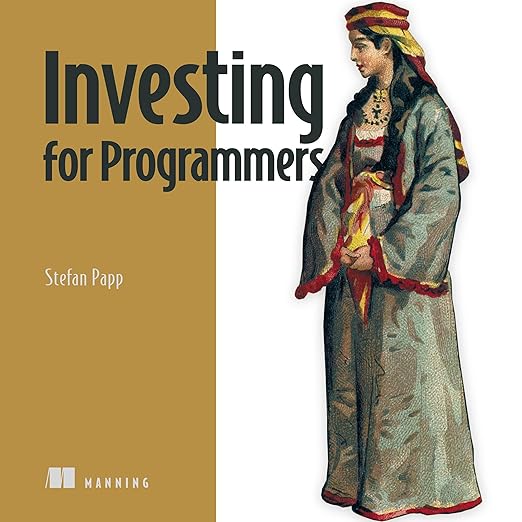
I picked this one up on a Saturday morning with low expectations. Books that promise to fuse two complex domains, programming and investing, usually end up doing justice to neither. They either condescend to the programmer about finance or condescend to the investor about code, and in both cases the person most likely to benefit is the one who already knows enough to know what has been oversimplified. Investing for Programmers by Stefan Papp does something meaningfully different, and I want to explain why that surprised me.
Papp’s background as both a data engineer and an algorithmic investor for over two decades is not incidental to the book’s success. It shapes the entire epistemological approach. He is not a financial writer who has learned to speak Python, or a programmer who has read a few investing books. He has lived both domains professionally, and that shows in the way he frames problems. When he describes market sentiment analysis using media data mining, he is not gesturing at the concept. He is explaining a real workflow with the same precision he would bring to explaining a data pipeline architecture.
Where the Python Actually Shows Up
The book’s commitment to tools like Pandas, NumPy, and Matplotlib is genuine rather than decorative. Papp walks through how these libraries apply to actual financial tasks: dissecting stock market data, building forecasting models, and automating elements of investment research using AI agents and LLMs. For a programmer with Python experience, the sections on building stock analysis tools and connecting to trading APIs will feel like familiar territory entered from an unfamiliar angle, which is exactly the productive discomfort that makes learning efficient.
One reviewer noted the book requires Python competence plus basic personal finance experience to get full value, and that is accurate. The book’s stated audience is professional and hobbyist Python programmers with basic personal finance experience, and Papp respects that stated audience by not padding the material with elementary explanations of what a stock is. The financial fundamentals section is enough to orient a programmer who has thought casually about investing but has never formally studied it. It is not enough to substitute for an introductory finance course if you have never engaged with those concepts at all.
The Risk Management Architecture
The section on systematic risk management is the book’s most underrated component. Most investment books for non-specialists treat risk as a philosophical caveat rather than an engineering problem. Papp treats it as the latter, framing risk management in terms of system design principles that programmers already apply in other contexts: redundancy, failure modes, circuit breakers. That framing is not a metaphor. It is a genuine structural parallel between how you build reliable software and how you design a portfolio that does not catastrophically fail under specific conditions. That chapter alone justifies the listen for many readers.
The sections on algorithmic trading strategies are more speculative in their claims, as they must be given the nature of the domain. Papp is appropriately careful here. He distinguishes between backtested performance and live market behavior, and he avoids the overconfidence that characterizes lesser books in this space. The promise in the synopsis that there is no dodgy financial advice or flimsy get-rich-quick schemes holds up throughout the text.
What the PDF Companion Adds
Like most code-adjacent audiobooks, Investing for Programmers includes a PDF companion, and like most such companions, it matters. The code examples and model architectures narrated in audio gain significant clarity when you can see them on a screen. Humphreys’ narration handles Python syntax and function names without making them awkward in audio, which is not a given in technical audiobooks, but the PDF is still the better reference for anything you intend to implement rather than simply understand conceptually.
At nearly fourteen hours, the book is longer than it needs to be in a few places, particularly in the earlier financial fundamentals sections where Papp occasionally over-explains concepts that his stated audience already handles. But the payoff in the more advanced chapters on AI-enhanced research and algorithmic strategy design is worth the investment of time.
Who Should Listen, Who Should Skip
Listen if you are a working Python programmer who has been curious about applying your analytical skills to your own portfolio decisions but has not known where to start. Listen if you have enough investing basics to engage with concepts like ETFs, portfolio allocation, and basic market mechanics. Skip if you have no Python background and expect to follow the code-specific sections without significant additional study. Skip if you are looking for a general personal finance audiobook. This is a specialty title, and its value is specific to the audience it serves.
Frequently Asked Questions
Do I need to know machine learning to follow the AI and predictive modeling sections?
Basic familiarity with machine learning concepts is helpful but not strictly required. Papp explains the relevant ML techniques in accessible terms, though reviewers note that prior exposure to Python libraries like Pandas, NumPy, and Matplotlib will determine how much you get from the implementation details. The AI agent sections assume comfort with LLM basics but do not require deep ML expertise.
Is this a general personal finance audiobook or genuinely technical?
It is genuinely technical and specifically targets Python programmers. If you are looking for a general investing introduction, books like The Little Book of Common Sense Investing will serve you better. Investing for Programmers is built around the premise that programmers learn best by building things, and it treats financial analysis as a software engineering problem throughout.
How does Aiden Humphreys handle the Python-specific narration?
Humphreys navigates the technical language cleanly. He does not stumble through function names or library references, which is a real risk in this type of audiobook. The narration remains accessible through the more code-dense passages. That said, any section featuring actual code examples is better experienced through the accompanying PDF than through audio alone.
Stefan Papp claims 20 years of investment experience. Does that authority come through in the content, or does the book read like a technical tutorial?
The practitioner experience is visible throughout, most notably in the risk management sections and the discussions of algorithmic strategy limitations. Papp avoids overpromising on backtested results and consistently frames investment decisions in terms of systematic risk rather than optimization for maximum return. That grounding in real-world experience distinguishes it from books written by academic researchers or pure programming instructors.