- Narration: Virtual Voice narration handles the text competently but struggles to differentiate four distinct characters across 77 hours; the prose carries the weight the delivery cannot.
- Themes: Alien invasion, multiverse consequences, ensemble survival under impossible odds
- Mood: Dark and relentlessly propulsive, zero comedic relief by design
- Verdict: An ambitious multiverse military SF epic that rewards patient genre fans willing to commit to the full boxset and accept the limitations of AI narration.
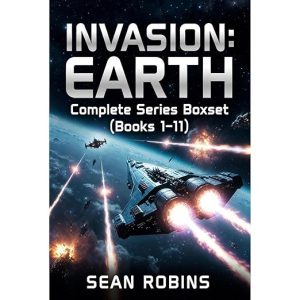
Seventy-seven hours of science fiction about alien war, fractured timelines, and a multiverse coming apart at the seams: the INVASION: EARTH Complete Series Boxset by Sean Robins is a serious commitment, and the author's note prepares you for it honestly. Robins flags upfront that this eleven-book series is a dark, gritty reboot of his earlier Crimson Deathbringer comedy series, and he makes clear that listeners who came for the laughs are at the wrong door. That transparency is rare in boxset packaging, and it tells you something about how Robins has approached the rebuild. As an audiobook experience, this series is not trying to be everything to everyone.
The Virtual Voice narration delivers the text without ornamentation. For a series this long and this action-dense, AI narration creates a particular challenge: seventy-seven hours without the texture of a human performer's vocal range means the emotional modulation has to come almost entirely from the prose. Robins's writing bears that weight reasonably well in the action sequences, less so in the character work, where a skilled narrator would typically add the dimension the page can only suggest.
Our Take on INVASION: EARTH Complete Series Boxset (Books 1-11)
The premise is structured for maximum scope. The Xortaag armada, which has never lost a war, arrives at Earth's orbit, and the response falls to four people who have no business saving the world: a pilot who quotes movies and courts disaster, a stuntwoman who treats danger as a hobby, an assassin defined by body count rather than personality, and a paranoid cosmic spymaster who trusts no one. The ensemble reads like a deliberate subversion of the competent-hero model, and Robins leans into that discomfort by sending the group not just through one war but through wormholes, broken timelines, and colliding alternate universes where every decision echoes across multiple versions of Earth.
The multiverse structure is the series' most ambitious element and also its most demanding one. Eleven books of escalating alternate-reality stakes require a listener who is genuinely invested in tracking which version of events is operative at any given moment. Robins builds the complexity incrementally across the early volumes, but the accumulation by the later books is substantial. For listeners who find that kind of layered consequence satisfying, the payoff is real. For those who prefer more contained narrative, the scale will feel unwieldy well before the midpoint.
Why Listen to INVASION: EARTH Complete Series Boxset (Books 1-11)
The comparison points Robins names, Star Wars, Battlestar Galactica, and The Expanse, are useful calibrations. This is space opera with military science fiction texture, less interested in hard-science plausibility than in the experience of war across impossible distances and fractured realities. Battlestar Galactica fans who respond to ensemble casts under sustained existential pressure will find the tonal register familiar even if the execution is looser. Expanse readers who want something faster and less clinical will also find their footing here.
The author's decision to rebuild the Crimson Deathbringer world from comedy to serious science fiction is also worth noting as a structural choice. The underlying story architecture was designed for humor, and Robins has had to reconfigure it for weight. That reconfiguration is more successful in some volumes than others. The early books, where the alien threat is being established and the team is being assembled, feel more controlled. The middle volumes, where the multiverse complexity accumulates, occasionally strain the seriousness the author is reaching for.
What to Watch For in INVASION: EARTH Complete Series Boxset (Books 1-11)
The Virtual Voice narration across seventy-seven hours is the most significant practical consideration here. An AI narrator is not well positioned to differentiate four distinct characters across that runtime, and the absence of vocal personality makes the ensemble harder to track aurally than it would be in print. Listeners who are already comfortable with AI narration for long-form genre fiction will adapt. Those who find Virtual Voice narration a barrier in shorter formats should treat this as a significant caveat before investing the time.
The series is also explicitly dark and gritty in a way the author's note foregrounds. Violence, moral compromise, and consequence feature heavily. The humor that made the Crimson Deathbringer series distinctive has been deliberately stripped out, and the replacement is a harder, less forgiving version of the same universe. Listeners who want any comedy relief across the full eighty-hour runtime should know they will not find it here.
The ensemble structure is also worth discussing separately from the multiverse mechanics. Robins has written four protagonists who are each defined by a specific dysfunction: the pilot's death wish, the stuntwoman's compulsive risk-taking, the assassin's emotional absence, the spymaster's pathological distrust. That collection of damage is what the series asks readers to follow across eleven volumes and multiple fractured realities. Whether the Virtual Voice narration can make those individual dysfunctions audibly distinct over seventy-seven hours is a real question; it probably cannot. But the character architecture is more interesting than the standard ensemble, and listeners who engage with it as read text will find more texture than the AI delivery can convey.
Who Should Listen to INVASION: EARTH Complete Series Boxset (Books 1-11)
Committed fans of multiverse military science fiction who want a long-form series with escalating stakes and are comfortable with Virtual Voice narration will get the most from this boxset. Listeners who want to sample the writing before committing seventy-seven hours should look for the first individual Invasion: Earth volume first. Those who came for Robins's comedy from the Crimson Deathbringer series should heed the author's own warning: this is a fundamentally different audiobook with a fundamentally different purpose, and the tone shift is not gradual.
Do you need to read the Crimson Deathbringer series before listening to this audiobook boxset?
No. Robins designed INVASION: EARTH as a standalone dark reboot of that world. The author's note explicitly addresses this: familiarity with the comedy series may create tonal expectations the boxset actively subverts.
How does the Virtual Voice narration perform across 77 hours of this audiobook?
The AI narration is consistent and intelligible but lacks the vocal range to distinguish four main characters across a long runtime. It works better during action sequences than during character-driven passages where tonal differentiation matters most.
What science fiction series is this audiobook closest to in tone and style?
Robins compares it to Star Wars, Battlestar Galactica, and The Expanse. The tone sits closest to Battlestar Galactica: ensemble cast, sustained existential threat, moral compromise under pressure, and no easy victories.