Before You Press Play
- Performance: Don Hagen delivers with the steady, measured authority the subject demands, conveying the weight of combat without melodrama.
- What it covers: Naval aviation and warfare in the Pacific Theater, survival and guerrilla resistance, the human cost of combat
- Feel: Gripping and immersive, with genuine emotional weight
- Our call: An exceptional piece of military history that earns its sixteen-hour length through meticulous detail and a deeply personal narrative thread.
I started listening to Intrepid Aviators on a Sunday afternoon intending to get through a chapter or two before dinner. I was still listening at eleven that night, sitting in the kitchen because I did not want to stop. That does not happen often with military history, a genre I read and listen to with genuine attention but rarely with that quality of sustained absorption. Gregory G. Fletcher has written something unusual here: a book with the research density of serious scholarship and the narrative pull of a story told by someone who needed to tell it.
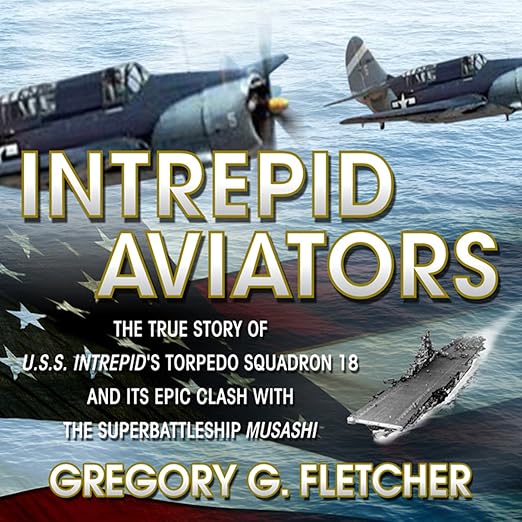
The book centers on VT-18, a torpedo bomber squadron based on the USS Intrepid, and specifically on the morning of October 24, 1944, when six young pilots departed to attack the Musashi, one of the largest battleships ever built. The Musashi was the pride of the Imperial Japanese Navy and the centerpiece of the enormous fleet converging on Leyte Gulf in what would become the greatest naval battle in history. Fletcher tells this story with granular precision: the mechanics of flying a TBF Avenger, the specific tactics of coordinated torpedo runs against a heavily armed capital ship, the terrifying calculus of anti-aircraft fire from a vessel with dozens of gun mounts. Two bomber crews were shot down in the first wave. Only Will Fletcher survived.
Will Fletcher is the author's father, and that relationship gives the book its emotional core. Gregory Fletcher grew up to be a Navy carrier pilot himself, and his technical knowledge of the aircraft, the carrier operations, and the physics of combat aviation shines throughout. But it is his access to his father's memories and the weight of that inheritance that separates this from a competent operational history. He is not reconstructing events from archival documents alone; he is trying to understand what it was like to be nineteen years old and adrift in the Sibuyan Sea after being shot out of the sky, trying to make it to shore, trying not to die in a jungle while also not getting captured by the Japanese.
Reviewer Dan, who identified himself as a World War II historian, called it one of the absolute best first-person accounts of the Pacific Theater he had ever read, and said it would make an incredible movie. I am inclined to agree on both counts. The guerrilla survival section, covering Will Fletcher's time with Filipino resistance fighters after reaching land, reads almost like a separate book embedded in the first. It shifts register, pace, and texture without losing coherence. Fletcher the son weaves between the two narrative threads with real skill.
The Best Parts of Intrepid Aviators
Reviewer Jack Sparacino observed that Fletcher practically gives the reader flying lessons through his microscopic descriptions of how the Avenger flew and fought. This is accurate, and it is not always comfortable. There are passages that require real attention: the approach angles for a torpedo run, the timing calculations, the way airspeed and altitude interact with weapons delivery. Some listeners will find this level of detail intoxicating. Others may find their concentration drifting during the more technical passages. I found it consistently rewarding because Fletcher never lets the mechanics overwhelm the human stakes. He always returns to the men inside the machines.
Reviewer Judy, who said she felt she was actually with the Air Group 18 pilots on their missions, is describing something Fletcher achieves through accumulated specificity. By the time a bomber is hit and going down, you know exactly what the pilot had been doing for the preceding twenty minutes, what he could see, what he could hear, what his options were. That preparation makes the crashes land with genuine force.
Before You Commit to Intrepid Aviators
Don Hagen's narration is steady and authoritative without becoming ponderous. He does not perform emotion where the text itself provides it. For a book running nearly seventeen hours, that restraint is essential. A narrator who overplays the combat sequences or the survival passages would exhaust the listener. Hagen trusts the material, and the material trusts him. The pacing is consistent through both the operational history sections and the more personal guerrilla narrative, which is a harder tonal balance to maintain than it sounds.
Should You Listen to Intrepid Aviators?
Listeners who appreciate Pacific Theater history, naval aviation, or World War II memoir will find this near the top of the genre. It works particularly well for people who have read broader strategic histories of Leyte Gulf and want to see the battle from the cockpit level. It also works for general memoir readers who respond to stories of survival, belonging, and the strange grace that sometimes appears in extreme circumstances.
The length and technical density make it a poor match for casual listeners looking for a quick military history overview. But for anyone willing to give it the attention it requires, Intrepid Aviators delivers the rare combination of scholarship and intimacy that makes military history feel genuinely alive rather than merely accurate.
Is Intrepid Aviators suitable for listeners who are not military history readers?
Reviewers with no specific military background found it compelling because of the personal narrative drive. The technical aviation content is demanding but not impenetrable for general readers. If you have read and enjoyed other immersive war memoirs, the learning curve here is manageable.
How does Gregory Fletcher handle the emotional dimension of writing about his own father?
With notable restraint. He does not sentimentalize or mythologize Will Fletcher but presents him as a specific young man navigating extraordinary circumstances. The emotional weight comes from the events themselves rather than from authorial commentary, which makes it more affecting rather than less.