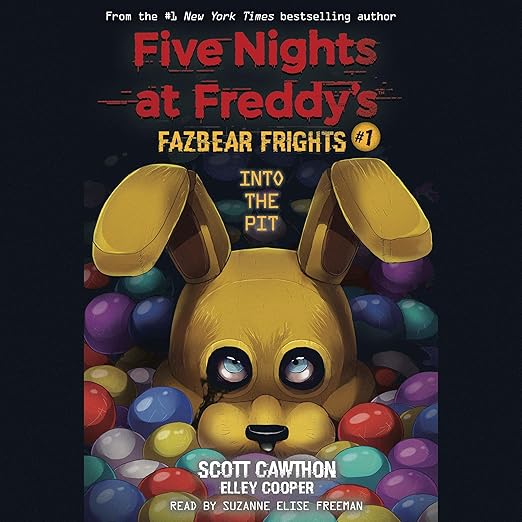
Birthday gift, delivery driver, shelf: that is the entire substance of two of the five written comments sitting beneath this audiobook. One reports the book arriving exactly as described despite neglect from a local delivery driver, then notes that the story 'seems to be compelling and it looks great on his shelf.' The other runs to two sentences, saying a son was happy and the book was in excellent shape. Neither describes the contents. Scott Cawthon's three novellas occupy five hours and one minute in Suzanne Elise Freeman's reading, and two of the five people who left words here were assessing a package.
Where This One Lands
Only one comment on this page treats the book as three separate objects, which is precisely what this book is. A five-star comment from September 2024 scores the stories individually: the title story takes 4.5 out of 5, To be Beautiful takes 4 out of 5. That is the most useful thing anyone has said about this collection, because a three-novella anthology is not a novel and refuses to behave like one. The same comment flags that the first story's ending 'kind of felt like some things were left hanging,' and warns that a listener who is not already a fan 'might cringe a little.'
Three novellas inside five hours means three hard resets. New protagonist, new wish, new consequence, roughly every hundred minutes, with a single credited reader carrying all of it. That is an unusual structural demand for a book this short: not one voice to sustain across an arc, but three separate casts to establish fast enough that a listener stops reaching backward for the previous story. Oswald wants his summer to be less boring. Sarah wants to be beautiful. Millie wants to disappear from the face of the earth. Cawthon's engine is that each wish gets granted exactly as stated, and the precision is the cruelty.
The Best Parts of Into the Pit: An AFK Book
One comment from October 2020 names the franchise question directly: 'It sure is fascinating to see how many ideas Scott can push out of this beloved video game series.' That is the real test facing any tie-in fiction, and this collection passes it in a specific way. Cawthon is not novelizing the games. He is borrowing their logic, a machine that grants what you asked for and then bills you for it, and building freestanding stories on top of it.
Wish stories are among the oldest horror forms and among the hardest to land, because a reader sees the trap coming from the first paragraph. What keeps these upright is that the wishes stay small and recognizable. Nobody asks for immortality. A bored kid wants an interesting summer, a girl wants to be beautiful, and a third child wants to stop existing, which is the one that quietly stops being a fairy tale. Handing that last wish to a middle-school protagonist is the most serious thing in the collection, and the description does not flinch from listing it beside the other two.
Five hours and one minute is a well-judged length for this material, and the description knows which format it is sitting on, opening its warning with 'Listeners beware.' Horror at novella length carries a natural audio advantage: a story you cannot skim ahead in, delivered at a pace you do not set, sits closer to how a campfire story actually works than a printed page can manage. For a collection built to unsettle rather than to shock, losing that control matters far more than any quantity of gore would.
What Gives Us Pause
Content guidance comes from a four-star comment filed in March 2020, doing work the listing itself never attempts. The book is described as a more mature version of Goosebumps set in the Five Nights at Freddy's universe, non-graphic while still discussing gore and darker themes, fine for children to read, told from the viewpoints of preteens and teens, and pitched at middle school reading level. This page files the title under teen and young adult, a half-step older than that description. Buying for a nine-year-old, trust the comment over the category. The same comment adds that 'The stories are just right in length.'
Series information is the weak spot. The series field reads Five Nights at Freddy's and numbers this as one, which names the franchise rather than the sequence the book actually belongs to, so anyone trying to establish reading order gets nothing usable from it. The title carries a publisher label, AFK Book, that identifies an imprint and says nothing about position. And thirteen ratings feed the 4.8 average while five written comments are visible, two of them about a parcel. That figure is arithmetically sound, but it is measuring a mixed group of buyers, some of whom bought paper.
Who Should Pick Up Into the Pit: An AFK Book
Existing Five Nights at Freddy's players are the obvious audience and will get precisely what they came for, though the more interesting recommendation runs sideways to that. Horror-anthology listeners with no interest in the games can start here cold, because the three stories are self-contained and the franchise supplies atmosphere rather than obligation. Middle schoolers who have outgrown gentler scares and are not ready for adult horror sit exactly in the target zone, and five hours is a length a reluctant young listener can realistically finish.
Parents after genuinely gentle stories should keep looking. The description promises terrifying tales, sinister enough to unsettle even hardened fans of the series, and the collection makes good on it. Pass, too, if you want the games' overarching mythology explained, since these are stories set in corners of the canon rather than a key that unlocks it. And anyone who prefers a novel's long build to an anthology's restarts will notice the three-part structure resetting exactly when a story has taken hold. That is the format doing its job. It is also why collections lose certain listeners for good.
In Brief
- Narrator: A single credited reader on a Scholastic Audio production, at a runtime short enough to clear in one sitting.
- Subjects: Granted wishes with a price attached, horror anthology, video game tie-in fiction, preteen protagonists
- Tone: Uneasy and compact, closer to a campfire story than a splatter reel
- Bottom line: A tight, genuinely unsettling trio of novellas that works for franchise players and horror-curious middle schoolers alike.
Before You Listen
Do I need to know the games to follow this audiobook?
No. The three novellas are self-contained, and the Five Nights at Freddy's setting functions as atmosphere rather than as required background. Players will catch references that everyone else will miss, but none of the plots depend on prior knowledge of the games or of the wider franchise canon.
How many stories does Into the Pit contain?
Three novella-length stories, each pulled from a different corner of the series canon and each turning on a wish that gets granted. The collection takes its name from the first of them, so the book and its opening story share a title, which makes it easy to lose track of which one a comment is discussing.
Is the audiobook too frightening for a younger child?
It avoids graphic content while talking openly about gore and darker themes, and the viewpoint characters are preteens and teens. Middle school is the natural fit. For a younger or more sensitive child, play the first story yourself before handing the rest of the file over.
Who reads Into the Pit, and how long is it?
Suzanne Elise Freeman is credited as narrator across five hours and one minute, published by Scholastic Audio Books. The single-reader format means one voice introduces three separate casts in sequence, with no continuing protagonist to carry a listener over the breaks between stories.