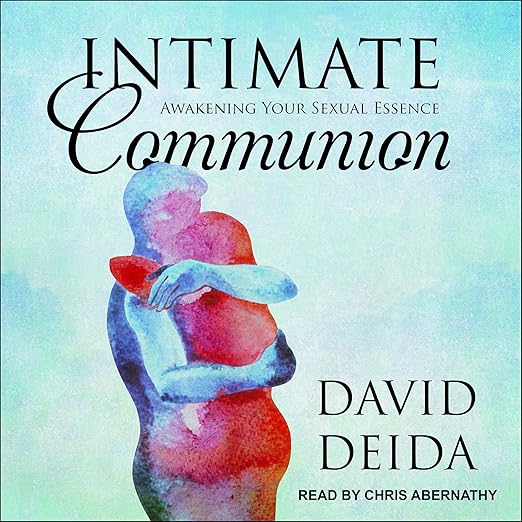
Quick Take
- Narration: Chris Abernathy suits Deida’s philosophically weighted prose, composed and serious without being stiff.
- Themes: Masculine and feminine essence, conscious coupling, spiritually grounded intimacy
- Mood: Dense and earnest, like a serious workshop on relational spirituality
- Verdict: Influential and still provocative after nearly three decades, best approached with critical distance, but genuinely worth the nine hours if Deida’s framework resonates with you.
David Deida is one of those writers who provokes very strong reactions, and I think that’s partly because his work exists in an unusual space: it takes the spiritual dimensions of sexuality and intimate relationship seriously, asks questions that mainstream relationship advice doesn’t ask, and does so in a framework that is simultaneously profound and, for some readers, deeply frustrating in its gender essentialism. Intimate Communion is Deida’s earlier work, first published in 1994, predating his better-known The Way of the Superior Man, and it carries the marks of that earlier period while still containing the thinking that established his reputation.
I listened to the nine-hour runtime across two days, and I found it doing something that the best relationship books do: making me think differently about dynamics I thought I understood. The concept of masculine and feminine essence as energies that don’t map neatly onto biological sex or gender identity, that a relationship needs a genuine polarity to sustain erotic charge, regardless of who carries which pole, is provocative in a productive way. What Deida calls Open Love, which reviewer LeAnn Martin flags as the concept that most shifted her thinking, is essentially the capacity to love someone without requiring them to behave in specific ways. That’s an idea with real weight.
The Masculine and Feminine Polarity Framework
Deida’s central argument is that the cultural movement toward role equality, while valuable politically and socially, has inadvertently produced what he calls sexually neutralized relationships: arrangements of fairness and mutual respect that drain erotic tension over time. He argues for a conscious cultivation of polarity, not a return to traditional gender roles, but a willing inhabitation of different energetic positions within the relationship, with full awareness that those positions can be discussed and adjusted.
This is where readers divide sharply. Reviewer M. T. D. C. M. describes the book as feeling fresh and relevant twenty-plus years after publication, and I understand why: Deida is asking questions about desire, energy, and the spiritual dimensions of sex that conventional relationship psychology tends to sidestep. Reviewer EXTRASAUCE24’s claim that Deida does an excellent job describing masculine and feminine essences and providing practical steps reflects the experience of many readers who find the framework liberating.
Other readers, and this is also legitimate, find the framework’s assumptions about essence and polarity to be dressed-up traditionalism that places unfair burdens on couples who don’t fit the mold it describes.
What Has Aged and What Hasn’t
Published in 1994, the book does carry assumptions about the primacy of heterosexual coupling and a somewhat binary understanding of masculine and feminine that feels limited against contemporary frameworks. Deida has evolved his thinking in subsequent books, and Intimate Communion should be understood as an earlier articulation of ideas he would refine. The practical exercises, which include specific practices for cultivating presence, opening to love, and deepening sexual connection, hold up better than some of the theoretical scaffolding.
Chris Abernathy’s narration is well-suited to this material. He reads with the gravity that Deida’s philosophical prose requires without making it feel like a sermon. The nine-hour runtime is long, but Deida works by accumulation, the arguments build across chapters, and the exercises are meant to be returned to rather than experienced once.
The Spiritual Dimension as Central, Not Decorative
One thing worth being explicit about for potential listeners: the spirituality in this book is not decorative. Deida is working within a framework that treats sexual energy as genuinely related to spiritual awakening, and the practice suggestions throughout reflect that orientation. This is not a secular relationship guide that borrows spiritual language for texture. If you’re skeptical of spiritually inflected frameworks for understanding sex and intimacy, the book will be a harder listen regardless of the quality of the specific insights.
Reviewer LeAnn Martin’s note that the book brought things together and gave her understandings she could translate into real improvements reflects the experience of a reader whose existing framework was compatible enough with Deida’s to absorb the specific insights. That’s the readership this book is written for.
Who Should Listen / Who Should Skip
Listen if you’re drawn to frameworks that treat intimacy as a spiritual practice, if you’ve found conventional relationship advice too focused on logistics and not enough on energy and presence, or if you’re interested in the intellectual lineage that influenced much contemporary masculine-feminine polarity work.
Skip if you need inclusive frameworks that don’t center heterosexual dynamics, if binary gender essentialism is a dealbreaker, or if you want instruction that is empirically grounded rather than philosophically derived.
Frequently Asked Questions
How does Intimate Communion compare to Deida’s later The Way of the Superior Man?
Intimate Communion is broader in scope and addressed to both partners rather than specifically to men, which makes it a useful entry point into Deida’s framework. The Way of the Superior Man is more focused and, for many readers, more practically actionable. Communion gives you the conceptual architecture; Superior Man works through specific applications for the masculine partner.
Is Deida’s framework applicable to same-sex couples?
Deida argues that the polarity framework applies regardless of gender, and in principle the concepts of masculine and feminine essence are meant to be energetic rather than biological. In practice, the examples and scenarios in Intimate Communion are almost exclusively heterosexual, and same-sex couples will have to do significant translation work to apply the material.
Does Chris Abernathy’s narration serve Deida’s philosophically dense prose well?
Yes. Abernathy reads with the measured seriousness that Deida’s writing requires without making it feel heavy or inaccessible. He’s a good match for material that could easily tip into either pomposity or dry lecture under a less calibrated narrator.
Is this a book that rewards re-listening or is a single pass sufficient?
Deida’s work is designed around practice rather than one-time absorption. Many of the exercises are meant to be returned to over time, and the conceptual framework builds in ways that become clearer after you’ve engaged with the whole arc. A single pass gives you the vocabulary; repeated engagement with specific sections is where the practical application lives.