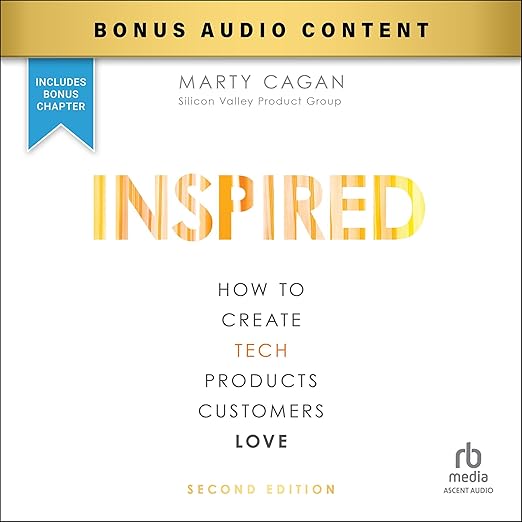
Marty Cagan narrating his own Inspired (2nd Edition) is the rare case where the author-narrator pairing is not just a convenience but a deliberate performance choice that changes the audiobook's texture. This second edition, covering how companies like Amazon, Google, Netflix, and Tesla approach product development, was already the closest thing to a canonical text in product management before the audio version arrived. The exclusive preface recorded only for this audiobook makes the format a distinct object rather than simply a recorded book, worth noting for listeners who might otherwise default to the print edition.
The craft question at the center of the second edition is whether the principles Cagan documented in the original have held up under the acceleration of tech product culture since the first edition, and the answer is largely yes. The core argument, that most technology companies organize themselves to fail at product work and that fixing this requires structural change rather than process tweaks, is more urgent now than when it was first articulated. The gap between how high-performing product organizations operate and how average organizations operate has, if anything, widened in the intervening years.
Part Art, Part Science, and Unfixable Luck
What Cagan is describing in the opening sections is a problem of organizational design that most product practitioners have felt but struggled to name. Product managers who are functioning as roadmap administrators rather than product discoverers, engineering teams that are feature factories rather than co-creators, and executives who confuse activity with progress: these dynamics are rendered with enough specificity that they read as accurate diagnosis rather than generic critique to anyone who has worked inside a tech organization for more than a year or two.
Reviewer Hazem Awad's description of product management as part art, part science, and part luck, and the challenge of finding literature that addresses all three, captures why this book has retained its reputation across multiple editions. Cagan does not pretend the luck element can be engineered away. What he argues is that the art and science components can be substantially improved through better team structure, better discovery practices, and a clearer understanding of what a product manager actually needs to do versus what most companies ask them to do. Reviewer D. Chatley specifically noted the actionability: this is a book that shows what effective product management looks like in practice, built from real examples rather than theoretical prescription.
Reviewer Dmitry Kolovskiy described returning to this book repeatedly as a source of product wisdom and a great starting point for product managers at every level of experience. That re-reading quality is significant in an audiobook context because it suggests the framework rewards returning listeners who are in different organizational situations than they were the first time through.
His Own Voice Creates a Tutorial Dynamic
The audiobook format suits Inspired particularly well for the sections on team composition and discovery techniques, where Cagan's case studies benefit from the discursive quality of audio. Hearing him move from principle to example to implication in his own voice creates a tutorial dynamic that the page sometimes flattens. The preface recorded exclusively for this audio edition adds material not available in print, giving the audiobook genuine added value rather than simply replicating the reading experience in a different medium.
Cagan's narration is direct and unadorned, occasionally conversational in a way that signals he is used to teaching this material in rooms rather than performing it on a microphone. That rawness is an asset here. The framework sections covering product discovery, staffing principles, and the role of leadership in product culture are dense enough that a second pass through the audio yields material the first listen does not fully absorb.
The company examples from Amazon, Netflix, Google, Tesla, and Facebook are referenced throughout as illustrations rather than as deep case studies, which means the depth on any single organization is limited. Listeners looking for detailed behind-the-scenes narrative on how specific products were built will find the coverage suggestive rather than comprehensive. The value is in the transferable framework, not the insider story, and the audiobook is honest about that priority throughout.
Starting With the Preface Sets the Right Lens
The book is organized into four discrete sections: people and skillsets, product discovery, process, and culture. The people section is where Cagan is most direct about the gap between what companies think a product manager does and what the role requires at high-performing organizations. The discovery section is the intellectual core, and listeners unfamiliar with concepts like continuous product discovery or rapid prototyping will find the frameworks introduced here with enough precision to be directly useful rather than merely illustrative.
One structural note for the audio version: the material on product culture in the later sections is worth holding in memory against the discovery sections heard earlier. Cagan's argument is that process failures are often culture failures in disguise, and that connection becomes clearer on a second listen. The audiobook's runtime of eight hours and forty-six minutes is dense material throughout, with no filler sections that can be safely skipped.
The preface exclusive to the audio edition contextualizes the second edition's revisions and Cagan's evolving thinking since the first edition. Starting with that preface rather than treating it as optional material is worth doing: it establishes the lens through which Cagan wants the updated content to be received, and it contains observations about the current product management landscape that are not replicated in the print edition.
Essential Context Even for Non-Product Roles
Product managers at any stage of their career will find relevant material here, though the second edition speaks most directly to those working inside established companies that have growth ambitions but struggle with consistent execution. Startup founders evaluating how to structure early product teams will also get significant value from the discovery and team composition sections. Those already working with methodologies directly descended from Cagan's thinking may find the foundational material familiar, but the organizational structure sections are worth revisiting regardless of experience level. Non-product professionals in adjacent roles, including engineering leads, designers, and executives, should consider this essential context for understanding what product leadership is genuinely supposed to provide to an organization.
Before You Listen
Does Cagan's self-narration of this audiobook work for a technical subject, or would a professional narrator be clearer?
Cagan's own narration is one of the audiobook's strengths. He delivers the material with the authority of someone who has taught it extensively in person, and the occasional conversational quality feels like direct access to a mentor rather than a formal recording. The production values are professional without being over-polished.
Is the second edition audiobook meaningfully different from the first edition, or primarily a format update?
The second edition is a substantial revision with significant new material on team structures, discovery techniques, and the evolution of product culture at major tech companies. The audiobook also includes an exclusive preface not in the print edition, making it a distinct version rather than simply a recorded reissue.
Does this audiobook work for someone outside of product management, such as an engineering lead or designer?
Yes, significantly so. Cagan's framework for how engineering and design integrate with product discovery is a recurring theme, and the book is explicit about why those roles need to be empowered co-creators rather than execution resources. Engineering leads and designers often cite this as a book that reframed their understanding of their own organizational position.