
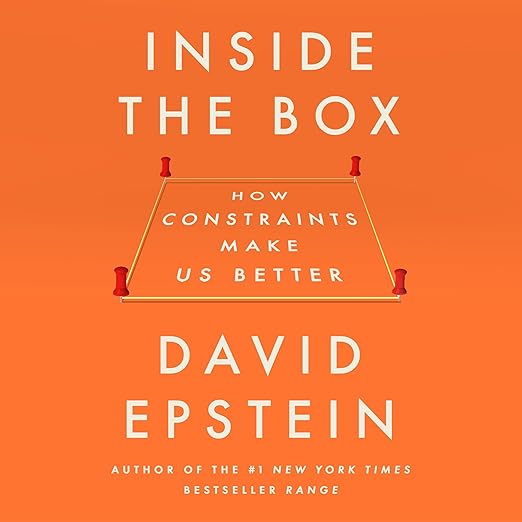
Constraints are the subject of this audiobook and, for the moment, its condition too: no rating, no written response, and a jacket quote from Malcolm Gladwell doing all the talking. Penguin Audio issued the recording on May 5, 2026, which is long enough for a buyer to expect at least one grade to have appeared. None has. Nine hours of argument sits behind a page whose entire evidence base is the publisher's own copy and one enthusiastic sentence from another author.
Gladwell Names One of Epstein's Two Prior Books
Epstein is arguing that limits are productive rather than merely tolerable, and the framing is sharper than the usual counterintuitive business thesis. The claim is that unlimited freedom is paralyzing, that unlimited resources do not reliably produce breakthroughs, and that guardrails, chosen or imposed, are where creativity actually happens. The title inverts the advice everyone in an office has heard about creativity, and it is doing that on purpose. What makes the premise worth a whole book rather than an article is the second half of the claim: not that limits are survivable, but that they are the mechanism, and that removing them removes the thing that made the work good.
Gladwell's endorsement sits at the very top of the description, ahead of the summary, and it contains a detail the rest of the page never resolves. The quote refers to David Epstein's first two books; the copy names exactly one of them, calling this the work of the number one New York Times bestselling author of Range. Anyone who wants the back catalog before starting here is given half of it and left to find the rest elsewhere.
Range is therefore the credential the listing leans on, and the argument here appears designed to sit alongside it rather than to repeat it. The description promises the science and practice of constraints, exploring exactly when and how boundaries help, which is a more careful formulation than most books of this kind attempt. Note the word exactly: the interesting version of this thesis is the one that says where it stops applying.
Nothing Here Needs to Be Seen on a Page
Guardrails are the operative image, and the useful version of this material is the practical one. A team with a budget, a deadline and a fixed set of tools makes different decisions from a team told to dream freely, and most people have lived both experiences without ever naming the difference. A book that gives you the vocabulary for that, and evidence about when the narrowing helps, earns its place far more than another volume about disruption. Audio suits this kind of argument well, since the structure is claim, story, claim, and the stories are the part that survives being heard once. Nothing here needs to be seen on a page to be understood, which is not true of most business writing built on data.
Limits also produce the better half of the case studies. The copy promises organizations that embraced constraints and transformed themselves, and, more valuably, a few that struggled from a lack of limits. Failure cases are what separate a real argument from a collection of flattering anecdotes, and their presence in the summary is the strongest signal on this page that the book intends to be tested rather than admired.
The Rating Field Is Empty, Never Graded
Freedom is a slippery variable, and a thesis about it can quietly become unfalsifiable. If a project succeeds under tight conditions, constraints did it; if it succeeds with vast resources, someone imposed a boundary somewhere. The description leans on the paradox of too much choice, which is well-trodden ground in popular psychology, and the value of this particular book will depend entirely on how strictly it defines the conditions where narrowing stops helping.
Nobody has graded this yet. The rating field is not showing a zero, it is empty, and no response has been written since publication. That is a genuine gap rather than a criticism: an early buyer is the test case, with only the sample to judge the reading by and only the publisher's summary to judge the argument by. If you prefer to buy on consensus, this record cannot give you one.
Publication landed in May 2026 with nine hours of runtime, which is a substantial commitment for a single-idea book. The risk with any thesis of this shape is padding: three chapters of evidence followed by six of variation. The stated scope, covering individuals, businesses, institutions and societies, is broad enough that the last of those categories is usually where the argument thins out.
Workplace and Organizational Behavior is the tag, and the record is filed under business and careers alongside health and wellness at the same time. The second filing is odd until you reach the last line of the summary, which promises the most creative, productive and satisfied version of yourself. Personal contentment is doing double duty here, and a listener expecting a well-being book will get an organizational one with a contentment argument attached.
A Tighter Brief Is a Kinder Brief
Managers who set briefs for other people will get the most out of this, because the practical application is immediate: a tighter brief is a kinder brief, and knowing why gives you something to say when a client asks for unlimited scope. Founders deciding what not to build, and anyone running a team through a lean year, will find the framing genuinely useful rather than consoling. Creative professionals working to a fixed format will recognize their own experience described from the outside, which is a specific pleasure: the sonnet, the thirty-second spot and the shipping deadline all belong to the same argument.
Skeptics of the counterintuitive-business genre have reason to wait for reviews, since the format is familiar even when the argument is not. Anyone hoping for a self-help program will find analysis instead of instructions. Until someone actually grades this listing, the honest advice is to play the sample, weigh the summary against your own experience of working under limits, and decide whether nine hours of it will change how you set up your next piece of work.







