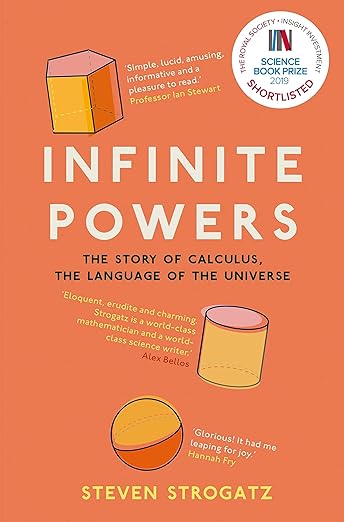
I finished Infinite Powers on a long flight over the Atlantic, somewhere between a three-hour nap and a mediocre in-flight meal. I had started it expecting a competent science history and found myself listening through the meal, headphones in, because Strogatz had gotten to Fourier and I didn't want to stop. That's the thing about this book: it earns its running time through genuine curiosity, not through padding.
The premise is audacious in its scope. Strogatz, a mathematician at Cornell and one of the clearer communicators in his field, wants to tell you the full story of calculus. Not the mechanics of it, not the exercises your high school teacher assigned, but the living intellectual history of how human beings slowly, over three millennia, developed a tool for thinking about continuous change. He succeeds more fully than most books in this genre manage.
What Steven Strogatz Delivers
What Strogatz understands, and what makes this book work, is that calculus is not primarily about math. It is about the problem of infinity and what happens when you treat the infinite as a tool rather than a barrier. The book's central organizing metaphor is elegant: calculus works by cutting difficult problems into infinitely many infinitely small pieces, solving each piece, then adding the answers back up. This is called the Infinity Principle, and once Strogatz articulates it in the opening chapters, everything that follows is a variation on that theme. Archimedes, Newton, Leibniz, and eventually modern chaos theorists and AI researchers: they are all, at bottom, applying the same intuition.
That connective tissue is what separates Infinite Powers from a more conventional history of mathematics. Strogatz isn't cataloguing discoveries in chronological order for its own sake. He's arguing that this one idea, developed and refined over centuries by idiosyncratic and often fiercely competitive people, is the intellectual foundation of virtually every modern technology. No calculus, he says, means no computers, no GPS, no space travel, no microwave ovens. Stated baldly, that sounds like boosterism. In the book, it lands as revelation, because he earns each claim through explanation.
What Steven Strogatz Gets Right
The audio format serves this book unusually well. Bob Souer reads with an easy, collegial warmth that mirrors Strogatz's own prose voice. The book was written by someone who clearly enjoys explaining things, and Souer's narration amplifies that quality without overdoing it. He doesn't perform excitement; he simply sounds interested, which is the right register for material this dense.
Several listeners who encountered calculus formally in school reported experiencing what one called many aha moments, the sensation of finally understanding how something actually works after years of operating it mechanically. That outcome speaks well of the book's explanatory approach. Strogatz doesn't dumb the mathematics down. He translates it into language that connects to things you already understand, then builds from there. It's a meaningful distinction.
The cast of characters is also genuinely engaging. The book was shortlisted for the Royal Society Science Book Prize in 2019, and one reason it earned that recognition is that Strogatz treats the mathematicians as people rather than as monuments. The Newton-Leibniz priority dispute is handled with enough detail that the personal stakes feel real. Archimedes comes across as a mind so far ahead of his time that you feel genuine pathos at his death. Fourier's obsession with heat transfer, which eventually gave us the mathematics underlying modern signal processing, reads almost like a thriller subplot.
Where Steven Strogatz Loses Some Ground
The book's most striking section, for my money, is the sweep through calculus's role in modern medicine and biology. Strogatz explains how calculus is embedded in the mathematics of HIV treatment, in the modeling of epidemic spread, and in the algorithms that power medical imaging. For listeners who assumed calculus was purely a physics and engineering tool, this section reframes the entire history that preceded it.
Listeners who have some prior mathematical education will find the book moves quickly through material they know, which is by design: Strogatz is writing primarily for curious non-specialists. If you want technical depth on any specific mathematician or application, the book will point you toward further reading but won't linger. The trade-off is that the breadth of coverage is genuinely impressive, and the book earns its subtitle, a magisterial history, without becoming academic or dry.
At just under eleven hours, Infinite Powers is well-calibrated for the material. Strogatz doesn't pad. He also doesn't rush through the genuinely difficult conceptual moments, which is the balance this kind of popular science writing has to find.
Who Should Pick Up Infinite Powers
This is the rare mathematics book that works for people who have had no calculus and for people who use it professionally. The non-specialist gains a genuine conceptual foundation for a discipline they may have found opaque. The specialist gains a richer sense of the intellectual tradition they're working within. Secondary school and university students who are currently taking calculus and wondering why would find it particularly useful as a companion to their coursework.
Listeners who prefer narrative-driven nonfiction over purely expository science writing should know that the book is organized around both ideas and stories. It is more discursive than a conventional textbook and more rigorous than a standard popular science read. That middle ground is exactly where it should be. Those who want derivations and proofs will need to look elsewhere. Those who want to understand what calculus is for, and what kind of minds built it, will find this one of the more rewarding listening experiences in the science category.
Common Questions
Do I need any prior knowledge of calculus to follow Infinite Powers?
No. Strogatz explicitly designs the book for curious non-specialists. He uses clear analogies and builds concepts progressively. Listeners who took calculus in school may recognize the terrain, but those who never did will not find themselves lost.
Does Bob Souer's narration handle the mathematical content clearly in audio format?
Very well, for a book of this type. The mathematical notation that appears in print is translated into Strogatz's verbal explanations, which Souer delivers with clarity and measured pacing. No equations are read aloud as equations, which keeps the listening experience accessible.
How does Infinite Powers compare to other popular mathematics histories like Simon Singh's Fermat's Last Theorem?
Infinite Powers is broader in scope and more focused on applications than Singh's book, which follows a single problem to resolution. Strogatz covers three millennia and dozens of thinkers, with the connecting argument being the Infinity Principle. Singh goes deeper on a single narrative thread. Both approaches work; they serve different curiosities.