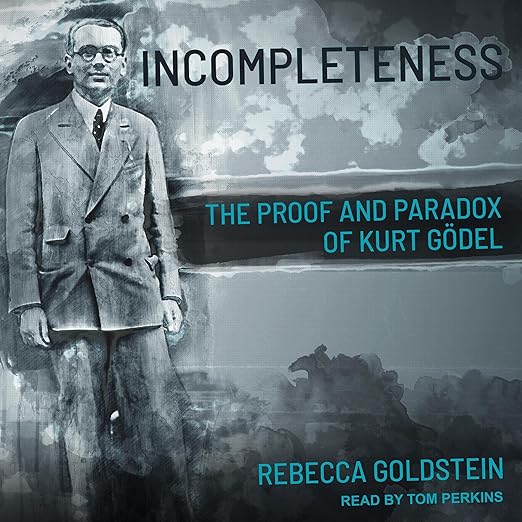
I came to Incompleteness on a long train journey, which felt appropriate. Rebecca Goldstein's account of Kurt Godel and his incompleteness theorems is the kind of book that benefits from sustained, uninterrupted attention, not because it is difficult to follow (it is remarkably clear given its subject matter) but because its argument accumulates across eight hours in a way that requires holding multiple threads simultaneously. Godel's life, the intellectual context of Vienna between the wars, the theorems themselves, and the question of what those theorems actually prove about the nature of mathematical truth, these threads braid together, and understanding any one of them fully requires attention to all the others.
The theorems themselves, for those unfamiliar with them, established in 1931 that within any sufficiently powerful formal mathematical system, there are true statements that cannot be proven within that system. This result shook the foundations of the project Bertrand Russell and others had dedicated decades to: the dream of a complete, consistent, fully formalized mathematics. Godel's proof demonstrated that this dream was impossible in a precise and irreversible way. Steven Pinker's blurb, "an unforgettable account of one of the great moments in the history of human thought", is not overstatement.
One reviewer with a background in mathematics criticized this book for spending too little time on the actual mechanics of the proof, suggesting that someone who understands how the proof works could have explained it more fully. The criticism is worth addressing directly because it points to a real choice Goldstein has made. She devotes approximately twenty pages to the mathematical argument itself, which is enough to give a non-specialist a genuine if partial understanding of what Godel actually did. The rest of the book is occupied with the life and the intellectual context.
That choice reflects Goldstein's particular skills and interests. She is a philosopher of science and a novelist, and she is most interested in the meaning of the incompleteness theorems, what they imply about the relationship between mathematical truth and formal provability, how they were misread and misappropriated by subsequent thinkers, and what Godel himself believed they demonstrated about the limits of mechanistic thinking. The Roger Penrose argument that the theorems prove minds cannot be computers gets detailed attention, and Goldstein's handling of that debate is one of the most illuminating sections of the book.
Why Listen to Incompleteness
Goldstein is excellent on the Vienna Circle, the group of logical positivists whose intellectual project dominated the philosophical atmosphere Godel worked within and, in many ways, against. Godel was not a logical positivist. He was a mathematical Platonist who believed that mathematical objects exist independently of human minds and that his theorems demonstrated precisely this. The irony that the incompleteness theorems were immediately claimed as support for the logical positivist program, a program Godel's own philosophical views directly opposed, is one of the threads Goldstein follows most carefully.
The biographical portrait of Godel himself is quietly devastating. He was a man whose intellectual achievement was matched by an increasing inability to function in the ordinary world. His paranoia worsened steadily after his move to Princeton's Institute for Advanced Study, where he and Einstein became close friends in a relationship that Goldstein handles with considerable sensitivity. By the end, Godel was afraid to eat food he had not watched being prepared, and he starved to death in 1978 when his wife was hospitalized and could no longer guarantee his meals. The man who proved the limits of formal systems could not protect himself from the limits of his own mind.
What to Watch For in Incompleteness
The audiobook format presents genuine challenges for a book this intellectually dense, and Tom Perkins handles those challenges with an unhurried delivery that gives the listener time to absorb each argument before the next one arrives. His voice has the quality of someone who has read and understood the material rather than simply recorded it, and the pacing reflects a sensitivity to where the text is doing conceptual heavy lifting versus where it is in biographical or historical narrative mode. The section on the actual proof is slower and more deliberate than the biographical passages, which is the right call.
Who Should Listen to Incompleteness
Incompleteness is for listeners curious about how a single mathematical result reshaped 20th-century philosophy of mind and mathematics, for readers interested in intellectual biography of the deeply eccentric variety, and for anyone who has encountered references to Godel's theorems in popular science or philosophy and wanted a rigorous but accessible account of what they actually prove. Listeners hoping for a technical presentation of the proof itself will be somewhat disappointed, Goldstein's twenty-page treatment is introductory rather than comprehensive. But as a portrait of a singular mind operating at the frontier of what human thought can establish, this audiobook is exceptional.