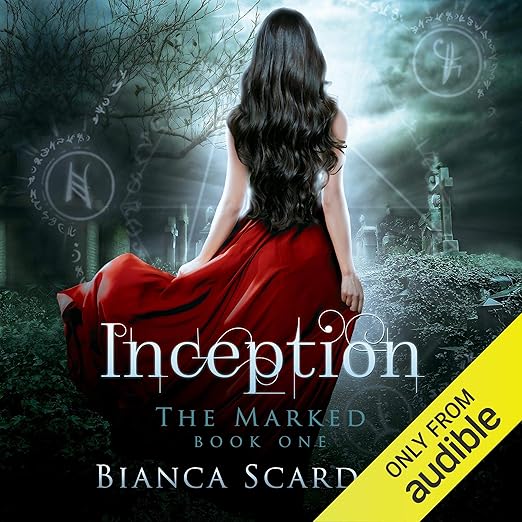
Inception earns its spot at the start of The Marked Saga by committing hard to Jemma Blackburn's uncertain grip on reality before ever confirming the vampire she says she watched murder her father was real, and that early ambiguity does more work in this audiobook than a quick back-cover pitch admits.
The Verdict, Briefly
Jemma insists she knows what she saw eight months ago, even though everyone around her tried to convince her otherwise, framing her trauma as the reason she lost touch with reality rather than accepting her account at face value. Moving to Hollow Hills was supposed to be a clean restart, a chance to bury the secret and live normally, except everyone around her turns out to be keeping secrets of their own too.
The real twist the synopsis holds back is not about the vampires hunting Jemma at all, but about Jemma herself: by the book's end she understands she isn't fully human, described as both the devil these vampires fear and the angel they crave, without yet knowing which she actually is. That unresolved self-identity question is the hook the sequel presumably has to answer, not a vampire mystery in the more conventional sense.
Worth a quick note for anyone searching the title cold: this shares its name with the well-known 2010 film, and the two have nothing to do with each other beyond the word itself. This audiobook opens The Marked Saga specifically, Bianca Scardoni's YA paranormal romance series, not anything connected to that unrelated movie.
Read-Love-Review Blog's account fills in detail the synopsis only gestures at: Jemma spent six months in a psychiatric facility following her breakdown, has a younger sister who needs a guardian, and lives now with an uncle described as aloof rather than warm, someone who provides a home without offering much emotional presence alongside it.
Why Listen to Inception
At fourteen hours and seven minutes, this runs long even by paranormal romance series standards, giving Scardoni real room to build out Hollow Hills, the surrounding vampire threat, and the ensemble cast Amanda M. singles out, rather than compressing all of it into a tighter, plot-only runtime. Listeners who enjoy a slower, more immersive series opener over a fast-paced one should find that length works in the book's favor.
Genuine, specific enthusiasm runs through the reviews here rather than generic praise: Jenababy13 calls it thrilling outright, Amanda M. describes being obsessed enough to already be partway through book four of the series, and Gen says being hooked pulled reading itself back to the front of a life that had deprioritized it for years. That kind of series momentum, readers actively continuing rather than stopping after one entry, is a meaningfully different signal than isolated five-star praise.
Amanda M.'s review also flags a specific structural strength: a large ensemble of main characters, described as so well drawn that it becomes genuinely hard to know who to root for. For readers who enjoy a paranormal romance with real triangle-or-more tension rather than one obvious endgame pairing, that ambiguity is a selling point rather than a weakness.
Given the size of the ensemble cast Amanda M. describes, distinguishing that many voices clearly across fourteen hours is a real technical demand for narrator Bailey Carr, a genuinely harder job than a smaller-cast YA romance would ask for.
Points to Consider
Reviewer Jenababy13 is specific and honest about a rough opening stretch, admitting to cringing at some early lines and thoughts from the main character, moments described as the urge to cover one's eyes in secondhand embarrassment. That same review says the book improves from there, which is a useful, concrete warning for anyone tempted to give up in the first hour rather than pushing further in.
Rita Marie's three-star review offers the most detailed critical counterweight on record: real praise for the backstory depth and unresolved lore early on, followed by frustration that the main character takes what the review calls a swan dive into repeating the same mistakes and the most self-destructive decisions available, over and over, as the book continues. That is a specific, recurring complaint worth weighing against the more uniformly enthusiastic reviews surrounding it.
Only seven listeners have left a rating so far, and the numbers behind that small sample are worth spelling out: they total thirty-one points combined, missing a clean five-star sweep by exactly four points. With a sample this size, Rita Marie's lone lower score is likely doing real work in keeping the average below a perfect 5.0.
Series momentum is the clearest external evidence available here: multiple reviewers describe pushing well past this first entry rather than stopping, with Amanda M. specifically already partway through the fourth book at the time of writing that review. That kind of continued reading is generally a stronger signal of a series' staying power than any single book's isolated star rating.
Who Should Pick Up Inception
YA paranormal romance with a large, competing cast of potential love interests and a slow-building identity mystery is the pitch here, best suited to listeners willing to push past an admittedly rough opening stretch for a payoff several reviewers say arrives later. Fans who like a protagonist whose reliability is genuinely in question, not just a narrative device quickly resolved, will find that tension sustained here.
A repeatedly self-sabotaging main character will frustrate some listeners more than others, so weigh Rita Marie's specific critique seriously before starting a fourteen-hour commitment. Anyone confusing this for the unrelated 2010 film of the same name should also know going in that the two share nothing beyond a title.