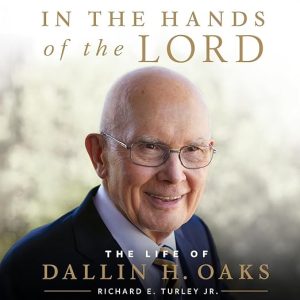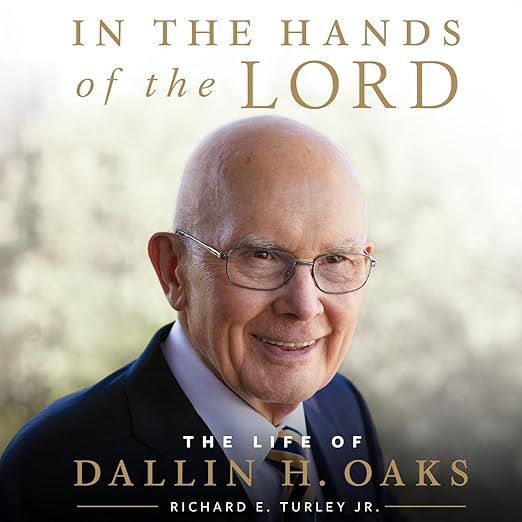
Biographies of living religious leaders carry a specific challenge that secular biographies do not face in quite the same way. The subject of such an audiobook is not only a person but also an office, a symbol of institutional faith, and a figure whose life story carries theological implications for believers who may already regard him as divinely called to his role. Richard E. Turley Jr.'s biography of Dallin H. Oaks walks that difficult line with the care you would expect from a noted historian who belongs to the same faith community he is writing about and who understands the difference between reverence and hagiography.
At twelve hours and fifteen minutes, this audiobook is a substantial commitment. It covers the full arc of Oaks's life from the early loss of his father, when he was only seven years old and his mother became a widow, through his education, military service, distinguished legal career, and ultimately his call to the apostleship of the Church of Jesus Christ of Latter-day Saints in 1984. That is a genuinely remarkable biographical arc independent of its religious context, and Turley has the historical instincts to let the life speak for itself rather than over-narrating the significance of each chapter for the listener.
His Life in the Hands of the Lord
Turley structures the biography to arrive naturally at the moment the title quotes: when President Gordon B. Hinckley extended the call to the apostleship, Oaks responded that his life was in the hands of the Lord and his career in the hands of His servants. That response lands with genuine weight when it arrives because the preceding hours have built the full context for what Oaks was actually giving up. A promising academic legal career. A distinguished tenure as president of Brigham Young University. The kind of professional trajectory that was attracting serious attention from the highest levels of the American legal establishment.
The sacrifice is real and specific, and Turley makes certain the listener understands its full magnitude before the religious significance is layered on top of it. That sequencing is the book's sharpest structural decision. The faith element is never absent from the narrative, but Turley builds toward it rather than assuming its primacy from the first page. The result is a biography that works both as a religious inspiration and as a straight account of a remarkable professional life redirected by something the subject did not plan for and could not have anticipated from the trajectory he was on.
Lindsay Narrates, and the Life Inflates Itself
Bruce Lindsay narrates with a calm and measured authority that suits a twelve-hour biographical listen well. He does not impose dramatic flourishes on material that does not require them, and the legal and academic sections, which carry significant factual density, are handled with clarity rather than being rushed through or dramatized for effect. The audiobook format serves this biography particularly well because so much of Oaks's story is carried through period detail, personal relationships, and the texture of incremental decision-making over decades. Lindsay renders all of that with the patience the material deserves across the full runtime.
Reviewers who came to this biography specifically to understand Oaks as a person rather than as an institutional figure found the approach rewarding. As one reader noted, the biography reveals his commonality with ordinary people even as it traces the extraordinary arc of his life. A simple orientation toward faith, applied consistently over decades of professional life, produces something remarkable. That quality is Turley's gift as a biographer: he does not inflate the subject. He narrates, and the life inflates itself through the honest accumulation of detail.
Most Compelling at the Beginning and at the End
Listeners who are not members of the Church of Jesus Christ of Latter-day Saints will find some of the institutional context and theological framework requires patience to navigate. The church's leadership structure, the specific nature of the apostolic calling, and the doctrinal significance of certain events in Oaks's career are explained but not extensively unpacked for outside audiences. This is a biography written primarily for a believing readership, and that orientation shapes which context the author provides and which he assumes the listener already carries into the experience.
The twelve-hour runtime does include sections where historical detail accumulates faster than narrative momentum. The legal career chapters are thorough in ways that listeners without a prior interest in academic law or constitutional history may find slower than the personal chapters. The biographical arc is most compelling at its beginning, in the account of a fatherless childhood built on discipline and faith, and at its end, in the quiet drama of the apostolic call and its acceptance without qualification or negotiation. Turley does not rush either end of that arc, and the patience is earned.
A Pace That's Demanding, Though the Appeal Is Universal
Members of the Church of Jesus Christ of Latter-day Saints who want a thorough understanding of Dallin H. Oaks as a person and as a leader will find this audiobook exactly what they are looking for. Religious biography readers with a broader interest in how faith intersects with professional achievement and voluntary sacrifice will also find substantial material here. Casual listeners without a prior interest in either Latter-day Saint history or legal academia will find the pace occasionally demanding, though the central story of vocation and sacrifice carries universal appeal that transcends the specific religious framework Turley works within.
Is Bruce Lindsay's narration of this audiobook well-suited to a twelve-hour religious biography?
Lindsay's measured and respectful delivery is well-matched to the material. He handles both the personal narrative chapters and the denser legal and academic sections with consistent clarity, and his tone is appropriate for a biography that carries significant meaning for its primary audience. The twelve-hour runtime is never made longer by the narration choices.
Does the audiobook cover Dallin H. Oaks's more recent role at the head of his church, or does it focus primarily on earlier periods of his life?
The biography's primary focus is the arc of Oaks's life through his call to the apostleship in 1984 and his subsequent decades of apostolic service. Readers who came to the biography because of more recent events will find the biographical foundation laid in earlier chapters is the book's primary emphasis, with later developments present but not the center of gravity.