At a Glance
- Read by: Feodor Chin voices a memoir written throughout in the author's own first person, so its intimacy reaches you through somebody else.
- At its heart: Dying and the bardos, dismantling identity, the gap between training and experience.
- Vibe: Candid, humbling, and quietly absorbing.
- Short version: A spiritual memoir that earns its insight through failure, though the credit line looks incomplete.
A monk slipped out of his monastery one night without telling anyone, and this audiobook is the account of what happened next. Yongey Mingyur Rinpoche was thirty-six, a rising figure among his generation of Tibetan masters and the abbot of three monasteries, when he walked away from his monastery in India intending to spend four years wandering as a mendicant. The plan was to shed his titles. What he met first was a screeching railway car and fellow travelers he found dirty.
Where This One Lands
This book's real subject is the distance between preparation and event. Rinpoche had trained his entire life to face death, and the description is candid that his earliest discoveries were smaller and more humiliating than that. He was too attached to his identity as a monk to remove his robes straight away, and too attached to sleep on the Varanasi station floor, so he paid for a bed in a cheap hostel instead. The retreat only turned real once the money ran out.
Greg supplies the context that makes those failures legible. By Rinpoche's own recounting, he had lived his whole life in safety and abundance, attended to and revered wherever he went, and did not know how to handle money because attendants had always done it for him; four and five star hotels were simply normal. Becoming a homeless wandering yogi was, in that account's phrase, a major shock to his system. The book's willingness to say so is what keeps it from turning pious.
Then the food poisoning arrives and the book becomes something else entirely. The illness runs severe enough that decades of accumulated training finally receive the test they were built for. The description frames this as an opportunity, which sounds glib until the structure comes into focus: this is a book about dying, written by somebody who went looking for the experience and very nearly found it.
Most useful on the page is the response explaining what makes this book teachable. Writing as a longtime reader of Rinpoche's work, one account calls this the favorite among his books precisely because the wisdom sits woven into the realistic details of the retreat's opening stretch, which makes it easier to connect to ordinary daily life. That account values something specific: he lays out struggles, thoughts, and feelings, then walks you through the reasoning that produced each insight, so you follow the train of thought instead of receiving a conclusion.
Casting raises a question worth settling before you buy. This is a first-person account by a Tibetan teacher, and Feodor Chin reads it, so the listener receives that first person at one remove. The arrangement is not automatically a loss, since a professional reading can carry long doctrinal passages more evenly than an author might manage. It does mean the vulnerability in this book arrives mediated, and how you feel about that is a matter of temperament.
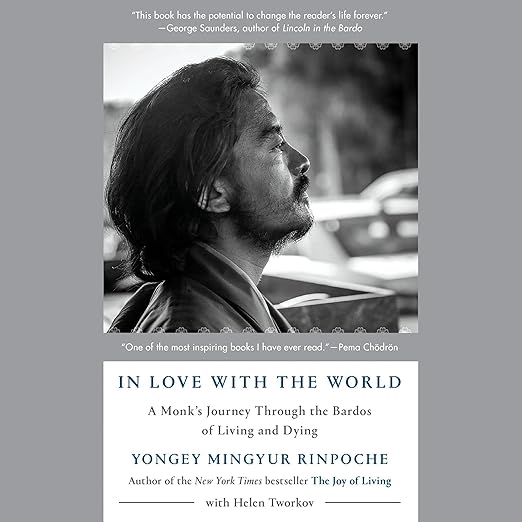
Endorsements here are unusually heavyweight and unusually varied. Pema Chödrön's blurb places it among the most inspiring books encountered, George Saunders says it has the potential to change a reader's life forever, and Tara Brach, Jack Kornfield, and Russell Brand all appear alongside them. When a book pulls praise from dharma teachers and novelists at once, it is usually because the narrative works independently of the doctrine, which is the case here.
What to Watch For in In Love with the World
The most significant problem with this listing is a missing name. Producervan's review gives the authorship as Yongey Mingyur Rinpoche and Helen Tworkov, while the page credits Rinpoche alone. A collaborator on a first-person spiritual memoir is not a marginal contributor, because shaping that voice is the actual work. If Tworkov co-wrote this, the credit line you are looking at is incomplete.
A subtitle has gone missing as well. The full title runs In Love with the World: A Monk's Journey Through the Bardos of Living and Dying, and this page carries only its opening phrase. That is not decoration. The bardos it names are the states the book is organized around, and anyone who knows the subtitle understands the structure before pressing play. Browsing on the short title alone, you would reasonably expect a travel memoir rather than a sustained meditation on dying.
Taken together the responses are a mixed instrument besides. One is an ebook review, complete with format and publication date, sitting on an audio page. Another consists largely of a personal recollection of meeting Rinpoche rather than any assessment of the writing. Both are sincere, and both tell you more about the author's standing than about this edition, so read the page for context and look elsewhere for a verdict on the recording.
Recommended For
Brett describes the book as a mix of Tibetan Buddhist philosophy and a monk's coming of age, and singles out the description of enlightenment. That pairing identifies the audience neatly. It works for people who want philosophy embedded inside a story rather than delivered as instruction, and it works for listeners with no practice whatsoever, because the narrative does the carrying.
Seekers after a practical meditation manual should adjust expectations, since the practices appear inside the narrative rather than as a program you can follow step by step. Extended physical illness is the other caution, because the food poisoning sequence is the centerpiece and it is not handled at a comfortable distance. And if a memoir this personal demands the author's own voice, sample the reading before committing.
This lands best with the listener curious about what a lifetime of contemplative training actually buys once circumstances turn bad. Nearly ten hours gives the story room to travel from a comfortable monastery to a station floor to a hospital bed, and the honesty about those early failures is exactly what makes the later material credible. Confirm the co-writing credit if that matters to you, and take the rest as offered.
Frequently Asked Questions
Does Yongey Mingyur Rinpoche narrate the audiobook himself?
No. Feodor Chin performs it. Because the book is told throughout in the first person by a named living teacher who has a public speaking presence, some listeners feel the substitution and others stop noticing after a chapter. Sampling is the only reliable way to learn which group you belong to.
What does the missing subtitle change about this audiobook?
The listing shows only the short form, while one review supplies the full wording, which names the bardos outright. In practice a browser sees a title suggesting travel or joy and receives a sustained meditation on mortality instead. Check the complete title before gifting this to anyone.