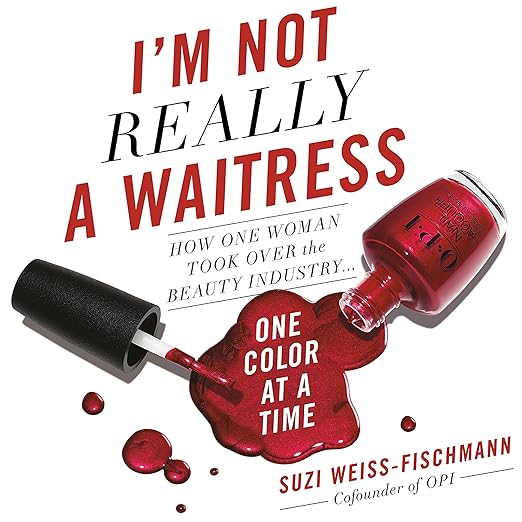
Suzi Weiss-Fischmann's name is printed on the back of billions of nail polish bottles, but most people who have ever worn OPI have no idea who she is. That gap between product omnipresence and personal obscurity is one of the subtler ironies in this audiobook, and it turns out to be the very engine of the book's appeal. When the woman behind a global beauty empire has gone largely uncelebrated, her memoir lands with the force of a long-overdue introduction. I'm Not Really a Waitress is Suzi's own accounting of how she arrived in New York as a timid teenager with no English and no money, fleeing Communist Hungary, and eventually transformed a modest dental supply company into the nail color brand the entire industry follows.
Narrator Sarah Mollo-Christensen handles the material with real attentiveness. Her pacing gives the immigrant chapters room to breathe, the early business years a sense of momentum, and the celebrity collaboration anecdotes the lightness they deserve. She never overdoes the emotional beats, which is the right call for a book whose power comes from understatement. When Suzi describes the fear of being foreign in a new country, Mollo-Christensen doesn't reach for sympathy. She just reads it straight, and it lands harder for it. At 6 hours and 7 minutes, the runtime allows the full arc to develop without compression.
Shade Names Are Their Own Form of Storytelling
The title, borrowed from OPI's best-selling nail color, is a small act of reclamation. It signals that this is not a book about waitressing or about suffering through humble beginnings until success finally arrives. It's about a woman who was always more than the limited roles available to her, and who built something that proved it. The framing works because Suzi's candor matches it. She does not pretend the path was smooth. She writes about the vulnerability of being an outsider, about the particular loneliness of not speaking the language, and about the way her co-founder George Schaeffer's confidence became a counterweight to her own self-doubt in the early years.
What sets this business memoir apart from the motivational-speaker variety is its specificity. Suzi doesn't deal in vague principles. She describes actual decisions: why OPI names its polishes the way it does, how celebrity partnerships developed, what it felt like to watch a product she created appear on the fingers of every major star in Hollywood. The shade names themselves are a form of storytelling, and the book makes you see them as such. One reviewer described it as funny and inspiring, and the balance between those two registers is something the audiobook maintains consistently. Another reviewer noted the book's honest approach to the realities of self-employment, which is a different kind of credential than the usual business-inspiration fare.
Suzi's Voice Filtered Through Mollo-Christensen's Performance
The audiobook is 6 hours and 7 minutes, which is long enough to cover the full arc of Suzi's journey without padding. The format suits the material particularly well because Suzi's voice, as filtered through Mollo-Christensen's performance, feels conversational rather than polished in the corporate keynote sense. This is not a book that sounds like it was written by a committee. It sounds like a woman talking through her life with genuine pleasure and occasional surprise at where it led.
There's a chapter on OPI's origins that's worth the whole runtime. The story of how a dental supply company pivoted toward nail care is both absurd and completely logical in retrospect, and Suzi tells it with the kind of self-aware humor that makes you trust her as a narrator of her own experience. The journey from Eastern Europe to the top of the American beauty industry is one that crosses multiple cultural and economic worlds, and Suzi's ability to hold all of those versions of herself in one account without losing coherence is a genuine literary achievement for a first-time author.
From Dental Supply to Film Sets and Red Carpets
The book does lean heavily on OPI's relationship with celebrity culture, and readers who find that world uninteresting may find those sections slower going. The dental supply origin story gives way fairly quickly to a glossier world of film sets and red carpets, and the transition is handled efficiently but not deeply explored. Some listeners may also wish for more structural analysis of how Suzi navigated specific business decisions rather than the narrative overview the book provides. The memoir form serves the emotional story well but inevitably means that operational detail is subordinated to personal experience.
That said, the book's emotional center holds throughout. The Hungarian refugee backstory is never used as simple pathos. Suzi draws clear lines between those early experiences of powerlessness and OPI's later identity as a brand built around female freedom and self-expression. The connection is made explicitly and it earns its place. One reviewer noted that the book works well for a middle school reader interested in fashion and beauty, which speaks to the accessibility of the writing, though the book's sophistication operates on multiple levels that reward adult reading as well. The 4.5 rating across 131 reviews reflects a wide readership finding it consistently satisfying.
Warmer and More Immediate Than the Print Version
This audiobook works well for anyone interested in entrepreneurship and immigrant success stories, and especially for listeners who appreciate business memoirs grounded in a specific product and industry rather than generic leadership advice. Women in early career stages who are building something will find Suzi's account of self-doubt and perseverance genuinely useful. Listeners who want hard data and strategic frameworks may find the narrative form less satisfying, but those who want a real human account of what it feels like to create something from nothing will get exactly that here. Sarah Mollo-Christensen's narration makes the listening experience warmer and more immediate than the print version, and for a story as personal as this one, that matters. Anyone who has ever put on a bottle of OPI nail polish and wondered where it came from owes themselves this listen.
- Performance: Sarah Mollo-Christensen delivers Suzi Weiss-Fischmann's story with warmth and a light immigrant cadence that feels entirely right for this material.
- What it covers: Female entrepreneurship, immigrant American dream, brand identity and color as empowerment
- Feel: Energetic and inspiring, with moments of quiet vulnerability
- Our call: A business memoir that earns its emotion because the story underneath the glamour is genuinely hard-won.