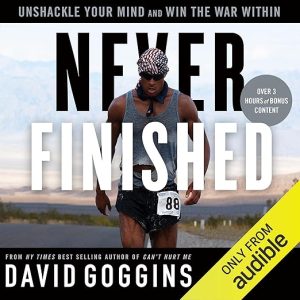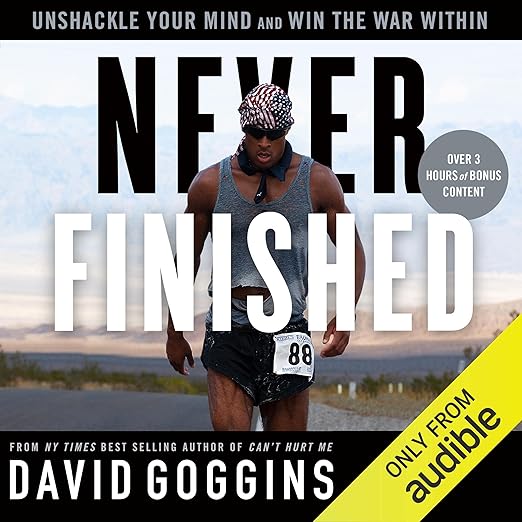
Goggins opens by refusing the label on his own shelf, and the audiobook edition of Never Finished doubles down. 'This is not a self-help book,' the description announces before anything else, and the sentence is doing more than posturing. It is a warning about method. Eleven hours and six minutes, self-narrated, published by Lioncrest, and structured around the argument that the reader is being confronted rather than coached. Whether that lands depends almost entirely on what you came looking for.
The Ceiling Turned Out to Be a Floor
The book positions itself against its own predecessor. Can't Hurt Me, the memoir that made Goggins a name outside endurance sport, is presented here as an opening statement about what the mind can do rather than the full account. Never Finished is meant to be the machinery: a tour of what the listing calls his 'Mental Lab,' the place where he assembled the psychology and the strategies behind the results. The organizing claim is that the ceiling he kept hitting turned out to be a floor, and that the pursuit itself has no terminal point. It is a memoir doing the work of a manual, a hybrid that sits awkwardly on a page and settles more comfortably in a voice, since spoken delivery lets a story and the lesson drawn from it share the same breath.
The marketing copy strains at one point, promising 'the only book you will ever need,' which is the kind of sentence no book survives contact with. What the reviews actually describe is narrower and more credible. One five-star listener, agreeing that it does not function as self-help, points out that 'the chapters in this book do show how he overcame challenges in his life and that is where you can find some nuggets of knowledge to apply to your situation.' That is an accurate description of the transaction: autobiography first, extractable method second, and the extraction is left to you.
Three Hours That Exist Only on the Recording
The reason to choose audio here is unusually concrete, and I would put it above every other consideration. This edition is annotated, carrying over three hours of extra recorded commentary that the description frames as fuller reflection and stories never told before, and the listing states plainly that none of it exists in other formats. Buy the hardcover and you are missing roughly a quarter of what the audio contains. Very few titles make the format choice that consequential. Most audiobooks are a delivery mechanism for a fixed text, while this one is a longer and materially different work than the book it shares a title with.
Self-narration compounds that. The annotations are, by construction, commentary on his own account, which means the format needs the author's voice rather than merely tolerating it. A hired reader delivering someone else's reflections on someone else's memories would collapse the whole premise. The confrontational register the description promises, 'raw, revealing, unflinching,' is also a register that depends on who is speaking. What I am describing is the architecture of the edition rather than the sound of any given chapter, and the first ten minutes will settle the rest for you faster than a paragraph can.
The book also travels to people who do not otherwise read, which is worth taking seriously as evidence rather than as flattery. One reviewer describes themselves as a hands-on learner rather than a reader and reports finishing it in two days, calling it hard to put down. A second reviewer, equally brief, calls it simply inspiring. That audience profile is precisely the one audio serves best, and it explains why this particular title behaves less like a business book and more like a companion for long training sessions.
An Excuse Is Not the Same as an Ending
The sharpest criticism available comes from a reviewer who otherwise recommends the book warmly, and it is a structural objection rather than a taste one. Their complaint is that the final chapter arrives without a closing evolution, and they say bluntly: 'I think this leaves the book unfinished.' They then begin to wonder whether that effect might be deliberate given the title, though the sentence trails off where the visible review text ends. I think the objection stands on its own. A book about refusing endpoints has an obvious excuse for not supplying one, and an excuse is not the same as an ending.
Expectation management matters here more than usual. This listing sits under career success, which is close to a category error. Nothing in it addresses promotion, negotiation, workplace strategy, or professional development in any conventional sense. A listener who arrives from that shelf wanting frameworks will get a memoir with a philosophy welded to it. The tone is also non-negotiable by design: the whole method rests on refusing to soften difficult material, and anyone who finds that mode counterproductive rather than clarifying should believe their instinct rather than push through.
The visible feedback also mixes formats in a way worth noticing. One four-star rating here concerns a physical copy that arrived damaged in transit and says nothing whatever about the content. A single entry like that tells you the average gathers print buyers alongside listeners, so the score is not a verdict on this recording specifically. That matters more here than on an ordinary title, precisely because the audio carries three hours the printed book does not, meaning the two products being scored together are genuinely different works. Anyone weighing the star figure should discount it accordingly and rely on the sample instead.
Eleven Hours Plus Three of Commentary
Existing readers of Can't Hurt Me are the clearest audience, and the annotated audio is the version I would send them to rather than the printed book. Endurance athletes, military and first-responder listeners, and anyone in a long rebuilding stretch will find the register familiar and useful. Listeners who respond to being challenged rather than reassured should also note that this is the rare motivational title where the author's own history supplies the credential, which one reviewer summarized as a true account of starting with nothing and ending up among the most elite and respected athletes anywhere.
Career-strategy seekers are on the wrong shelf entirely and should work that out early rather than fifty pages in. The same goes for readers who need warmth, gradualism, or an author who meets them halfway, since the method here is deliberately abrasive. Those unmoved by the previous book will not be converted by this one. Everybody else gets eleven hours plus three of commentary, and the commentary is the part that makes the format choice matter.
- Read by: Goggins reads his own annotated edition, which the format requires, since the bonus material is commentary on his own account.
- At its heart: mental conditioning, self-confrontation, rebuilding after failure, refusal of endpoints
- Vibe: Abrasive and relentless, with no interest in comforting you
- Short version: The annotated audio is the definitive version, and the only one worth buying if the format is your choice.
What does the annotated audiobook include that the print edition does not?
More than three hours of recorded commentary, presented as fuller reflection plus stories never told before, which the listing confirms exists nowhere else. That makes this version roughly a quarter longer in content than the printed book. Choosing between formats here is not a neutral decision.
Do I need to read Can't Hurt Me before this audiobook?
Not strictly, though it helps. The earlier memoir is framed as a first demonstration of what untapped ability looks like, with this one supplying the machinery behind it. A newcomer can follow the life story, but the method chapters land harder once the first book is already in place.
Is this a business or career book?
No, whatever the shelving says. Promotion, negotiation, and workplace strategy never come up. This is autobiography with a philosophy welded on, and one reviewer notes that the usable material comes from watching how specific setbacks were handled rather than from any framework handed over directly.