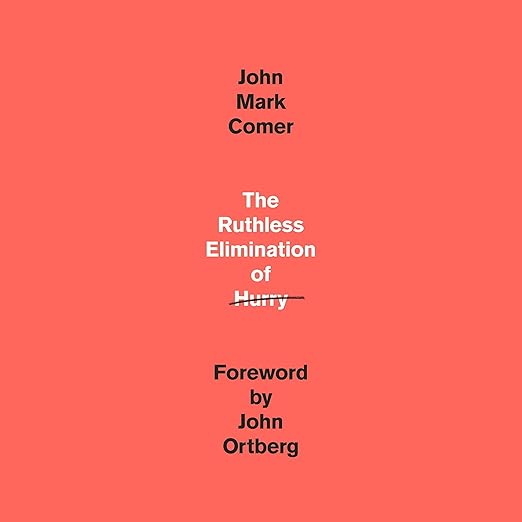
John Mark Comer wrote The Ruthless Elimination of Hurry out of a crisis recognizable to a lot of people in professional and ministry life: the gap between how you appear to the outside world and what is actually happening inside. This audiobook captures that crisis honestly from its opening pages, and Comer's willingness to use his own story as evidence rather than illustration gives the material a quality of personal reckoning that sets it apart from the broader genre of Christian productivity and spiritual wellness books. He is not presenting a system he has mastered. He is presenting a practice he needed and is still learning.
The Great Enemy Is Hurry Itself
The central premise comes from a conversation with a mentor: ruthlessly eliminate hurry from your life, because hurry is the great enemy of the spiritual life. Comer spends the book unpacking why that counsel is so much harder than it sounds, and why our standard approaches to the problem, time management, calendar optimization, productivity systems, all treat symptoms rather than the underlying condition. His argument is that hurry is not primarily a scheduling problem but a spiritual one, rooted in anxiety, ego, and a disordered relationship with time that modern life both reflects and amplifies. This is a more serious claim than many books in the genre are willing to make, and Comer makes it with enough intellectual honesty to resist easy resolution.
The framework he draws on is rooted in the Jesus tradition, specifically the ancient practices of Sabbath, simplicity, solitude, and silence. For readers in the Reformed or evangelical Protestant tradition, much of this material will feel familiar; for those outside that tradition, Comer is clear enough about his premises that the practices themselves can be evaluated on their own terms. Reviewer T.S. Rock's observation that this is not about time management or eliminating calendar commitments is accurate and important: Comer is after something more interior, the quality of attention and presence that busyness systematically erodes regardless of how efficiently you schedule your hours.
One Reviewer Went From Audiobook to Journal
Self-narration from Comer is the right call for this material. He is a pastor, and his natural register is pastoral: attentive to the listener's resistance, comfortable with silence, not in a hurry to arrive at conclusions. Listening to him deliver these arguments in his own voice creates a dynamic very different from a professional narrator reading his text. The intimacy is appropriate to the subject matter. One reviewer went directly from the audiobook to purchasing a journal version, which suggests Comer's voice carries enough of the book's spirit to inspire practical follow-through rather than passive consumption.
At five hours and twenty minutes, the runtime is right for the material. Comer does not overstay his welcome or pad the argument with case studies that diffuse rather than sharpen his point. The book is structured as a genuine roadmap, as described in the synopsis, moving from diagnosis of the problem to examination of its roots to concrete practices that address it at the level of habit and formation rather than intention alone. Listeners who have found the broader genre of spiritual wellness books either too shallow or too technique-heavy may find Comer's balance between theological depth and practical guidance a relief.
Emily Felt Disconnected Before, Renewed Afterward
Comer writes from an explicitly Christian theological framework, and this shapes both the diagnosis and the prescription throughout. The argument that hurry is a spiritual problem requires accepting some version of his premises about what spiritual health means and what it is oriented toward. Listeners from outside the Christian tradition who are drawn to the book's cultural critique of busyness will find the practical chapters on solitude, Sabbath, and simplicity translatable to secular contexts in some respects, but the underlying framework is not neutral. Comer is not trying to write a general self-help book dressed in religious language; he is writing from a specific tradition and is transparent about that.
Reviewer Emily's experience of feeling spiritually disconnected and overstimulated before the book and renewed afterward is representative of the testimonials this book tends to generate. That pattern suggests it works best for listeners who are already somewhere in the Christian tradition, experiencing the gap between faith commitments and daily practice that Comer himself describes. The national bestseller status and one million copies sold indicate that this message has found a very wide audience, which is worth noting, but the book's authority comes from theological rootedness rather than from broad applicability. Listeners should come to it knowing what it is rather than hoping it will offer a secular equivalent.
Old Practices That Feel Like Recoveries
Christians in pastoral, ministry, or creative-professional contexts who recognize the gap Comer describes between outward functioning and interior health will find this audiobook genuinely useful. The practices he recommends, Sabbath rest, silence, simplicity, digital boundaries, are grounded in a tradition that gives them more weight than similar recommendations from secular productivity literature, and Comer presents them with enough historical and scriptural context to make them feel like recoveries rather than innovations. Listeners who want follow-up will find the journal companion version mentioned in reviews a natural next step.
Listeners outside the Christian tradition who are looking for a rigorous secular critique of busyness culture will find Comer's book only partially satisfying, since the diagnosis is inseparable from its theological premise. Those who are in or adjacent to faith communities but have found this genre superficial should give this specific audiobook a serious chance; its willingness to locate the problem at the level of spiritual formation rather than time management is more substantive than most of what the genre offers.
Common Questions
Does this audiobook require a Christian faith background to be useful?
The framework is explicitly Christian and theological throughout. While some of the practices, Sabbath, solitude, simplicity, have parallels outside the tradition, the argument itself is rooted in Christian spiritual formation and works best for listeners who share or are open to those premises.
Is The Ruthless Elimination of Hurry audiobook a time-management guide or something different?
Comer explicitly argues against treating busyness as a time-management problem. The book addresses the spiritual and emotional roots of hurry rather than offering productivity strategies, so listeners expecting scheduling advice will need to adjust their expectations.
At just over five hours, does this audiobook cover the material in adequate depth?
The runtime reflects a focused argument rather than a padded one. Comer builds his case systematically from diagnosis to practices without unnecessary repetition, and most listeners find the length well-matched to the content rather than feeling rushed or incomplete.