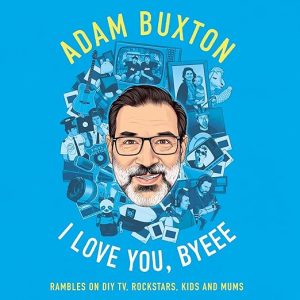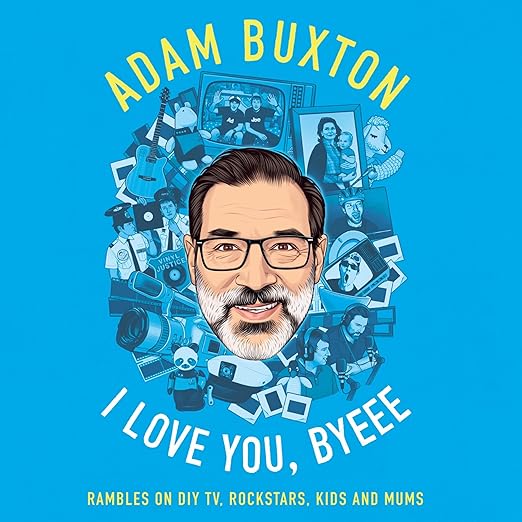
Adam Buxton's follow-up to his bestselling Ramble Book arrives as this audiobook, I Love You, Byeee, and its listed narrator field is empty in the cataloguing data, which is genuinely peculiar for a memoir this personality-driven. The absence of narrator credit raises the practical question of who is actually reading it, and the publisher's own synopsis ends with a parenthetical recommendation to download the audiobook for bonus material and original music, which suggests the audio version is either self-narrated by Buxton or read by someone the catalogue forgot to credit. For accuracy's sake, listeners should verify at point of purchase, because the reading voice matters enormously in a memoir this dependent on comic timing.
Set aside the cataloguing anomaly and I Love You, Byeee is exactly the kind of book Buxton's audience has been waiting for. The Observer called it poignant and properly funny, a bracing dip into nostalgia, but self-aware, too, and that covers the territory accurately. The memoir picks up the thread of his work with Joe Cornish on Adam and Joe, their celebrated British comedy partnership that ran from DIY public-access style television through radio and into the early podcast era. Buxton frames this not as nostalgia alone but as a reckoning with what that collaboration meant, what it cost, and what the transition into middle age and the losses that come with it actually feels like.
Buxton writes with a self-deprecating intelligence that does not become false modesty. His accounts of hanging around with Travis and Radiohead, described with characteristic understatement as notorious rock and roll hellraisers, demonstrate exactly the kind of dry deflation that made Adam and Joe a cult phenomenon. The humor is specific, mined from actual memory rather than generic anecdote, and the difference between Buxton's comic voice and the warmed-over celebrity reminiscence mode is clear on every page.
The memoir is also notably honest about loss. Buxton writes about his mother's death with the same register he uses for the Bake Off section and the argument-with-wife set pieces: with humility, with precision, and without sentimentality. That tonal consistency is harder to achieve than it looks. A book that moves between comedy about Louis Theroux giving instructions on edginess and grief for a parent has to earn its emotional range, and I Love You, Byeee earns it by never treating either register as more legitimate than the other. The drug incident that nearly ended his life in a comedy legend's arms is handled with enough specificity to feel serious and enough self-awareness to avoid melodrama.
Bonus Waffle Runs to Hours of Audio
The synopsis's promise of hours of bonus waffle and original music suggests the audio version extends the text in meaningful ways. Buxton's podcast work has established that he thinks in audio natively; his podcast episodes frequently run long not because he lacks discipline but because the medium suits the way his mind moves through anecdote and digression. That sensibility likely translates into an audio experience that is genuinely different from the print edition, not just a reading of it. Listeners who have never encountered Adam and Joe's output should note that some of the specific comedic references assume familiarity with British alternative comedy of the late 1990s and 2000s, but the emotional material around parenting and grief does not require that background at all.
The reviewer who observed that the book's predecessor, Ramble Book, would have been better experienced in audio form is making a point about authorial voice. Buxton's writing is performative in the sense that it implies a delivery, and readers who know his podcast will hear his voice in the sentences regardless of who actually reads the text. If Buxton does indeed narrate this one himself, as the publisher's hint at bonus material suggests is likely, the audiobook becomes the primary edition rather than a secondary format.
Association and Mood Replace Strict Chronology
The memoir's structure is looser than a traditional linear autobiography, which suits Buxton's rambling mode but may frustrate listeners expecting a conventional arc. This is a book organized around association and mood as much as chronology, and the chapters on DIY television and early podcasting may feel like detours to listeners who came primarily for the grief and parenting material, or vice versa. Both threads are present throughout, and the book rewards patience with the digressions.
At 10 hours and 13 minutes, I Love You, Byeee is a comfortable audiobook length for the material. Buxton's fans will likely finish it quickly; newcomers will find it a reasonable introduction to a sensibility that rewards the investment. The parenthetical about parenting a child and losing a mother in the same period gives the book its emotional spine, and the comedy never becomes a way to avoid that material but rather the particular mode through which Buxton processes it honestly.
Grief and Parenting Need No Comedy Background
The obvious audience is Buxton's existing fanbase from his podcast and the Adam and Joe era, and they will not be disappointed. But the parenting and grief material opens the book to listeners who have no background in British alternative comedy at all. Anyone who has navigated the specific emotional complexity of losing a parent while simultaneously raising children will find something true in I Love You, Byeee that does not require prior knowledge of Radiohead adjacency. Skip this one if you need a memoir organized around a clear thesis or a single coherent narrative arc; Buxton's book is, true to its title, a fond and slightly chaotic farewell that contains multitudes.
Frequently Asked Questions
Does I Love You, Byeee work as an audiobook for listeners who have never heard Adam Buxton's podcast?
Yes, though the Adam and Joe-era television references will land better with some background. The sections on grief, parenthood, and middle age are fully accessible without any prior familiarity with Buxton's work.
Is I Love You, Byeee a standalone audiobook or do listeners need to start with Ramble Book first?
Standalone. Ramble Book enriches the context, but I Love You, Byeee introduces its own material fully and does not assume you have read the predecessor.
The narrator credit appears to be missing from the audiobook listing for I Love You, Byeee. Who actually reads it?
The publisher's own synopsis suggests bonus audio content and original music that implies Buxton's direct involvement in the production, but confirm the narrator at point of purchase since the catalogue data is incomplete.
What is the tone of the I Love You, Byeee audiobook: primarily comedy or primarily serious memoir?
Both registers are genuinely present and consistently managed. The book moves between comedy about Louis Theroux and Radiohead and honest writing about grief and parenthood without treating either as a digression from the other.