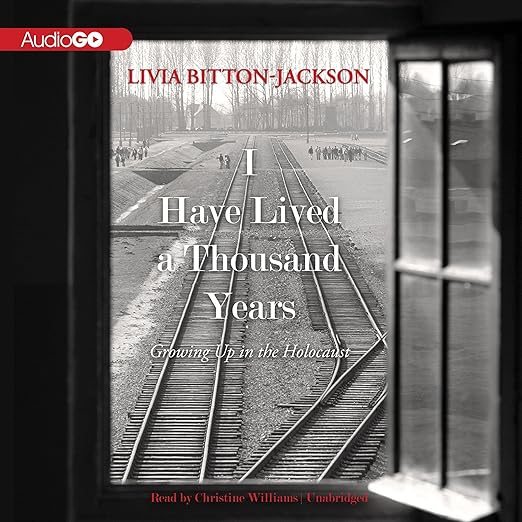
Elli Friedmann's memoir stands apart from other Holocaust accounts because of how specifically it inhabits a thirteen-year-old's consciousness, and this audiobook makes that quality audible in ways the print edition cannot fully achieve. Christine Williams narrates with a restraint that is exactly right for material this severe, never reaching for emotional effect but never retreating from it either. The result is one of the more important YA nonfiction audiobooks in this category.
How I Have Lived a Thousand Years Holds Up
In March 1944, Elli Friedmann was a thirteen-year-old girl in Hungary who loved school and boys and her family. Then the Nazis arrived and her world was dismantled in the systematic, bureaucratic way that Bitton-Jackson renders with terrible precision: first the prohibitions, then the ghetto, then the transport, then Auschwitz. Her golden braids, which her captors found aesthetically useful for their purposes, led to her selection for work rather than the gas chamber. She survived because of that and because of a sequence of small, contingent miracles that she does not attempt to explain away with the comfort of retrospect.
What distinguishes this memoir from many others in the Holocaust genre is Bitton-Jackson's insistence on the teenager's perspective. She does not reconstruct the history from an adult vantage point that has processed and contextualized the events. She writes, as nearly as possible, from inside the consciousness of the girl who was there, which means the narrative preserves a quality of incomprehension and shock that more distanced accounts lose over time. The atrocities do not arrive as historical knowledge but as events that keep happening to a person who cannot make full sense of them while they are unfolding.
The intimacy is excruciating in the literal sense. This is not distant historical narration. It is close and personal and sometimes very hard to be with. Reviewers note needing to pause and return, to step away from the grief and anger the book induces before coming back. That response is appropriate and intended. Bitton-Jackson is not writing to be easy on the reader, and she should not be.
Why I Have Lived a Thousand Years Works as an Audiobook
Christine Williams's narration is essential to the audiobook's power. She keeps a quality of controlled feeling throughout that matches the text's own restraint. Where Bitton-Jackson writes about suffering without excess sentiment, Williams narrates without melodrama, and the effect is more devastating than a more performed reading would produce. The spaces between what is said and what is implied are audible in Williams's delivery in a way that print cannot fully convey to a reader processing alone.
For the intended audience of older teenagers, the audio format offers something the print edition does not: a voice to bear witness alongside. Elli's story, told in Williams's narration, becomes a shared experience rather than a private reading, which matters for material this serious. Many teachers have used the print edition in classroom settings; the audiobook serves a similar communal function for group listening contexts, making it possible for a teacher or group leader to guide responses to the material in real time.
At just under seven hours, the audiobook is substantive without being overwhelming. The chapters are relatively short, which allows listeners to pause and process without losing narrative thread. The pacing is humane for the material, giving the testimony room to land without driving past its own weight.
Weak Spots in I Have Lived a Thousand Years
The book covers Auschwitz with specificity. This is not a memoir that maintains a safe narrative distance from the camp's conditions, the selections, the labor, the starvation, the deaths. Listeners should know this before beginning. It is not gratuitous, it is truthful, and the truth is severe. Parents choosing this for younger teenagers should be confident their child is emotionally ready for that level of honest content.
The narrative focuses almost entirely on Elli's immediate experience rather than on the broader historical context of the Holocaust. Readers looking for political and historical framing will need to supplement with other sources. This is a memoir of survival, not a history of the genocide, and that specificity is both its greatest strength for emotional immediacy and its primary limitation for contextual understanding.
Some editions include maps and photographs that are not present in the audiobook format. These materials add context that some listeners will want access to alongside the listening experience. Reading alongside a print copy or supplementing with historical resources is worth considering if this is being used for educational purposes.
The Right Listener for I Have Lived a Thousand Years
Appropriate for older teenagers, roughly fourteen and up, and for adults who want a survivor memoir pitched at emotional directness rather than analytical complexity. Reviewers who describe themselves as long-time readers of Holocaust memoir consistently place this among the most affecting accounts they have encountered in the genre.
For educators, the audiobook is a powerful complement to the print edition for classroom or small-group study. The narration gives the testimony a different quality of presence than silent reading provides. For listeners approaching Holocaust memoir for the first time, this is an important starting point precisely because it refuses to mediate the experience through historical distance. Christine Williams's performance honors that refusal fully.
A note for listeners who have read widely in Holocaust memoir: Bitton-Jackson's approach is distinctive not only for its youth perspective but for its insistence on the specific and the sensory. She does not write in abstractions about suffering. She writes about what things smelled like, what people said at precise moments, what small objects became talismanic. That granularity is what makes I Have Lived a Thousand Years feel different from more distanced accounts, and it is what makes Christine Williams's narration so essential as the vessel through which that specificity reaches the listener.
In Brief
- Read by: Christine Williams brings a controlled, unmelodramatic gravity to Bitton-Jackson's testimony that amplifies rather than decorates the material.
- At its heart: Survival, the fragility of normal life, the role of contingency and small miracles in extreme circumstances, and what it costs to bear witness.
- Vibe: Severe, intimate, and deeply serious, not a comfortable listen but a necessary one for the right audience.
- Short version: One of the most affecting Holocaust survivor memoirs in the YA space, significantly enhanced by narration that respects the weight of the material.
Common Questions
Is this audiobook appropriate for middle school students?
The book is marketed as YA but the content is serious. Most educators recommend it for grades nine and up, roughly age fourteen. The Auschwitz content is truthful rather than gratuitous but genuinely severe, and younger students benefit from adult support during and after listening.
How does this audiobook compare to other Holocaust memoirs like Night by Elie Wiesel?
Both are essential survivor memoirs but they differ in approach. Wiesel's Night is compressed and has a more literary quality. Bitton-Jackson's account is longer, more specifically attentive to the teenager's perspective, and more focused on the intimate texture of daily survival. Many readers find this more emotionally immediate.
Is a content warning appropriate for this audiobook?
Yes. I Have Lived a Thousand Years depicts the conditions of Auschwitz with specificity, including the selection process, forced labor, starvation, and deaths of prisoners. It is truthful rather than gratuitous but deeply serious. Listeners sensitive to graphic depictions of historical atrocity should approach with that knowledge.