
The Short Version
- Narrator: Erin Bennett is credited for IT Revolution, delivering a staged model whose diagrams live in the companion PDF rather than in the audio.
- Subjects: AI transformation as organizational change, staged maturity, governance and role design, resistance.
- Tone: Measured, strategic, deliberately unhyped.
- Bottom line: A credible change-management frame for AI adoption, unproven on this page and best used with the PDF open.
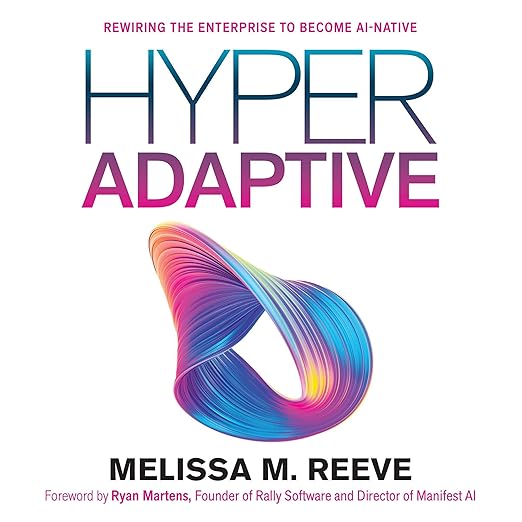
Blueprint is the word this audiobook keeps returning to, and it is an accurate one: Melissa M. Reeve is not writing about what artificial intelligence can do, but about what it does to the shape of a company that tries to use it. The opening move is a refusal, telling you plainly that this is not another book about AI technology. What follows is a five-stage progression from an initial foundation to something the book calls organizational orchestration, published by IT Revolution on May 12, 2026, with Erin Bennett reading and a supporting PDF supplied alongside the audio.
Leaders Have No Blueprint Even When the Path's Clear
Reeve identifies the right problem, which is more than most books in this category manage. Pilots succeed and then nothing happens: the win stays inside one team, collides with the culture around it, and quietly stops. That gap between a working experiment and a changed organization is where the money goes missing, and the description names the reason without flinching, which is that leaders have no human blueprint to follow even when the technical path is clear. Framing an AI book as a change-management book rather than as a tools book is the decision that gives this one a chance of aging well.
Toyota, Nike and Moderna are the named examples, and the choice tells you the intended altitude. These are large, old, physically complicated companies rather than software startups, which matters, because the hard cases in this transition are precisely the organizations with existing processes worth protecting. The claim attached to them is that they moved from running projects to becoming organizations that sense, respond and evolve at the speed the technology sets. Whether the case studies support a claim that strong is the sort of thing you can only judge with the book in front of you.
The Messy Middle Gets Its Own Chapter
Eighty percent of AI initiatives fail, according to the description, and the book undertakes to explain why and how to avoid the predictable versions of that failure. Whatever you make of the figure, the promise behind it is the useful one: failure here is treated as patterned rather than as bad luck. The section the copy calls the messy middle, where old structures collide with new capabilities, is the part most transformation books skip entirely, and giving it a name and a chapter is the kind of practical honesty that earns trust from people who have lived through one of these programs.
Governance, roles and resource allocation are where the book gets specific, and that specificity is the reason to choose it over a keynote. Restructuring who decides what, and how budget follows a capability that did not exist last year, is unglamorous work that determines whether anything survives contact with an organization chart. The copy is careful not to oversell it, saying outright that no overnight transformation is on offer and describing progress as incremental. In a genre built on urgency, that restraint reads as confidence. Four decades of organizational research sit behind the argument, according to the description, which is a way of saying that most of this thinking predates the technology and has simply been pointed at it.
Bennett Reads It, and Stage Three Needs a Page
Frameworks are the format risk. A five-stage model with concrete actions per phase is designed to be seen, held in view, and referred back to, and hearing stage three described while you are driving is not the same as having the five stages on one page in front of you. The PDF that ships with the file exists precisely for this, and treating it as optional would waste half the purchase. Anyone planning to actually apply the model should expect to listen once for the argument and then work from the document.
Adoption of the book itself has not been measured yet, and buyers should know how little the page can tell them. Released in May 2026, this record carries no rating, no rating count and no written comment of any kind, which is normal three months into the life of a business title and still leaves you buying on the strength of the description alone. Everything above, the eighty percent, the four decades of research, the named companies, is a publisher claim that nobody outside the project has yet tested in public.
A Shared Vocabulary for Leaders to Argue In
Executives with budget authority are the primary audience, and the copy says so, addressing senior leaders setting strategy, division heads implementing it, and the people it calls change champions who push adoption from inside. That is a wide brief, and the risk of writing for all three is a book that lands slightly above everyone's actual job. Read it as the shared vocabulary a leadership team can argue in, rather than as instructions for any single role, and it does the work. Anyone who has sat through a transformation program that died between the pilot and the second department will recognize the failure modes being named here.
Orchestration is the destination the book names, and the people it will not serve are equally clear: engineers wanting implementation detail, small teams without an organization to restructure, and anyone hoping for prompts and tool comparisons. Nothing on this page has been tested by a buyer yet, so the honest position is that the framing is strong, the intended reader is a leader with a real transformation to run, and the proof will have to arrive later.
A Few Questions About Hyperadaptive
Is the Hyperadaptive audiobook aimed at technical teams or at leadership?
Leadership, explicitly. The description addresses senior executives setting strategic vision, division leaders running implementations, and internal change champions driving adoption. Engineers looking for architecture, tooling or model selection are not the intended audience and will find the altitude high throughout.
How quickly will this audiobook date?
Slower than most AI titles, because the subject is organizational structure rather than tooling. The five-stage model and the material on governance and roles should hold, while the named case studies and the failure statistic are pinned to a May 2026 publication and will age faster.







