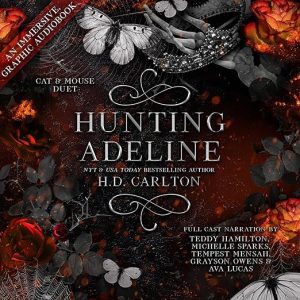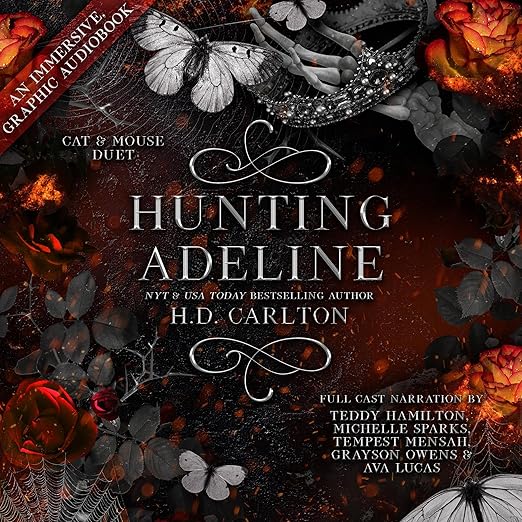
Adeline Reilly ran from Zade for the entire span of Haunting Adeline before falling for him, so what is left to fear once the mouse has already surrendered to the cat? That is the question this audiobook has to answer, since Hunting Adeline is the concluding half of H. D. Carlton's Cat and Mouse Duet, and it answers it by trading the courtship-through-terror of book one for something considerably darker: a trafficking ring, a house called Parsons Manor built to groom women for the elite, and a survival trial called the Culling that Adeline has to win just to stay alive. The synopsis opens with a line that sets the tone before the story even starts, 'If she were to die... the world would die with her,' and the nineteen hours that follow spend themselves proving that is not an exaggeration.
Endurance and Desperation Drive the Back Half
Where Haunting Adeline built its tension out of a stalker's obsession and a woman slowly realizing she wanted to be caught, Hunting Adeline widens the frame considerably. Adeline is no longer just running from Zade, she is trapped inside a house designed to break women down before selling them to people who consider that ordinary business, and the horror-adjacent haunted-hallway atmosphere of the first book gives way to something closer to a thriller about captivity and endurance. One five-star reviewer called it 'not just a sequel, it's an emotional reckoning,' and that framing holds up: this is a book more interested in what survival costs than in prolonging the chase.
Structurally, the story splits its attention between Adeline's fight to survive the Culling from the inside and Zade's refusal to accept that he might not find her in time, described in the synopsis as a man willing to 'burn the world' to get her back. That dual pressure, her endurance against his desperation, is what gives the back half of the duet its momentum, and it pays off plot threads that Haunting Adeline spent its runtime setting up rather than introducing a new set of problems for the sake of length.
Underneath the trafficking-ring plot, Carlton keeps a thread of the first book's gothic atmosphere alive. The synopsis still gestures toward the unholy ghosts haunting the hallways of Parsons Manor that gave Haunting Adeline its early chill, and that paranormal texture never fully disappears even as the story pivots toward a more grounded, high-stakes thriller structure. It is a genre blend, gothic horror bleeding into captivity thriller bleeding into romance, that gives the book a distinct flavor within the wider dark romance shelf rather than reading as a single-lane genre exercise.
Hamilton Makes Zade's Obsession Sound Like Confession
Teddy Hamilton narrates, and listeners who know his other dark-romance work will recognize the register immediately: he is well established at delivering obsessive, first-person male intensity as confession rather than performance, letting a character's irrationality come through as something the character is half-aware of rather than something the narration is winking at. That skill maps directly onto Zade, whose entire arc here is a man who knows exactly how far he is willing to go and does it anyway. Carrying both Adeline's captivity chapters and Zade's hunt in the same performance is a real range test, and it is the reason this audiobook does not feel like two separate stories stitched together.
For listeners who finished Haunting Adeline already invested, this is the payoff volume, and reviewers describe it in exactly those terms. One reader wrote that the book 'destroyed me but also put me back together,' which is about as honest a description of a duet finale as you will find, and it signals that the emotional intensity here is not incidental spice dressing but the actual point of the story. The trafficking-ring plot gives the romance real external stakes rather than leaving the tension entirely inside the central relationship, which keeps the back half from feeling repetitive.
The book's reception also says something about how far this duet's audience reaches beyond its original English-language readership. Alongside the five-star English reviews quoted above, one reader left an equally enthusiastic five-star review written entirely in Portuguese, describing the story as heavy enough that they repeatedly stopped to consider whether to keep going, then pushed through for Adeline and Zade regardless of the toll it took. That kind of response from readers well outside Carlton's primary English-language market is a genuine signal of how far this particular story has traveled, dark subject matter, trafficking plot, and all, and it says something about how universally the central romance lands even in translation.
Nineteen Hours of Plot Rather Than Padding
This is explicitly not a standalone listen. The synopsis itself carries a direct warning that Hunting Adeline is 'the second and final installment,' and it will not make sense without Haunting Adeline first. Carlton also situates both books inside a wider Cat and Mouse universe alongside Satan's Affair and Where's Molly, so listeners who want the fuller picture have a specific recommended order to follow rather than picking titles at random.
Content-wise, this is heavy listening by design, not by accident. Between the trafficking plot, the psychological toll of captivity, and a central relationship that began with literal stalking, this is dark romance in the fullest sense of the term, and the explicit content is frequent and unambiguous. One reviewer described crying, feeling disgusted, screaming, laughing, and blushing over the course of the story, which is a fair preview of the emotional range required of you as a listener. If stalking-as-love-language or trafficking as plot device are hard limits, no amount of narration quality will make this a comfortable listen.
At nineteen hours and fourteen minutes, Hunting Adeline runs noticeably longer than a typical single-title dark romance, and that extra length goes almost entirely toward the trafficking-ring survival plot rather than dragging out the central relationship; listeners should expect the added runtime to deliver real plot movement, not padding. With a 4.4-star average across just over 140 ratings at the time of this review, reception is still accumulating relative to its predecessor, though early response tracks consistently positive.
Finish Haunting Adeline Before Starting This One
This audiobook is built for listeners already fluent in dark romance, readers who finished Haunting Adeline and want Adeline and Zade's story resolved rather than left open, and anyone who prefers a love interest with real moral weight on him rather than a safely reformed bad boy. If you want romance with plot stakes that extend past the central couple, the trafficking-ring survival arc delivers that.
Skip this one if you have not listened to Haunting Adeline, since the emotional and plot logic depends entirely on that setup. Skip it too if dark romance conventions, obsession framed as devotion, captivity, and trafficking themes specifically, are things you would rather not spend nineteen hours inside, however well the craft around them is handled.
- Read by: Teddy Hamilton brings his established dark-romance register to Zade, carrying obsessive first-person intensity across both halves of a dual-perspective story without losing the thread between them.
- At its heart: captivity and survival, stalker-turned-protector romance, loyalty tested against a trafficking conspiracy
- Vibe: Heavy, claustrophobic, and emotionally unrelenting
- Short version: A satisfying, intense close to the duet for listeners who finished Haunting Adeline and want the darkest version of this love story resolved, not softened.
A Few Questions About Hunting Adeline
Do I need to listen to Haunting Adeline before starting the Hunting Adeline audiobook?
Yes. The synopsis states directly that this is the second and final installment of the Cat and Mouse Duet, and the plot picks up mid-story with no recap of the first book's events.
Where does the Hunting Adeline audiobook fit in the wider Cat and Mouse universe listening order?
H. D. Carlton lists the recommended order as Satan's Affair, then Haunting Adeline, then Hunting Adeline, then Where's Molly, so this is the third entry overall even though it is the second half of the core duet.