Key Details
- Performance: David Bendena is handed eight and a half hours of dates, instruments, witnesses and Utah place names that a listener cannot glance back at.
- What it covers: fifty years of unexplained events at one address, science pushed past its own instruments, what a research team could and could not record.
- Feel: Dry and methodical on the surface, genuinely unsettling underneath.
- Our call: The primary source behind a television phenomenon, on a listing whose credits and arithmetic both need correcting.
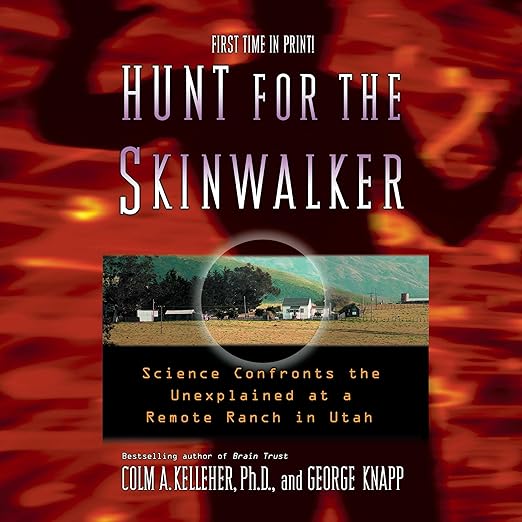
Two doctorates sit on the byline of this audiobook, printed twice in a row and abbreviated the same way both times, and a co-author sits nowhere on it at all. Colm A. Kelleher's account of the years a research team spent on a remote Utah ranch is credited to Kelleher alone, while the description names investigative reporter George Knapp as the only journalist permitted to witness and document that work. Simon & Schuster Audio issued eight hours and forty-two minutes of it on April 14, 2026, read by David Bendena. Who actually made this book is the first question the record leaves hanging.
First, the Big Picture
The byline question gets settled, without anybody meaning to settle it, by the entry filed from the United Kingdom. That entry describes the book as written by investigative journalist George Knapp and scientist Colm Kelleher, naming both, in that order. The description agrees in substance and puts Kelleher first. The author field names one of the two. So the page's own evidence points at a collaboration while its most searchable field points at a sole author, and anyone looking for Knapp's work will not find it filed here.
That matters more than a credit line usually does, because the division of labor is the book's method. A scientist ran the instrumentation and the fieldwork. A reporter documented what the team did and did not manage to capture. Those are two different kinds of authority, and the value of the account depends on both being present. A record crediting one of them describes a weaker book than the one the copy is selling.
The byline carries a second, smaller problem. It reads Colm A. Kelleher Ph.D. Ph.D., with the credential printed twice. That is a data slip rather than a claim, and it belongs to a class of listing defect worth noticing on nonfiction in particular, where credentials are part of the sales argument. A page that cannot state its author's name cleanly is not the strongest frame for a book asking you to take its science seriously.
What Makes Hunt for the Skinwalker Worth Hearing
A December 2018 five-star does the best job of describing what the book actually contains. That entry places the property, the Gorman Ranch, just south of Ballard in Utah, notes that it became known through Utah and Las Vegas news coverage, and then itemizes the phenomena: dire wolves, cattle mutilations, orbs that zapped a dog. Whatever a listener concludes about any of it, the inventory is what makes the book work. It is specific, it is dated, and it is attached to one address rather than floating free the way most writing in this territory does.
Television is how a good part of this audience now arrives, and the column's only four-star, filed in May 2025, describes the route exactly. That reader came from the History Channel series about the same ranch, went looking for news of the next season, and found an article pointing at this book instead. The same entry describes the show's research team repeatedly mentioning the earlier Bigelow program that studied the property before the current owner bought it, and a feeling among that group that the earlier researchers should have shared more. This book is the earlier program's own account, which makes it a primary source for an audience that has only heard it described.
Kelleher's stated ambition raises the stakes above ghost-story level. The copy frames the conclusions as hair-raising in their implications and calls the book a clarion call to expand our vision beyond what we know, and the earlier title the copy attaches to that byline, Brain Trust, is described as a controversial bestseller. Whether that ambition is earned is the argument the book invites, and eight and three quarter hours is a sensible length in which to have it.
A Few Reservations
Written in Italian and filed from Italy in February 2022, the sharpest criticism in the column arrives inside a recommendation. Its single complaint is that it expected more scientific reporting on the events and found comparatively little, with the narrative concentrating instead on the people at the center of it. That reader was won over anyway by the historical material and the digressions on Native Americans, praising the richness and precision of the regional detail. Buyers arriving for laboratory data rather than for story should weigh that carefully.
The numbers on this record do not work. The badge shows 4.5 across three ratings, and five written responses are attached to the page. Three whole-star votes cannot produce a 4.5: thirteen over three displays as 4.3 and fourteen over three displays as 4.7, so nothing lands where the badge sits. Separately, a counter of three cannot account for five people who each left a grade. Whatever that average is measuring, it is not the column printed beneath it, and the five entries are the more reliable read.
Shelving is a mess as well. The record carries Religion and Spirituality, Science and Engineering, and Sports and Outdoors, with an Occult tag beneath. Two of those are arguable and one is not, since nothing in this book belongs on a sports shelf. The consequence is practical rather than cosmetic: a listener browsing for paranormal investigation or for fringe science may never see a title filed three categories away from either.
Who Should Pick Up Hunt for the Skinwalker
Its natural audience is described precisely by a February 2026 five-star that reads, almost in full, that the book is a good read and makes you think, bought in order to go to the source after hearing so much about it, and unavailable at the local library. Somebody who has absorbed this ranch through television and podcasts and now wants the account all of that was built on gets exactly that here. Curiosity rather than belief is the useful posture.
Skeptics who need controlled data and a clean chain of evidence should know that this is the narrative of an investigation rather than a report from one. Bendena's job across eight and a half hours is to keep dates, instruments, witnesses and locations straight for a listener who cannot glance back at a page. Sample two minutes of the ranch chronology and you will know quickly whether that holds.
Common Questions
Who narrates Hunt for the Skinwalker, and how long is it?
David Bendena reads, across eight hours and forty-two minutes, published by Simon & Schuster Audio on April 14, 2026. That is a single long weekend of listening for a book covering more than fifty years of reported events at one property.
Why does the audiobook credit only one author?
No explanation appears on the page. The author field carries Colm A. Kelleher alone, while the description names investigative reporter George Knapp as the only journalist allowed to witness and document the team's work, and credits the chronicling to the two of them jointly. Searchers looking for Knapp never reach this listing.
Does the audiobook contain actual scientific data?
Partly. The copy promises the theories of modern physics behind the phenomena alongside firsthand observation by a team of research scientists, and it describes the conclusions as far from coldly detached. Expect an investigative narrative that reports on instrumentation rather than a paper that presents its measurements.
Is this the source book behind the television coverage?
The record makes no claim of any connection to a series. What the description documents is a scientist spending hundreds of days and nights on the property with a research team, which this book was written to chronicle. Anyone arriving from a program about the ranch should expect a source account rather than a companion volume.