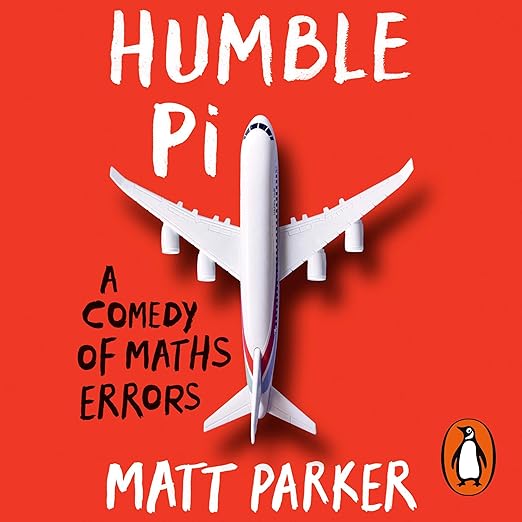
Parker's bridge wobbled, and it wobbled for a reason nobody in the engineering team had calculated correctly. That is the kind of story at the heart of Humble Pi, the audiobook written and read by Matt Parker, a comedian and mathematician whose central argument is that mathematical errors are everywhere in modern life and that most of them are preventable. This self-narrated audiobook runs just over nine and a half hours and benefits enormously from Parker's own delivery, which carries the dry observational precision of someone who has spent years explaining mathematics to audiences who do not think they care about it.
First, the Big Picture
Parker's method in this audiobook is to start with the absurd and work backward to the mathematics. A gym class jumping to a 1990 pop hit causes a building to resonate at its natural frequency. Billions of dollars vanish from accounts due to a floating-point rounding error. An Olympic shooting team's results are affected by a software glitch nobody caught in time. These are documented incidents, and Parker catalogs them with the affectionate exasperation of someone who cannot quite believe that real systems failed in these particular ways. The effect, spread across nearly ten hours, is cumulative. By the time Parker arrives at his cases involving financial systems and election software, the listener has already internalized the book's central claim: mathematics is not an abstract discipline. It is the infrastructure beneath everything, and when it breaks, the consequences are disproportionate to the size of the original mistake.
The self-narration is the single most important feature of this audiobook. Parker's timing is precise in a way that a professional voice actor would struggle to replicate, because the jokes are embedded in the mathematics, and only the person who wrote them knows exactly where the punchline lives. He reads the chapter on the Roman Empire's calendar dysfunction with a weariness that makes the section funnier than the text alone would suggest. He reads the chapter on GPS rounding errors with the controlled alarm of someone who has realized, mid-explanation, that the implications are genuinely serious.
Why Listen to Humble Pi
Parker is, among other things, a YouTuber with a substantial following on the Standup Maths channel, and his audiobook delivery reflects that: he is comfortable being interrupted by his own tangents, confident that the digression will pay off. That quality works particularly well in audio form. The book's structure is loose, organized around categories of mathematical failure rather than a strict narrative arc, which means listeners can pause between chapters without losing momentum. Each section functions as its own self-contained examination of a different domain where math goes wrong, from computer code to cartography to financial modeling.
The three deliberate mistakes Parker mentions in the synopsis are a signature move. They invite the listener into a slightly paranoid relationship with the text: everything sounds authoritative, and yet somewhere in these nine hours, three things are factually wrong. Parker does not reveal where they are, and the effect is a useful destabilization of the assumption that confident presentation equals accuracy. That is, quietly, one of the book's most important arguments, delivered with a light enough touch that many listeners will only recognize it as an argument after the audiobook has finished.
A Few Reservations
Listeners who want a sustained, linear argument will find this book's chapter-to-chapter structure loose by design. Parker is not building toward a single thesis beyond the general claim that mathematical errors matter more than we admit. Readers wanting a deeper technical treatment of any individual case, the Millennium Bridge resonance problem or the Ariane 5 rocket disaster, will find the audiobook gives each incident a single chapter's worth of attention before moving on. Parker is writing for general audiences, not engineers, and the depth of treatment reflects that. As one reviewer noted, listeners with strong mathematics backgrounds will find less technical density than they might want.
The audiobook also contains puzzles and challenges, which Parker integrates into the narration in ways that work better in print than in audio form. Following a geometric proof with your ears rather than your eyes requires a different kind of attention, and Parker's delivery helps, but some of the more visually oriented material loses impact in the listen-only format. The geometric socks referenced in the synopsis are one of several visual jokes that land differently without illustration.
The Right Listener for Humble Pi
This audiobook works well for anyone who has ever wanted to understand why technology fails in ways that seem obvious in retrospect. It does not require a mathematics background; Parker's gift is making errors legible to non-specialists. The chapter structure supports interrupted listening, which makes it practical for commutes or fragmented schedules. Listeners who want a more rigorous treatment of any individual case are better served by dedicated engineering literature, but for a wide survey of the ways human reliance on imperfect mathematics shapes daily life, Parker's audiobook is among the more entertaining available. Skip it if you want either a technical textbook or a purely narrative nonfiction experience; Humble Pi occupies neither category, and its value is precisely in that middle space where comedy and consequence overlap.
Listeners with children who are starting to learn about how computers and financial systems work will also find this audiobook unexpectedly useful as a shared listen. Parker's explanations of why small rounding errors cascade into large real-world failures are the kind of lessons that stick precisely because they are attached to absurd or alarming outcomes. The audiobook does not moralize about the failures it describes. It simply presents them with the appropriate mix of amusement and concern, and leaves the listener to draw the obvious conclusions about the systems we build and the margins of error we accept within them.
In Brief
- Read by: Matt Parker reads his own book with the timing of a practiced stand-up mathematician, letting jokes land without telegraphing them.
- At its heart: Mathematical error in the real world, the hidden cost of rounding, engineering failures from faulty assumptions.
- Vibe: Playful and alarming in equal measure.
- Short version: Parker makes mathematical failure genuinely funny without ever losing the serious point underneath.
Good to Know
Does the Humble Pi audiobook work for listeners with no mathematics background?
Yes. Parker pitches the material at a general audience throughout, and the mathematical concepts are always introduced through concrete real-world failures before any formal description.
Is the Humble Pi audiobook meaningfully different from the print edition?
The self-narration adds considerable value. Parker's comedic timing changes how several of the funnier sections land, and his delivery of the more alarming cases gives them a different weight than silent reading provides.