Quick Take
- Narration: Joseph Chapa reads his own essays with the pacing of a careful thinker, neither rushed nor performative, which suits a collection that rewards slow absorption.
- Themes: AI as a mirror of human nature, tacit knowledge and machine understanding, the philosophical stakes of automation
- Mood: Reflective and surprising, with the texture of philosophy written by someone who has also flown fighter jets
- Verdict: A collection of essays that uses AI as a lens for examining what human beings actually are, and does so with more originality and warmth than most books in this space.
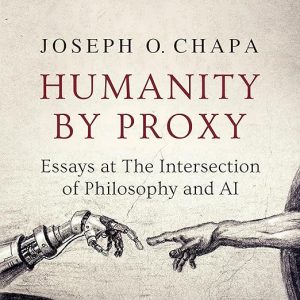
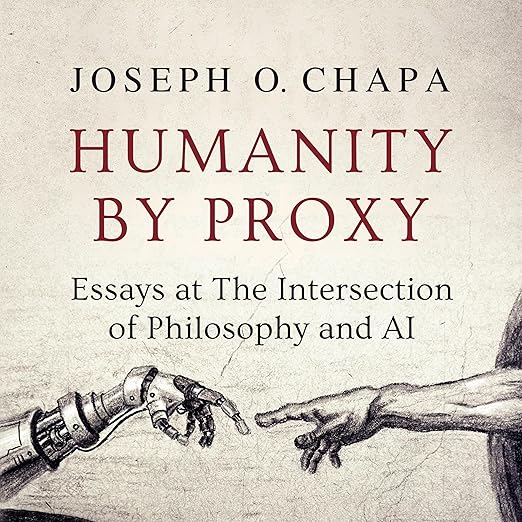
There’s a particular kind of AI book that spends its first three chapters explaining what a large language model is and its final chapter suggesting you go outside more. Humanity by Proxy is not that book. I picked it up expecting another entry in the genre of cautious techno-optimism and found instead something closer to philosophical memoir, a collection of essays that uses artificial intelligence as a way of asking questions about human nature that have always been worth asking.
Joseph Chapa brings an unusual combination of credentials to this material. He is an Air Force veteran who flew combat missions, a philosopher trained in the analytic tradition, and someone who has spent years thinking about the ethics of autonomous weapons systems. That background shows. The book is not written from the position of a technology observer who discovered AI last year. Chapa has been grappling with these questions in professional contexts where the stakes were concrete and the answers mattered for how people lived and died.
Tacit Knowledge and the Wingman Problem
The passage that reviewer Brian Morrison describes, about communicating with a wingman purely through aircraft maneuvers, is worth highlighting because it crystallizes the book’s central philosophical move. Chapa uses it to illustrate tacit knowledge: the kind of understanding that cannot be formalized, that doesn’t exist in any database, that emerges from embodied experience in a specific community of practice. This is not a new philosophical concept. Michael Polanyi developed it in the 1950s. But Chapa’s application of it to AI’s fundamental limitations is precise and illuminating. The machine can produce text that describes tacit knowledge. It cannot have it. That distinction is load-bearing in ways that a lot of popular AI commentary glosses over.
The essay format suits this kind of argument. Rather than building a single extended argument across hundreds of pages, Chapa circles the central questions from different angles: history, pop culture, personal experience, philosophy. The Google products and Greek gods that reviewer Robert Underwood mentions aren’t decorative; they’re part of a method that takes the long view on what it means to build something that thinks.
What the Essay Collection Gives You
At just under six hours, this is among the shorter serious books in the AI nonfiction space, and the essay format means each chapter is self-contained enough to think about on its own. Chapa’s prose has the quality of someone who has drafted and revised carefully: it’s plain-spoken without being reductive, and it surprises you with insights that feel earned rather than performed. Reviewer Scott Swanson’s observation about the book working for both newcomers and veterans of AI discourse is accurate. The entry points are accessible, but the ideas reward existing familiarity with the philosophical territory.
Chapa narrates his own work, and this is clearly the right choice. These are personal essays, grounded in specific experiences from his life and career, and the intimacy of his voice carries something that a professional narrator would have to reconstruct from the outside. There’s a moment in one essay where he describes an experience from his military service, and the shift in his voice, subtle but real, wouldn’t survive the translation.
The Limits of the Mirror Metaphor
The book’s recurring claim is that AI systems reveal truths about ourselves, that in building machines that mimic human cognition we learn what human cognition actually involves. This is a productive framework, but Chapa is more rigorous about some of its implications than others. The idea that AI mirrors our best hopes and worst biases is stated clearly. The question of what to do with that mirroring, politically, institutionally, personally, is left somewhat open. For a collection of philosophical essays, this is defensible. The book is meant to provoke thought rather than issue directives.
Where it lands most strongly is in its refusal to choose between techno-optimism and existential dread. Chapa’s position is that AI is genuinely new and that human nature is genuinely ancient, and that understanding the relationship between those two facts is more useful than picking a side.
Who Should Listen, Who Should Skip
Listen if you want a philosophically informed, personally grounded engagement with what AI actually reveals about human beings. The self-narration and essay format make this a distinctive audiobook experience in a crowded genre.
Skip if you’re looking for technical explanations of how AI works, policy recommendations, or a straightforward tour through AI risk scenarios. This is a book about what AI means, not what AI does.
Frequently Asked Questions
Is this a book about AI safety or AI ethics in the policy sense?
Not primarily. Chapa’s concerns are more philosophical than regulatory. He’s interested in what AI reveals about human nature, consciousness, and knowledge rather than in governance frameworks or risk mitigation strategies. Readers who want policy-oriented AI analysis should look elsewhere.
The reviews mention it originated as a Substack, does it read like a newsletter collection?
The essay origins are detectable in the self-contained structure of each chapter, but Chapa has shaped the material into something more cohesive than a raw anthology. The listening experience is of a book that has a consistent voice and central preoccupation, not of individual posts stitched together.
Does Chapa’s military background shape the book significantly?
Yes, in important ways. His examples from aviation and weapons systems ethics are among the book’s most concrete and original passages, and they give his philosophical arguments a grounding that purely academic AI ethics often lacks. The tacit knowledge chapter in particular is stronger for his firsthand experience.
With only 4 ratings, is there enough evidence to trust this recommendation?
The rating count is low, but all four reviews are substantive and specific, suggesting genuine engagement with the material rather than casual endorsements. The book’s Substack origins also mean it has a documented readership beyond the audiobook platform. The low rating count is more likely a discoverability issue than a quality signal.