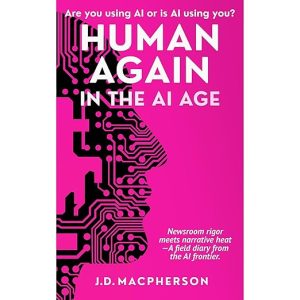
Six hours and forty-six minutes is not much time to reset an entire relationship with artificial intelligence, but Human Again spends every one of them trying. J.D. Macpherson's audiobook, narrated by a synthetic Virtual Voice performance, argues that the real risk of AI isn't the technology itself but losing your own judgment, taste, and voice while everyone around you starts to sound the same.
A High Signal Question Engine Built Around Qualia
The book is structured as part reflection, part practical guide, built around named tools like a 'High Signal Question Engine' meant to help readers ask sharper questions of AI systems rather than settle for generic output. Macpherson also leans on the Socratic method and mindfulness practice as training for deeper thinking, and repeatedly circles back to what the book calls 'qualia,' the specific, unspeakable textures of human experience the author argues no algorithm can actually touch.
Reviewer Raphael Fernandez, whose review is titled 'Navigating the Silicon Shift,' frames the book's core move as treating AI 'not just as a tool, but as a partner,' and traces that argument back to a specific origin point: the author testing AI out in her own kitchen after returning from maternity leave, according to his account. That small, domestic starting image is a useful entry point into a book that otherwise deals in fairly abstract territory, identity, authenticity, creative compounding.
Qualia is a real, borrowed philosophy-of-mind term, referring to the subjective, first-person texture of conscious experience, the specific redness of red or ache of grief that resists full external description. Macpherson repurposes that concept directly for an argument about AI's limits: whatever algorithms can eventually simulate, the book argues, they cannot actually have qualia, and that distinction becomes the philosophical spine underneath the book's more practical advice.
Old Philosophical Training to Compound Clarity
Macpherson's practical toolkit blends genuinely old philosophical method with a distinctly modern problem: the Socratic method and mindfulness practice, both centuries old in different traditions, get repurposed here as training specifically for working alongside AI rather than as ends in themselves. That synthesis, ancient thinking discipline applied to a brand-new technological pressure, is a more interesting move than a typical productivity-book toolkit built entirely from scratch.
Macpherson's promise to help readers 'compound clarity and creativity' borrows a specific financial metaphor worth unpacking: small, consistent gains building on each other over time rather than one dramatic breakthrough. Applied to creative practice and AI collaboration, that framing suggests the book's real value shows up gradually, through repeated use of its tools, rather than in a single insight gained during the six-hour-and-forty-six-minute listen itself.
Between Utopia and Doom Sits a Manual-Style Listen
The Virtual Voice narration is synthetic, and that matters differently here than it would for narrative nonfiction. Reviewer D Heckel describes the book as functioning less like something read front-to-back and more like a manual, posing questions readers are meant to carry into their own conversations with an AI assistant. A flat, consistent synthetic delivery may actually suit that reference-and-prompt structure better than it would suit a book built on narrative momentum, even though it still lacks the interpretive warmth a human narrator brings.
Reviewer PK frames the payoff in personal terms, writing that 'embracing the unknown by learning more about AI' helped diminish fear while sharpening respect for AI's real risks and curiosity about everyday use. At under seven hours, the book asks for a real but modest time investment, which suits a busy professional wanting a framework rather than a deep, multi-week commitment to the subject.
Most AI-anxiety books on the market right now settle into one of two default postures, breathless utopianism or flat doom, and the title Human Again signals a third lane from the outset: recovery and reclamation rather than either celebration or alarm. That positioning alone sets real expectations for what kind of book this is before a single chapter starts, and it mostly delivers on that specific, less crowded promise.
The book frames asking better questions as a thinking skill rather than a technical one, distinct from prompt engineering as it is usually marketed. Where prompt engineering tends to focus on the exact wording that produces a better output, Macpherson's 'High Signal Question Engine' is pitched more as training for the underlying judgment about what is actually worth asking in the first place.
Synthetic Voice Narrates a Book About Authenticity
D Heckel is explicit that this 'is not a read, front-to-back book,' but a manual meant to be worked through actively, posing its questions to an AI assistant as you go rather than absorbing them passively. That active-use design creates a real audio-format tension: a listener cannot easily flip back mid-task to a specific prompt the way a reader could with the print or ebook edition, so some of the book's practical value is harder to access purely by ear.
A genuine irony sits underneath the production choice worth naming directly: a book explicitly about protecting your own authenticity, taste, and voice while AI reshapes creative work is narrated by a synthetic voice rather than a human one. That does not disqualify the content, but it is a detail some listeners will want to weigh before choosing the audio edition over print.
Involuntary AI Adoption Gets a Competitive Angle
Advice to 'protect your authenticity, taste, and voice' is meaningfully harder to operationalize than a skills-based AI guide built around concrete before-and-after outputs or reusable prompt templates. Listeners wanting hard tactical takeaways, specific workflows, exact prompt structures, step-by-step processes, may find real stretches of this book more reflective and philosophical than actionable, which is a fair trade for some readers and a real frustration for others.
Much of the current AI conversation frames adoption as a choice, but plenty of listeners are encountering these pressures because an employer now expects AI fluency, not because they sought it out personally. Human Again's framing, using AI 'better than anyone around you' while protecting your own judgment, speaks directly to that involuntary position, offering a competitive-advantage angle for career-minded listeners alongside its more philosophical identity concerns.
Reviewer PK's review title, 'Embracing the unknown,' captures something the book returns to repeatedly: the goal isn't eliminating uncertainty about AI's trajectory but building enough personal clarity to stay curious rather than anxious about it, a genuinely different aim than the productivity-hack framing most AI books default to.
Anxious Professionals, Not Practiced Prompt Engineers
Professionals and creators anxious about AI reshaping their work, and wanting an actual framework rather than either blanket reassurance or fear-mongering, are the clearest audience here. The book's question-based tools give that anxiety somewhere concrete to go.
Students and early-career creators specifically worried about being displaced rather than merely inconvenienced by AI form a distinct audience worth naming separately from established professionals simply adjusting existing workflows; the book's identity-first framing speaks more directly to the former group's anxiety.
Anyone already deep into prompt engineering as a practice, or hoping for a traditional narrative reading experience rather than a workbook-style manual, will likely find portions of this covering ground already familiar, and the synthetic narration may compound that sense of the material moving past them rather than with them.
A Few Questions About Human Again
Does the synthetic Virtual Voice narration hurt this audiobook?
It costs the book some interpretive warmth, but the flat, consistent delivery arguably fits the question-and-prompt structure reviewer D Heckel describes better than it would fit a story-driven book.
What is the High Signal Question Engine mentioned in this audiobook?
It is one of Macpherson's named practical tools, a framework for asking sharper questions of AI systems so responses create real leverage instead of generic noise.
Is this audiobook written by a man or a woman?
Reviewer Raphael Fernandez's account describes the author testing AI in her own kitchen after maternity leave, which points to Macpherson being a woman, though the author field itself uses only initials.