Before You Press Play
- Performance: Wil Wheaton is an ideal match for Randall Munroe's absurdist humor, landing the comic timing precisely and navigating the shifts between deadpan physics and gleeful catastrophism without missing a beat.
- What it covers: Absurdist problem-solving, the limits of engineering, science as comedy
- Feel: Gleeful and slightly unhinged, like a physics textbook edited by someone who wants to see the world end
- Our call: Munroe's approach to impossible tasks produces some of the most enjoyable science communication available in audio, and Wheaton is the right narrator to carry it.
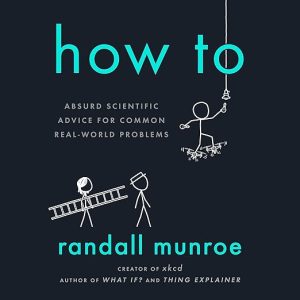
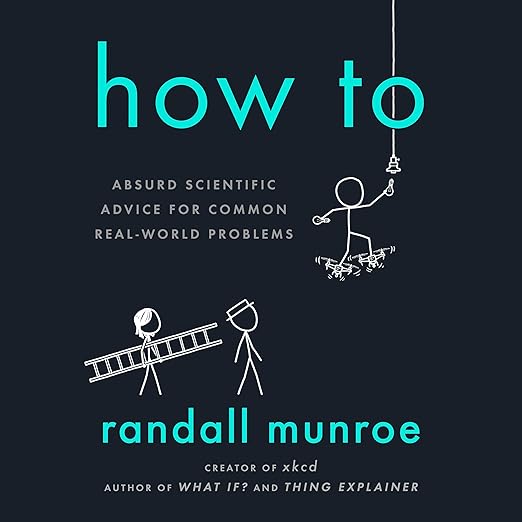
Randall Munroe's How To opens with a premise so deliberately ridiculous that it functions as an implicit contract with the listener: this audiobook will explain how to do ordinary things using the most overpowered, dangerous, and physically catastrophic methods imaginable. Narrated by Wil Wheaton and clocking in at six hours and fifteen minutes, it is the kind of science communication that earns its laughs not through dumbed-down simplification but through a precise understanding of what real physics actually implies when you push it past any reasonable limit. Munroe, creator of the xkcd webcomic and author of the bestselling What If? series, brings the same commitment to genuine calculation here. The humor is the byproduct of taking the science seriously.
First, the Big Picture
The book's central conceit is that any practical problem, landing a plane, digging a hole, throwing a ball, crossing a river, has at least three solutions: the correct one, the wrong one, and one that is so elaborately incorrect as to require Nobel Prize-level engineering and will probably destroy several things in the process. Munroe works through the third option with the kind of rigor that makes it genuinely educational. His method for predicting the weather by analyzing the pixels of your Facebook photos is absurd, but the section teaches real atmospheric physics. His approach to sending a package across the country via projectile motion covers ballistics, orbital mechanics, and why the postal system's current approach remains, narrowly, preferable. The chapter on how to take a selfie with the moon involves telescope physics, shutter speeds, and orbital positioning. None of it is useless knowledge. It is all just knowledge applied to deeply useless ends. Reviewers have noted that children and adults find the material equally compelling, and there is something telling about that. The appeal of Munroe's approach is not just the jokes but the underlying message that science is a tool that generalizes to everything, including things no one should ever actually attempt. One reviewer described conversations sparked by reading together as among the book's best secondary features, which tracks with the structure of the text: each chapter ends with enough genuine understanding that you can continue the speculation on your own. That quality, material that generates its own extension, is rarer in science communication than it should be.
Wheaton's narration is a genuine asset. He has the range to deliver a deadpan setup and then pivot to mock-enthusiasm when the catastrophic implications land, and he never oversells the jokes. The timing on some of the more extended comic payoffs is particularly well-calibrated. At just over six hours, this is a comfortable single-weekend listen.
Why Listen to How To
The audio format works well for this material in a way that might not be immediately obvious. Munroe's original books rely heavily on his stick-figure illustrations, and those drawings are central to the humor and to the visual presentation of data. The audiobook compensates by leaning into Wheaton's performance as the explanatory medium. Munroe's prose is strong enough to carry most of what the drawings do in print, and Wheaton's delivery fills in the rest. The result is not identical to reading the physical book but it is a genuinely complete experience rather than a degraded one. For listeners who prefer audio during workouts, household tasks, or any activity where a screen is not practical, the six-hour runtime is designed for exactly that kind of engagement. The chapters are self-contained enough that you can stop and start without losing the thread, and each chapter's independent structure means you can return to a specific section, the lunar selfie, the river boiling method, the tectonic disposal of unwanted books, without re-listening to the whole thing.
A Few Reservations
Pay attention to the moments when Munroe's calculation reveals something genuinely surprising about physical reality. The section on crossing a river by boiling it is funny, but the underlying thermodynamics of what it would actually take to evaporate a river of a given volume is startling and memorable in ways that a straightforward thermodynamics explanation would not be. Similarly, the chapter on using tectonic plates to subduct a book into the Earth's mantle is a vehicle for teaching plate tectonics at a timescale that most people never stop to visualize. The humor is the door; the actual understanding is what waits on the other side. Munroe also reserves some of his best moments for the chapter on how to dispose of a book you no longer want, which includes dissolving it in the ocean, converting it to vapor, and launching it into the sun. Each method is evaluated with engineering specificity, including the cost in kilowatts and the regulatory obstacles. It is among the book's most self-referentially satisfying chapters, and Wheaton delivers it with the particular relish of a narrator who understands that the book being discussed is, implicitly, the one you are currently holding.
Who Should Pick Up How To
Adults with an appetite for science who have given up on finding science communication that is both accurate and genuinely funny will enjoy this immediately. Parents looking for material that holds the attention of science-curious kids aged ten and up, and that sparks actual conversation about physics and engineering, will find this a reliable choice backed by multiple reviewer reports. Skip it if you need practical guidance on any of the tasks Munroe covers: landing a plane, crossing a river, or moving from one home to another. His advice will get you killed, expensively, using mechanisms that technically comply with the laws of thermodynamics. The 4.7 rating across reviewers reflects an unusually consistent response for a comedy-science hybrid.
Questions Listeners Ask
Does the How To audiobook work without the illustrations from the print edition?
Better than you might expect. Munroe's prose is structured to carry the explanatory load, and Wil Wheaton's narration compensates for the absence of stick-figure diagrams. It is a different experience from the print book but a complete one rather than a stripped-down version.
Is this audiobook appropriate for younger listeners alongside adults?
Reviewers specifically note that children as young as nine or ten have engaged enthusiastically with the material. The science is accurate and the humor is not adult-only. It works well as shared listening for households with science-curious kids.
How does Wil Wheaton's narration compare to other popular science audiobooks?
Wheaton is one of the more skilled comic narrators working in audiobooks, and he suits Munroe's tone precisely. He understands that the deadpan delivery is the mechanism of the joke, not an obstacle to it, and he does not over-perform the humor.
Is this audiobook connected to Munroe's What If? books, and do I need to listen to those first?
How To shares a method and sensibility with the What If? books but is completely standalone. Each title operates on the same premise of taking absurd questions seriously using real physics. Listening order does not matter.