Quick Take
- Narration: Daniel Hawksford delivers a clean, measured performance that suits the book’s balance between analytical precision and insider storytelling. He doesn’t oversell the drama, which is exactly right for material this grounded in evidence.
- Themes: Data science in professional football, competitive edge through analytics, the limits of traditional scouting
- Mood: Intellectually curious and quietly authoritative
- Verdict: The best popular account of how data science reshaped a major football club, with enough intellectual depth to reward listeners well beyond the sport itself.
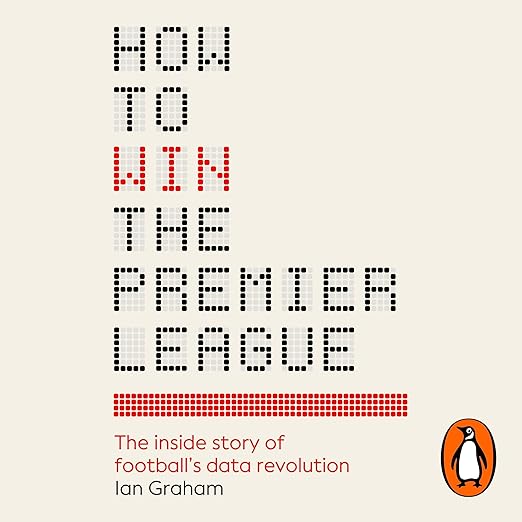
I finished this one on a Sunday evening with a level of genuine satisfaction I hadn’t expected when I started it. I went in assuming another entry in the sports-analytics genre that promises insider access and delivers vague gestures toward spreadsheets. What Ian Graham has written instead is something closer to a scientific memoir, a record of how one man brought a methodology into a resistant environment and watched it slowly, then suddenly, transform the institution around him.
Graham spent a decade at Liverpool FC as Director of Research, from 2012 to 2023. The club’s transformation during that period is well documented: the appointment of Jurgen Klopp, the signing of Mohamed Salah, the 2020 Premier League title that ended a thirty-year wait. What Graham reveals here is the degree to which data drove those decisions, and more importantly, the specific nature of that data and why it worked when similar approaches failed elsewhere.
The Science Behind the Signings
The book’s most compelling sequences concern the practical mechanics of Graham’s work. He is unusually candid about what his models could and couldn’t do. The Salah signing chapter is particularly striking: Graham describes the analytical process that identified Salah as severely undervalued relative to his actual contribution, and the internal conversations required to make the case to people who trusted their eyes over his models. The tension between data-driven assessment and human intuition is not presented as a conflict where one side wins. Graham is honest about the limits of his own work and the legitimate value of what experienced scouts and managers bring.
The Klopp appointment is handled with similar specificity. Graham’s account of how the club modeled managerial candidates, what metrics they used, and why Klopp emerged from that analysis as the clear choice adds considerable texture to a story that has been told many times from the outside. Reading it from the inside, with access to the actual analytical reasoning, is a different experience.
Home Advantage, GOATs, and What the Data Actually Shows
One of the sections I found most intellectually satisfying concerns a phenomenon that the pandemic inadvertently turned into a natural experiment. When Premier League games were played behind closed doors in 2020, home advantage effectively disappeared. Graham uses this as a lens for examining what home advantage actually consists of and what drives it. The answer is not what most analysts assumed, and his treatment of the evidence is careful enough to be genuinely persuasive without being dismissive of alternative explanations.
The GOAT question is handled with similar intellectual honesty. Graham doesn’t name his candidate so much as describe the methodology for thinking about the question, which is more useful and considerably more honest than most “greatest of all time” arguments in sports media. He acknowledges what the data can settle and what it cannot, which is exactly the disposition you want from someone making this kind of argument.
Where the Book Leaves You Wanting More
The mixed reviews on Audible reflect a real tension in the book. One reviewer found it shallow and self-promotional, essentially a longer version of “my model helped Liverpool win.” I think that reading is too harsh, but it points to something real: Graham is not writing a data science textbook. The technical depth is popular-level. If you came hoping for a detailed breakdown of expected goals models or the specific architecture of Liverpool’s analytical infrastructure, you will finish the book knowing more than you did but not as much as you hoped.
The book is also, inevitably, a defense of Graham’s own work. He is not an unreliable narrator exactly, but he is a narrator with obvious interests in the account. The moments where his recommendations were overruled or where his models failed are present but not lingered over. That’s fair for a memoir but worth noting for anyone hoping for a fully balanced institutional history.
Listener Guidance
This is genuinely one of the best audiobooks in the sports analytics genre, and it rewards listeners who have no particular interest in football. The underlying questions about how organizations make decisions under uncertainty, how to introduce data-driven thinking into institutions built on expertise and instinct, and how to communicate probabilistic reasoning to skeptical stakeholders are universal. Daniel Hawksford’s narration serves the material well, keeping the analytical passages clear and the personal passages human. The nine-and-a-half hours go quickly.
Frequently Asked Questions
Do I need to be a football fan to get value from this audiobook?
No. The football context provides the narrative, but the book’s underlying themes concern decision-making under uncertainty, the introduction of data science into traditional institutions, and how to make probabilistic models actionable. These are relevant to anyone working in analytics, strategy, or organizational change regardless of sport or industry.
How technical is Ian Graham’s explanation of his analytical methods?
The technical depth is popular-level, not academic. Graham explains concepts like expected goals and player valuation models clearly and accessibly, but does not go into the mathematical or statistical detail that a data science practitioner would need to replicate his approach. The book is better understood as a narrative account of applied data science than a technical guide.
Does the book cover the period after Graham left Liverpool in 2023?
No. The book covers Graham’s tenure from 2012 to 2023 and focuses primarily on the most significant moments within that period, particularly the Klopp appointment and the Salah signing. The final sections include some forward-looking argument about how data-savvy clubs can maintain a competitive edge, but it is not a post-Liverpool account.
What does the book reveal about the pandemic season that is genuinely new or surprising?
Graham uses the 2020 season played behind closed doors as a natural experiment to study home team advantage without crowd effects. His analysis suggests the crowd explanation for home advantage is more significant than many analysts assumed, and the data from that season allowed his team to isolate variables that are normally impossible to separate in regular conditions.