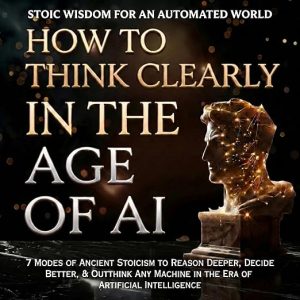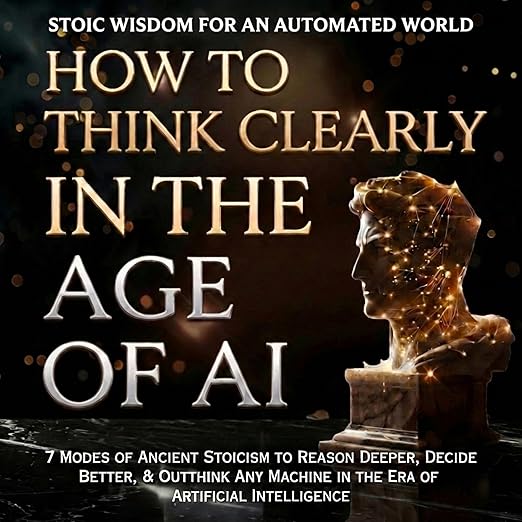
Austin Chen's core argument in How to Think Clearly in the Age of AI: Stoic Wisdom for an Automated World begins with a distinction that most conversations about artificial intelligence skip entirely: the difference between automating tasks and displacing judgment. AI can write your emails, summarize your meetings, and generate your strategy decks, as the synopsis states plainly. It cannot tell you which decisions actually matter. This audiobook, narrated by Ted Kettler and part of the AI for Business, Strategy, and Leadership series, is not another guide to using AI tools more efficiently. It is a philosophical argument that the response to AI disruption is not faster tool adoption but deeper cultivation of the specific cognitive capacities that machines are not approaching, and may never approach.
The Stoic framework Chen builds around that argument is substantive rather than decorative. Marcus Aurelius, Seneca, and Epictetus appear here not as inspirational quote sources but as precise thinkers who mapped the territory of human cognition that remains distinctly human: judgment under genuine uncertainty, the capacity to derive meaning from ambiguity, values-based reasoning when the stakes are real. Chen's seven-mode framework, which he calls the Unautomated Mind Method, moves through discernment, meaning-making, ethical reasoning, negative capability, presence, perspective, and integration. Each mode is grounded in a specific Stoic text or practice and connected to a concrete modern application. The architecture is rigorous, which distinguishes this from the loosely philosophical self-help that tends to cite Marcus Aurelius for motivational rather than analytical purposes.
Negative Capability Borrows a Term From Keats
The most original contribution in this audiobook is the section on negative capability, which Chen identifies as the single most underrated professional trait of the coming decade. The term itself comes from Keats, not the Stoics, but Chen connects it cleanly to the Stoic practice of remaining stable under uncertainty without collapsing into premature conclusions. In an AI-accelerated environment where everyone is under pressure to arrive quickly at confident positions, the trained ability to hold genuine uncertainty without false resolution is genuinely scarce and genuinely valuable. Chen makes that case more clearly than most writers working in this space, and the connection to specific Stoic practices makes it more actionable than an abstract endorsement of intellectual humility.
Kettler's narration serves the material with appropriate weight. He does not rush the philosophical passages, which is the correct choice for content that asks listeners to sit with ideas rather than extract bullet points. The denser sections of the text, where Chen is working through the specific mechanisms of each cognitive mode, require the kind of careful delivery that allows listeners to track an argument across several minutes of audio without losing the thread. Kettler maintains that clarity consistently.
Kettler Reads Seven Modes as Trainable Skills
The framing of the Unautomated Mind Method as seven trainable modes rather than fixed personality traits is worth dwelling on. Chen is making a claim that is more hopeful and more demanding than either techno-pessimism or the reassurance that humans will inevitably find their place in an AI-transformed economy. The claim is that the cognitive capacities that matter most in this new environment are learnable through deliberate practice, but that the deliberate practice is philosophical and contemplative rather than technical. You cannot train discernment by using more productivity apps. You train it the way Epictetus trained it: by repeatedly distinguishing what is within your control from what is not, and disciplining your attention accordingly.
At four hours and thirty-eight minutes, the runtime is substantial enough to develop each of the seven modes with genuine depth while remaining accessible for a single sustained listening session or a week of commute listening. The series context positions this alongside other business and strategy titles, but it is less conventionally business-focused than that framing suggests. Leaders and knowledge workers will find the most direct application, but the philosophical content has broader relevance than any single professional context.
Depth of Engagement Is Itself the Practice
This audiobook makes significant demands on the listener's willingness to engage with philosophy rather than skim it for actionable outputs. Listeners who want specific step-by-step exercises or tool recommendations will find the philosophical register frustrating. Chen's argument is that the depth of engagement with the underlying ideas is itself the practice, which means passive listening through the Stoic passages without sitting with what they actually mean will produce much less than the book offers to someone who slows down for it. The audio format can work against that slowing-down in ways that the print version does not face.
The book is also written at a level of educational and professional sophistication that assumes familiarity with at least some of the current debates around AI and work. Listeners who are early in developing their understanding of what AI actually does and does not do may want to build that foundation before the philosophical argument here lands with its full force.
Deep Work Readers Get a Natural Next Step
This audiobook is best suited to knowledge workers, leaders, and strategic thinkers who feel the pressure of AI disruption in their professional lives and want a framework grounded in something more durable than the current cycle of tool recommendations. Readers with an existing interest in Stoic philosophy will find Chen's application of that tradition to contemporary AI questions genuinely fresh. Those who finished books like Cal Newport's Deep Work or Oliver Burkeman's Four Thousand Weeks and wanted more philosophical rigor alongside the practical argument will find this a natural next step. It rewards a second listen, and the seven-mode framework is structured well enough to function as a reference after the initial encounter.