A close friend with a three-year-old who had just thrown a spectacular library tantrum recommended this one to me with the specific urgency of someone who had experienced a conversion. I am not a parent myself, but I work adjacent to several people who are, and the book sat in my queue for months before I finally put it on during a long Saturday of domestic errands. I spent the rest of the afternoon thinking about the things I had learned and how I had failed to apply them in my own adult relationships, which was not what I expected from a parenting audiobook and is probably the best endorsement I can give it.
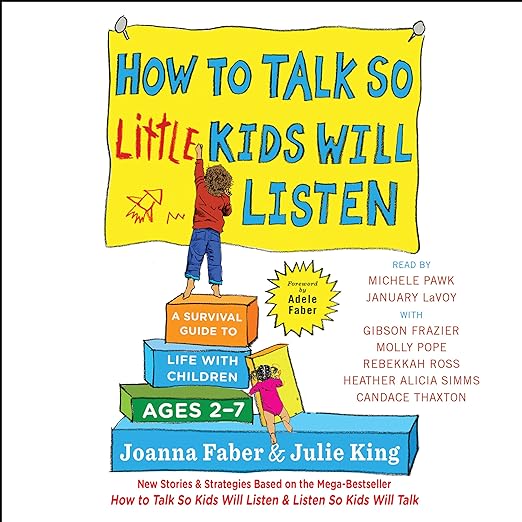
How to Talk So Little Kids Will Listen is Joanna Faber and Julie King's adaptation of the foundational Faber and Mazlish communication framework, originally developed by Adele Faber and Elaine Mazlish in How to Talk So Kids Will Listen and Listen So Kids Will Talk. The earlier book, published in 1980, was aimed at school-age children. This one focuses specifically on the two-to-seven window, which has its own distinct developmental logic and its own distinct frustrations that parents of older children sometimes forget they once survived.
Organized by Problem Type, From Teeth to Tantrums
Most parenting books are organized around principles that the reader is then expected to translate into specific situations. Faber and King invert this. The book is organized by problem type, won't brush her teeth, screams in his car seat, throws books in the library, runs rampant in the supermarket, with the communication strategies offered as responses to those particular situations rather than as abstract frameworks to be applied later. That inversion is significant because the moment of crisis, which is when the parenting book knowledge most needs to be accessible, is precisely when abstract principles are hardest to retrieve under pressure.
The workshop anecdotes throughout the book serve a similar function. Faber and King draw on years of conducting How to Talk sessions with parents, teachers, and pediatricians, and they use the workshop material to show what happens when the strategies fail on the first attempt and need adjustment. One reviewer describes reading the book repeatedly every time they feel themselves slipping into old patterns, which suggests how the book is most usefully deployed: not as a one-time listen but as a reference document for specific recurring situations that every parent will recognize.
Heather Alicia Simms's Tonal Agility Across Ten Hours
The central skill the book teaches, acknowledging a young child's feelings before attempting to redirect, correct, or problem-solve, sounds obvious until you try to actually do it during a meltdown. The book is very good at acknowledging that this skill feels unnatural at first, and at explaining why: most of us were not parented this way, and most of us have strong reflexes toward explanation, correction, or distraction when confronted with intense emotion in a small person who cannot be reasoned with yet.
Heather Alicia Simms handles the variety of voices and registers in the book with real skill. The workshop anecdotes, the narrative sections, the direct instructional passages, each gets a slightly different delivery without the transitions feeling abrupt. For a book that relies heavily on illustrative dialogue, parent says this, child says that, parent tries again, that tonal agility matters considerably across ten hours. One reviewer who came to the book as an aunt suddenly responsible for young children in her household, rather than as a biological parent, describes taking a highlighter to the physical copy and treating it as a college textbook. That response captures something real about how the book works best: actively, with specific situations in mind.
Half a Million Copies, Traveling Across Cultures
The book includes a chapter specifically addressing children with sensory processing differences and autism spectrum disorders, which reviewers with neurodivergent children consistently praise. The strategies do not require modification for these children so much as they require the listener to slow down and observe more carefully, the same acknowledgment-first approach applies, but the book is explicit that the signals young neurodivergent children send may look different and require more patience to read correctly. That specificity is one of the places where the book goes beyond generic advice into genuinely useful territory that is often absent from mainstream parenting guides.
The book has sold over half a million copies, and the reviews across multiple countries confirm that the core framework travels across cultural contexts. A reviewer in Spain and one in Australia both respond positively to the same fundamental approach, which suggests the emotional logic of the communication model is not culturally specific even when the anecdotal examples are drawn from American contexts. That universality is one of the more remarkable things about how this series has traveled.
Anyone With a Small Child in Their Life
Listen if you have children aged two through seven in your life in any capacity, parent, teacher, caregiver, regular aunt or uncle. The strategies transfer beyond biological parenting relationships, and several reviewers note that the communication principles apply to adult relationships as well. Skip if you are looking for behavioral modification through consequences and reward systems, this book is explicitly moving away from that framework, and listeners committed to that approach will find the methodology in genuine tension with their existing instincts. At ten hours, it is also a genuine commitment; dipping in for specific chapters by topic may be more useful than a linear listen for caregivers dealing with one particular recurring challenge.
Is this book an update of Adele Faber's original How to Talk So Kids Will Listen, or a separate work?
It is a separate work that applies the same underlying communication framework to the specific developmental stage of ages two through seven. Adele Faber wrote the introduction, and the book explicitly positions itself as a companion to the original rather than a replacement. You do not need to have read the earlier book first.
Does the audiobook include the cartoons and worksheets referenced in the text?
The audiobook narration works through the examples that the cartoons illustrate in the print version, so the content is accessible even without visual elements. Simms provides enough context in the surrounding narration that the absence of visuals does not create significant gaps in understanding.
How does the book handle situations where the acknowledgment strategy simply does not calm a child down?
The workshop sections throughout the book specifically address what happens when the strategies do not produce immediate results. Faber and King are realistic about the learning curve and include examples of parents trying the techniques imperfectly on the first attempt, which makes the failure cases as instructive as the successes.
Is the book applicable to children who are older than seven, or strictly for the target age range?
The strategies generalize beyond the two-to-seven window, though the specific examples are anchored in that developmental stage. Multiple reviewers note that the communication principles apply to relationships with older children and even adults. The age framing is about where the examples come from, not about where the underlying skills stop working.