Quick Take
- Narration: Dani Martineck delivers a clean, measured performance suited to the book’s design-meets-technology register, accessible without being condescending.
- Themes: Machine learning literacy, human-technology co-creation, inclusive design
- Mood: Thoughtful and exploratory, intellectually unhurried
- Verdict: A durable conceptual framework for understanding how machines think, strongest for non-technical leaders and designers who want a mental model rather than a technical manual.
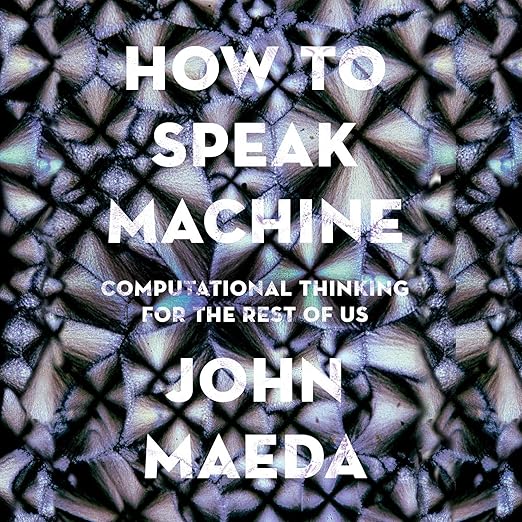
I finished this one on a Sunday afternoon, sandwiched between a newsletter about LLM inference costs and a conversation with my editor about whether we were covering AI too much or not nearly enough. The irony was not lost on me. John Maeda’s book is precisely about that disorientation: the feeling of being surrounded by machines whose logic you cannot quite read, whose capabilities keep outrunning your categories for them.
Maeda is an unusual thinker for this space. He has worked at MIT Media Lab, as president of RISD, at Kleiner Perkins, and at Microsoft Research. He is neither a pure technologist nor a pure humanist, which makes him genuinely useful for a book that is trying to build a bridge between those two worlds. His previous work, The Laws of Simplicity, showed he can distill complex systems thinking into durable principles without losing the complexity that makes them interesting.
The Framework at the Center of Everything
The book’s core contribution is a framework for understanding machine learning systems: what they can do reliably, where they fail systematically, and why those failure modes matter as much as the capabilities. Maeda is not trying to teach you to code. He is trying to give you a conceptual vocabulary for asking good questions about any computational system you encounter. That is a more modest ambition than many AI books advertise, but it is also more useful to more people.
The review from David Weiseth that calls this “a delectable deep dive” captures something real. Maeda’s frameworks have a Zen quality to them: spare on the surface, rich in application. The machine learning framework he develops here operates the same way. Once you have it, you start applying it everywhere, which is exactly what a good mental model should do.
What the book does not do is provide up-to-the-minute technical grounding. Published before the current wave of generative AI products reshaped the public conversation, some of the examples feel like artifacts of an earlier moment. The conceptual framework, however, holds. Maeda is writing about structural properties of machine learning systems, not about specific products, and those structural properties have not changed even as the implementations have accelerated dramatically.
The Design Lens That Separates This from Other AI Primers
What makes Maeda’s approach distinctive is that he approaches machine intelligence from a design perspective. He is interested in how these systems interact with human experience, how they can be made inclusive, and what responsibility looks like for the people who build and deploy them. This is genuinely different from the engineering-first framing that dominates most AI writing, and it is why the book remains useful to product designers, policymakers, and executives in ways that more technical texts are not.
Reviewer Kay’s note about Maeda showing “both sides of this technology” is accurate. He is not an uncritical booster, but he is also not a doomer. The tone is more like a careful teacher who wants students to see clearly rather than to feel a particular way about what they are seeing.
One reviewer noted the book as “dense but understandable,” which is a fair description. The density is conceptual rather than technical, Maeda is working through ideas carefully, not throwing jargon at you. For listeners used to faster-paced business audiobooks, the pace may feel slow. For those who want to actually understand the ideas rather than just have them mentioned, the pace is appropriate.
The 150-Rating Question: Is the Praise Proportionate?
At 4.3 stars across 150 ratings, the book has accumulated genuine approval without the kind of uniform enthusiasm that sometimes signals a marketing campaign rather than a reading experience. The reviews skew toward people who came in already curious about AI and found the framework genuinely useful. The lower ratings (and there are some) tend to come from listeners who wanted either more technical depth or more concrete tactical advice. Maeda is not writing for either of those audiences, and knowing that upfront will save you disappointment.
Dani Martineck’s narration is well-matched to the material. The voice is calm and intelligent without being clinical. For a book built around conceptual frameworks, that measured delivery helps ideas land rather than rushing past them.
Who Should Listen / Who Should Skip
Listen if you are a designer, executive, or policymaker who works near technology and wants a durable mental model for thinking about what machine learning actually is and what it cannot do. The design-forward framing is a genuine differentiator.
Skip if you need current technical grounding in generative AI, large language models, or the 2023-onward product landscape. The conceptual framework transfers, but the examples will feel dated. Also skip if you are already deep in the technical literature; the book is pitched at a level you will have moved past.
Frequently Asked Questions
Does the book cover ChatGPT and large language models, or is it pre-GPT?
The book predates the current generation of publicly available LLMs and does not cover ChatGPT specifically. The conceptual frameworks Maeda builds apply to machine learning systems broadly, including generative AI, but readers looking for a current account of the GPT era will need to supplement with more recent sources.
Is Dani Martineck’s narration suited to a design-meets-AI subject?
Yes. Martineck’s measured, clear delivery works well for a book built around conceptual frameworks. The pacing gives listeners time to absorb ideas rather than racing through them, which suits Maeda’s style of careful elaboration.
How does this compare to Maeda’s earlier book The Laws of Simplicity?
Both books share the same framework-first methodology and the spare, principle-driven style. How to Speak Machine is more applied and more focused on a specific domain, while The Laws of Simplicity is broader in scope. Fans of the earlier book will find a familiar intellectual texture here.
Is this suitable for someone with no technical background in AI or programming?
Yes, that is the intended audience. Maeda explicitly avoids code and works at the conceptual level throughout. The goal is vocabulary and judgment, not technical skill.