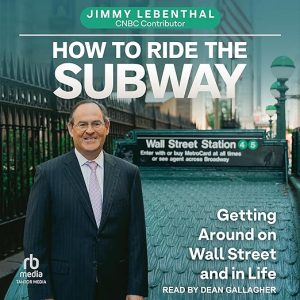
The Short Version
- Read by: Dean Gallagher voices a first-person New York memoir that also has to work as instruction, switching between the two registers throughout.
- At its heart: personal investing, business relationships as a skill, growing up in 1970s and 1980s New York, patience as method
- Vibe: Conversational, anecdotal, city-flavored
- Short version: A promising hybrid of memoir and method, offered on a page with no listener evidence behind it at all.
Jimmy Lebenthal builds his investing advice on the perspective of a seasoned subway rider, and the publisher copy states that premise without ever explaining it. The audiobook runs six hours and twenty-one minutes from Tantor Media, read by Dean Gallagher, and pairs two subjects most finance titles keep apart: how to invest and how to build the business relationships that make investing possible. Underneath both sits a memoir of growing up in New York City in the 1970s and 1980s, when the city was, in the copy's own word, hardscrabble.
The Boring Line That Actually Gets You There
Titles built on a metaphor make a promise, and this one puts real weight on its central image. A subway system is a closed network with fixed routes, predictable delays and a learnable logic, where the experienced rider knows which car to board and when the express is actually slower. Mapping that onto equity investing suggests patience, route knowledge and a preference for the boring line that gets you there. Whether the book develops the analogy that far, the description declines to say.
An Investor Who Learned Cycles From the Street
What the copy does establish is the biography behind it. Lebenthal grew up in the city during two of its hardest decades, developed what the description calls a passionate interest in the subway system, and started investing in public equities during those same years. Beginning young in a difficult period is a genuine credential for a book about patience, and it explains why the memoir material and the instruction material are woven together rather than separated into sections.
New York in the 1970s and 1980s is not incidental decoration either. That city taught a specific lesson about risk, decline and eventual recovery, and an investor formed there learned about cycles from the street rather than from a chart. The best version of this book uses the memoir to make the investing advice concrete, which is exactly the structure the copy claims when it calls the result part how-to guide and part memoir.
Whose Voice Are You Hearing When He Says I
Relationship-building is the more unusual half of the offer. Investing books rarely discuss the human infrastructure around a portfolio: the broker who returns a call, the colleague who explains an industry, the contact who tells you what a filing actually means. Treating that as a skill worth teaching, alongside the mechanics of buying equities, is a distinctive angle and a large part of what separates this from the shelf it sits on.
Six hours and twenty-one minutes suits the hybrid shape. Long enough to develop a personal history and connect it to method, short enough that the anecdotes cannot sprawl into a full life story. Listeners who have run out of patience with finance audiobooks that restate the same three principles for eleven hours will find the length itself a mark in the book's favor.
Dean Gallagher reads it, and third-party narration of a first-person memoir always raises the same question: whose voice are you hearing when the author says I. The material here is heavily local, shaped by the idiom and rhythm of a particular city in a particular decade, and it also requires switching between anecdote and instruction, often within a page. A reader who plays the memoir sections warmly and the investing sections plainly will make the hybrid work; the page offers a buyer nothing to test that against, so a sample is the sensible first step.
CNBC Contributor Doesn't Say What Kind of Investor
Zero is the number attached to every quality signal on this page. Five months after a March 2026 release from an established audiobook publisher, nobody has graded it and nobody has written about it. That silence is not evidence of a weak book, but it does mean the description is the only source you have, and the description was written to sell. That leaves the copy and the metadata as the only available evidence, and a buyer should weigh them accordingly.
Credentials in the copy are thin on specifics as well. Lebenthal is presented as an acclaimed contributor to CNBC, which establishes a media profile without indicating what kind of investor is speaking: an allocator, a stock picker, a market commentator, a fund manager. Those are different jobs producing very different advice, and the page never says which one informs the method here.
One smaller wrinkle sits in the categories. The record carries a Career Success tag and sits under business and careers alongside money and finance, though the subject as described is personal investing and professional relationships rather than career progression. Anyone browsing for promotion strategy will find something else entirely, and anyone browsing investing shelves may never see it.
The Pitch Is Wisdom and Charm
Newer investors who prefer method delivered through story are the natural audience, particularly those who find pure technique dry and remember principles better when attached to a person who learned them the hard way. Listeners drawn to New York as a subject will get a second book alongside the first, since the city in its difficult years is present throughout the description as more than a backdrop.
Experienced investors looking for strategy should be cautious, because nothing in the copy promises analytical depth, screening criteria or portfolio construction. The pitch is wisdom and charm, and readers who want tables and rules will be poorly served by a title built on an extended metaphor.
Everyone else should treat this as an early listen and act accordingly: sample the narration, weigh the memoir-plus-instruction structure against what you actually want, and accept that on a page this empty you are buying on the publisher's word alone. Come back to the ratings in six months and the picture will be clearer than it is today.