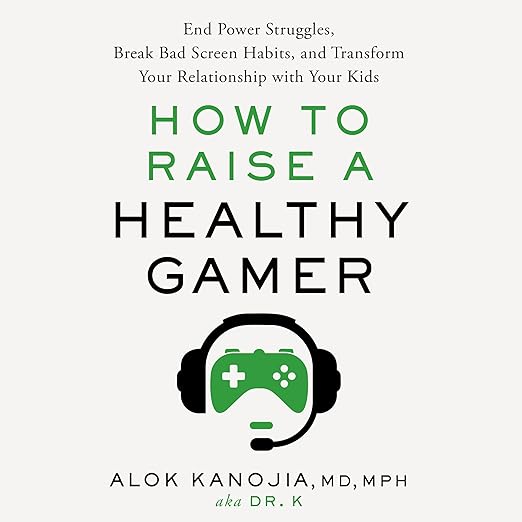
Quick Take
- Narration: Dr. Alok Kanojia narrates his own book, and it is one of those cases where self-narration is not just a nice addition but the only option that makes sense, his personal history with gaming addiction lends the material a credibility and warmth that no third-party narrator could replicate.
- Themes: Video game psychology and addiction, parent-child communication, healthy technology boundaries
- Mood: Supportive and science-grounded, honest about parental frustration without being alarmist
- Verdict: A practical, empathetic guide for parents navigating gaming culture, made considerably more effective by the author’s own voice and backstory.
I listened to most of this one during a week when a close friend was describing, with barely concealed anxiety, the hours her twelve-year-old was spending on an online game I had never heard of. She had already tried the usual approaches: time limits she couldn’t enforce, chargers moved to common areas, threats that escalated into full household standoffs. By the time I mentioned Dr. K’s book, she had already found it herself. That kind of word-of-mouth doesn’t happen by accident.
Alok Kanojia, who runs a mental health practice focused on gamers and goes by Dr. K online with millions of followers, has built an unusual kind of credibility for this subject. He is a Harvard-trained psychiatrist who needed professional help to break his own gaming habits in college. That combination of clinical authority and personal experience produces a book that does not treat gaming as the enemy. It treats it as a complicated system that meets genuine psychological needs, and the goal is not to eliminate gaming but to help children meet those needs in ways that leave room for the rest of their lives. That reframing is the book’s most important contribution.
The Eight-Week Road Map in Practice
The book’s central offering is a structured eight-week plan for setting, enforcing, and troubleshooting healthy gaming boundaries. What distinguishes this from the generic screen-time-limit advice that dominates the parenting conversation is the granularity and the underlying model. Kanojia explains the neuroscience and psychology behind why children are drawn to games in specific ways: the dopamine reward loops, the social connection that online gaming provides, the sense of mastery and progress that school often does not offer. Understanding the pull is prerequisite to addressing it effectively, and the book takes that prerequisite seriously.
The communication strategies are the section that reviewers consistently highlight. One listener noted the strategies are helpful in a myriad of parent-to-child conversations beyond gaming. That rings true based on the material. Kanojia is drawing on clinical expertise about how to reach people who have checked out of a conversation, and that expertise translates across contexts. The specific guidance on how to react when a child becomes irritable or seemingly directionless after gaming limits are introduced is particularly useful: it names a dynamic that many parents have experienced but few parenting resources address honestly.
Why the Author’s Voice Carries Weight
Dr. K’s self-narration is the right choice here, and not only because he is the expert. The book’s tone is consistently supportive and non-judgmental, and that tone is harder to fake in someone else’s voice. When he talks about his own gaming addiction in college and the professional help he needed to break it, the weight of that admission lands differently than it would in a third-party reading. He is not a clinician who studied gamers from outside; he was one of them. That biographical authenticity runs through the entire listening experience and makes the clinical frameworks feel grounded rather than prescriptive.
At six hours and fifteen minutes, the pacing is well-calibrated. The material never drags, which is notable for a book structured around a therapeutic road map. The chapters move between narrative, science, and practical guidance in a way that keeps the listening experience varied without losing coherence.
Where the Book Addresses More Than Screens
The inclusion of guidance on ADHD, spectrum disorders, and substance abuse alongside gaming concerns is an important signal about the book’s real scope. Kanojia is not treating gaming addiction as an isolated phenomenon. He is situating it within a broader clinical picture of adolescent mental health and the ways technology intersects with existing vulnerabilities. For parents whose children have co-occurring challenges, that broader framing is genuinely valuable. It stops short of being a clinical manual for those conditions, but it gives parents enough context to understand when gaming behavior is a symptom of something else and when it is the primary issue.
The downloadable PDF of appendices and bibliography mentioned in the synopsis is worth accessing alongside the audio. For a book built on research and a structured protocol, having the reference materials in print form is more than a convenience.
Who Should Listen, Who Should Skip
Listen if you are a parent navigating conflicts over gaming at home and are looking for something more substantive than time-limit apps and willpower. The book’s combination of clinical grounding, personal authority, and practical structure makes it one of the more useful resources in this space.
Skip if you are looking for a comprehensive clinical guide to gaming disorder diagnosis and treatment. This is a parenting guide, not a psychiatric manual. For parents with children who may need professional intervention, the book is excellent at identifying when that threshold has been crossed, but it stops there.
Frequently Asked Questions
Is Dr. K’s eight-week plan something a parent can implement without professional support, or does it require working with a therapist?
The book is designed as a self-guided parenting resource, and the road map is structured to be implementable at home without clinical support. That said, Kanojia is explicit about when a child’s gaming behavior may signal issues that warrant professional help, particularly around ADHD, spectrum disorders, and substance use.
Does the book address gaming on mobile phones and tablets, or is it focused on console and PC gaming?
The synopsis references gaming broadly, and Kanojia’s practice addresses gaming psychology across platforms. The psychological mechanisms he describes, particularly around reward systems and social connection, apply across gaming formats. Mobile gaming is likely addressed as part of the broader landscape.
My teenager is already in a conflict pattern with me over gaming. Does the book address repair alongside prevention?
Yes. The communication strategies and guidance on handling irritability and directionlessness are specifically aimed at families already in conflict, not only those trying to establish boundaries preemptively. Multiple reviewers mention the strategies as useful precisely because they address entrenched patterns rather than just early-stage habit formation.
Is this book useful for parents of younger children, say under ten, or is it primarily aimed at parents of teenagers?
The clinical focus on addiction and neuroscience is most relevant to parents of older children and teenagers, but the communication strategies and habit-formation frameworks apply across a broader age range. Dr. K’s practice works with people of all ages and varying degrees of involvement with gaming, and the book reflects that range of experience.