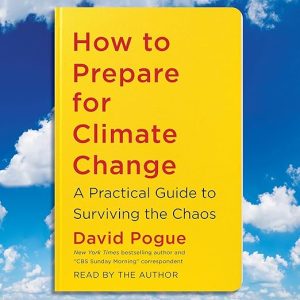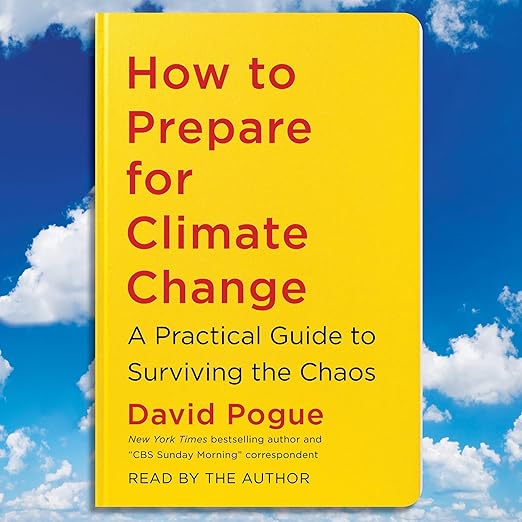
David Pogue's audiobook How to Prepare for Climate Change, running eighteen hours and thirty minutes, is the kind of reference work that you approach with mild dread and leave with something closer to directed resolve. Pogue, the CBS Sunday Morning correspondent and New York Times bestselling author, narrates his own research, which covers a scope most single-volume treatments of this subject do not attempt: what to grow and eat, how to build and insure, where to invest, how to prepare children and pets, and where specifically to consider relocating. His research points toward two particular regions of the United States that he identifies as climate havens, places with cool temperatures, good hospitals, reliable water access, and resilient infrastructure. That specificity is one of the things that distinguishes this book from the many adjacent guides that offer frameworks without destinations.
The book's opening is deliberately unsettling. Pogue's examples are not projections; they are current events framed as previews. Laborers in Arizona starting before dawn because midday heat has become dangerous to work in. Chinese investors quietly buying Canadian real estate. Millennials with evacuation folders. Moguls building bunkers. Retirees in Miami moving inland. The argument Pogue makes from the first pages is that climate disruption is not a future problem you can prepare for at your leisure; it is a present reality requiring decisions now, and the decision to treat it as someone else's problem or a future problem is itself a choice with consequences.
Pogue's Tech-Journalism Method, Applied to Climate Choices
Pogue's background in accessible technology journalism shapes his methodology throughout. He approaches climate preparedness the same way he would approach explaining a new operating system: by identifying the categories of concern, breaking each into concrete decisions, and presenting the research clearly enough that a non-specialist reader can act on it. One reviewer described it as a book of practical suggestions rather than a science text, and that framing is accurate. Pogue does explain the underlying science, but always in service of the practical question: given this, what should you actually do?
The depth is genuine. The financial planning chapters, covering how climate risk reshapes investment decisions, insurance calculations, and property values in specific market conditions, are as substantive as sections from specialized finance texts. The sections on food systems, including what crops to grow, what supply chains to expect disruption in, and how home food production changes household resilience, go well beyond the surface-level advice that characterizes most popularized guides on this subject. The psychological management chapter, which addresses how to sustain action without collapsing into paralysis or denial, is one of the more practically useful treatments of climate anxiety available in this format. Pogue does not pretend that reading about this is comfortable; he addresses the emotional reality of the material directly and gives it real space.
Pogue Narrates Eighteen Hours Meant for Active Planning
The audiobook benefits significantly from Pogue narrating it himself. This is dense material, with specific recommendations, statistics, and geographic details that require a consistent authoritative voice to hold together across a substantial runtime. Pogue's delivery is calibrated to maintain listener engagement across eighteen hours without sacrificing precision. He does not editorialize past what the research supports, which makes the emotional weight of the material land more forcefully when it does arrive. His CBS correspondent register, comfortable with complexity but committed to clarity, is the right instrument for this particular content.
One reviewer's observation that the book fueled their sense of impending doom rather than relieving it is worth addressing directly. Pogue's intent is not comfort. The book's value is proportional to how seriously you engage with its recommendations. Treating it as background listening will produce anxiety without direction. Treating it as an active planning resource, with notes and follow-up research on current conditions, returns something substantially more actionable. The book rewards the listener who comes to it as a working document rather than a piece of content.
Numbers Age, but the Relocation Logic Holds
The publication date is relevant context. Some specific investment and insurance recommendations may have shifted as climate risk has become more legible to financial markets since publication. Listeners should treat the book's numerical specifics as starting points for current research rather than as locked figures. The structural recommendations, around relocation criteria, home hardening, food systems, and psychological frameworks, hold up well; those are logic-based rather than market-dependent, and the underlying reasoning remains sound even where specific figures have moved.
Listeners who came to this audiobook from The Uninhabitable Earth or The Sixth Extinction, both mentioned in Pogue's own framing as companion texts, will find this operates in an adjacent but distinct register. Those books diagnose the problem with literary force and considerable alarm. This one builds the action list. They work well together as a complementary reading pair, with Pogue providing the practical response to the analysis those books deliver.
Meant for Adults Done Debating and Ready to Decide
This audiobook is for adults who have moved past the question of whether climate disruption is real and want to make concrete decisions about property, relocation, finance, food systems, and family planning with the best available evidence. It is equally relevant for homeowners assessing their exposure to specific risks, parents thinking about long-term geography for their children, and anyone managing financial assets where climate risk has become a material pricing variable.
Listeners seeking an emotional narrative about climate change will find this too pragmatic; those looking for specific, research-backed guidance on what to actually do will find it unusually thorough. At eighteen hours, the commitment is substantial, but the coverage justifies the runtime for anyone who wants to approach climate adaptation as a serious planning exercise rather than a cultural conversation.
Frequently Asked Questions
Is this audiobook more practical guide or scientific overview?
It is primarily a practical guide. Pogue explains the relevant science but always in service of specific decisions. The emphasis throughout is on what you should actually do, from financial planning to food systems to relocation criteria.
At eighteen-plus hours, is this audiobook best listened to in sections or straight through?
Given its reference-book structure, most listeners will find it more useful to engage with it in focused sessions by topic area rather than as continuous background listening. The chapters are designed to function as standalone modules covering distinct aspects of preparation.
Does David Pogue narrate the audiobook himself?
Yes. Pogue narrates the full audiobook. His CBS correspondent background gives him facility with complex material at length, and his pacing is calibrated for listener comprehension across the substantial runtime without losing engagement.