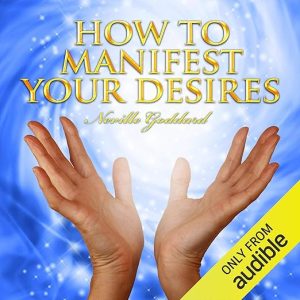
Neville Goddard occupies a singular position in twentieth-century spiritual thought, and How to Manifest Your Desires is one of his more focused distillations of his core teaching. This audiobook clocks in at just under nine hours, and narrator Clay Lomakayu handles the material with a composed, even-keeled delivery that never strays into evangelical fervor. The result is something that feels more like a long conversation with a thoughtful mentor than a motivational seminar, which is exactly the register Goddard himself preferred.
Goddard's central premise is deceptively simple: your imagination is not a passive faculty but the primary creative force shaping your experience. The instruction he gives throughout these pages is visceral and concrete. He does not ask you to believe in abstractions. He asks you to feel them. Want a piano? Run your hand across the smooth wood in your mind, feel the keys yield under your fingers, hear the particular resonance of the strings. Want a friend's congratulations? Hear that voice, not as a wish but as a present-tense acoustic reality. This emphasis on sensory specificity separates Goddard from the more vague strands of positive-thinking literature, and it is what gives his work its unusual stickiness.
The Best Parts of How to Manifest Your Desires
There are two kinds of readers who come to Goddard: those who arrive from mainstream self-help and find his metaphysics unexpectedly demanding, and those who come from a theological background and find his equation of human imagination with divine power genuinely provocative. Reviewer Suzanne, citing the passage "God became man that man may become God," captures exactly that second camp's response. Goddard is not offering a technique for goal-setting; he is offering a complete cosmology in which the human being, properly understood, is both the creator and the creation.
The reviewer identified as MagnifyingGlassBuyer makes a point worth highlighting: Goddard's human empathy comes across in every word. This is rare in the genre. He is not addressing an imagined ideal listener who lacks for nothing except belief. He writes for people who have failed, who have suffered, who do not understand why their circumstances have not changed despite their efforts. His instruction carries the texture of lived experience rather than theory, and Lomakayu's narration preserves that warmth without sentimentalizing it.
The question of whether the audiobook format serves a text this reliant on inner practice is worth raising. Several passages invite you to pause, to close your eyes, to actually perform the imaginal exercise Goddard describes. Listening while driving or exercising makes that impossible. This is a title that rewards a quiet space, unhurried time, and a willingness to stop the recording when the work itself requires stopping. At nearly nine hours it is also long enough to function as a sustained immersion rather than a casual introduction to the ideas, which makes it more valuable than shorter Goddard compilations for the serious student.
Goddard's New Thought lineage is worth placing for listeners unfamiliar with it. He belongs to a tradition that runs from Phineas Quimby through Mary Baker Eddy and Charles Fillmore, but he breaks from that tradition in significant ways. Where most New Thought teachers locate divine power in an external God that can be petitioned, Goddard collapses the distinction entirely. The divine is imagination itself, and imagination is the human being's most essential attribute. That move is philosophically radical in a way that casual descriptions of the law of attraction rarely convey, and Lomakayu's steady delivery helps the listener sit with the implications without being rushed past them.
Before You Commit to How to Manifest Your Desires
Goddard's language is rooted in Biblical imagery and New Thought tradition, which can create friction for secular listeners who resist religious framing. His references to scripture are not incidental decoration; they are structural to his argument. He reads Isaiah and the Psalms as psychological documents describing states of imagination rather than historical accounts. Readers unfamiliar with this hermeneutic approach may find early chapters opaque before the interpretive logic becomes clear.
Also worth noting is the distinction between this title and Goddard's better-known works such as The Power of Awareness or Feeling Is the Secret. How to Manifest Your Desires functions partly as a practical companion to the broader system, concentrating the method into the specific sensory exercises that Goddard considered the engine of the whole enterprise. If you are new to his work, this is not a bad entry point, but listeners who have already absorbed his ideas in other formats will find the most value here in the compression and the specificity of the technique rather than in conceptual novelty.
The reviewer who identifies as an Amazon Customer issues a fair warning: engaging seriously with Goddard requires giving up the belief that God resides entirely outside yourself and that external circumstances are the primary cause of your inner life. That is not a small ask. Listeners who want spiritual content that reinforces conventional frameworks may find the premise too destabilizing. Those who are ready for that friction will find it genuinely productive and, in the context Lomakayu's narration establishes, surprisingly calm rather than threatening.
Should You Listen to How to Manifest Your Desires?
This audiobook is well-suited to listeners already exploring New Thought, metaphysical spirituality, or the intersection of psychology and religious experience. It rewards patience and a willingness to do actual inner work rather than simply absorbing information. Anyone who found Goddard's other lectures or writings valuable will find this a worthwhile extended treatment of his core method.
Listeners who need empirical grounding, who want case studies or neuroscientific framing, or who are looking for a straightforward productivity system will likely find the material unsatisfying. The absence of diagrams, frameworks, or step-by-step checklists is not a weakness of this particular audiobook; it reflects Goddard's conviction that the practice is internal and cannot be reduced to a procedure. Go in with that understanding and the nine hours pass with purpose.